Camp Hill
Discover Harpers Ferry
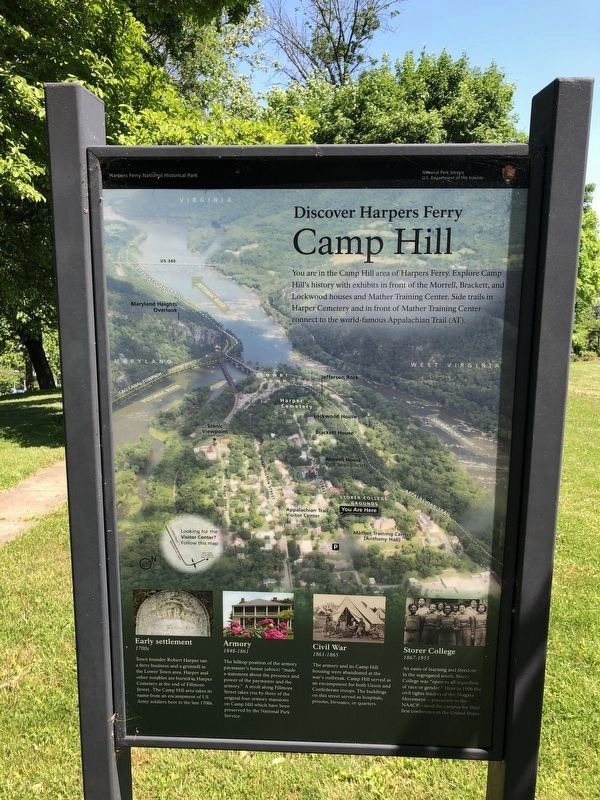
You are in the Camp Hill area of Harpers Ferry. Explore Camp Hill's history with exhibits in front of the Morrell, Brackett, and Lockwood houses and Mather Training Center. Side trails in Harper Cemetery and in front of Mather Training Center connect to the world-famous Appalachian Trail (AT).
Early settlement
1700s
Town founder Robert Harper ran a ferry business and a gristmill in the Lower Town area. Harper and other notables are buried in Harper Cemetery at the end of Fillmore Street. The Camp Hill area takes its name from an encampment of US Army soldiers here in the late 1700s.
Armory
1848-1861
The hilltop position of the armory paymaster's house (above) "made a statement about the presence and power of the paymaster and the armory." A stroll along Fillmore Street takes you by three of the original four armory mansions on Camp Hill which have been preserved by the National Park Service.
Civil War
1861-1865
The armory and its Camp Hill housing were abandoned at the war's outbreak. Camp Hill served as an encampment for both Union and Confederate troops. The buildings on this street served as hospitals, prisons,
this page online
Storer College
1867-1955
An oasis of learning and freedom in the segregated south, Storer College was "open to all regardless of race or gender." Here in 1906 the civil rights leaders of the Niagara Movement — precursor to the NAACP — used the campus for their first conference in the United States.
Erected by National Park Service.
Topics and series. This historical marker is listed in these topic lists: African Americans • Education • Settlements & Settlers • War, US Civil. In addition, it is included in the Historically Black Colleges and Universities series list. A significant historical year for this entry is 1906.
Location. 39° 19.485′ N, 77° 44.461′ W. Marker is in Harpers Ferry, West Virginia, in Jefferson County. It is at the intersection of Fillmore Street and Storer College Place, on the left when traveling east on Fillmore Street. Touch for map. Marker is at or near this postal address: 770 Fillmore Street, Harpers Ferry WV 25425, United States of America. Touch for directions.
Regionally, this marker is in the Washington Metropolitan Area and in the Eastern Panhandle. It is
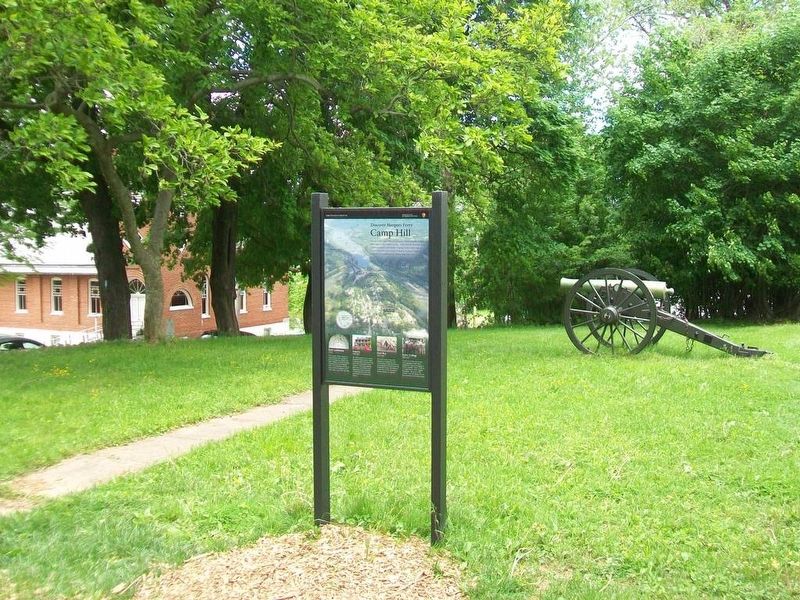
Other nearby markers. At least 8 other markers are within walking distance of this marker: The Black Americans (within shouting distance of this marker); Storer College Veterans Memorial Gate (within shouting distance of this marker); Virginia Lodge No. 1 (within shouting distance of this marker); Foundations of Freedom (within shouting distance of this marker); The Niagara Movement (within shouting distance of this marker); a different marker also named A Land Divided (within shouting distance of this marker); The Second Meeting of the Niagara Movement (about 300 feet away); That was the happiest time of my life. (about 300 feet away). Touch for a list and map of all markers in Harpers Ferry.
Other markers no longer nearby. Church and School (was within shouting distance of this marker but has been confirmed missing); A Land Divided (was within shouting distance of this marker but has been replaced with another marker now near it); Camp Hill during the Civil War (was within shouting distance of this marker but has been permanently removed); Storer College 1867-1955 (was within shouting distance of this marker but has been permanently removed); The Niagara Movement at Storer College (was about 300 feet away, measured in a direct line but has been replaced with another marker now near it).
Credits. This page was last revised on May 21, 2021. It was originally submitted on May 22, 2017, by William Fischer, Jr. of Reynoldsburg, Ohio. This page has been viewed 971 times since then and 42 times this year. Photos: 1. submitted on May 21, 2021, by Devry Becker Jones of Washington, District of Columbia. 2. submitted on May 22, 2017, by William Fischer, Jr. of Reynoldsburg, Ohio.
