Near Newell in Modoc County, California — The American West (Pacific Coastal)
Tule Lake
May 1942 - March 1946
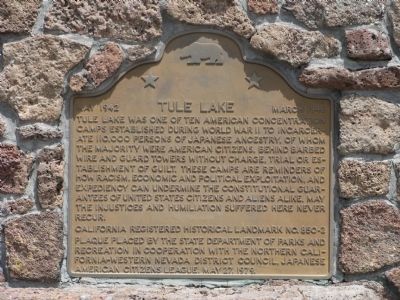
Photographed by Syd Whittle, May 10, 2008
1. Tule Lake Marker
California Registered Historical Landmark No. 850-2
Erected 1979 by State Department of Parks and Recreation in cooperation with the Northern California-Western Nevada District Council, Japanese American Citizens League May 27, 1979. (Marker Number 850-2.)
Topics and series. This historical marker is listed in this topic list: War, World II. In addition, it is included in the California Historical Landmarks, and the National Historic Landmarks series lists.
Location. 41° 53.12′ N, 121° 22.493′ W. Marker is near Newell, California, in Modoc County. It is at
this page online

Regionally, this marker is on the Modoc Plateau and in the Shasta Cascade. It is also in the American Mountain West. Globally, it is in North America, on the Ring of Fire, on the Pacific Rim, in the Western Hemisphere, in the Western World, and in the Anglosphere. Historically, it finds itself in what was once New Spain and also Mexico’s Alta California.
Other nearby markers. At least 8 other markers are within 4 miles of this marker, measured as the crow flies: Tule Lake Segregation Center (approx. 0.2 miles away); Battle of Dry Lake Memorial (approx. 0.6 miles away); Canby’s Cross (approx. 0.6 miles away); Captain Jack’s Stronghold (approx. 0.6 miles away); Warm Springs Indians (approx. 0.7 miles away); Petroglyph Point (approx. 3 miles away); Raptors - Birds of Prey (approx. 3 miles away); Applegate Trail - Bloody Point (approx. 4 miles away). Touch for a list and map
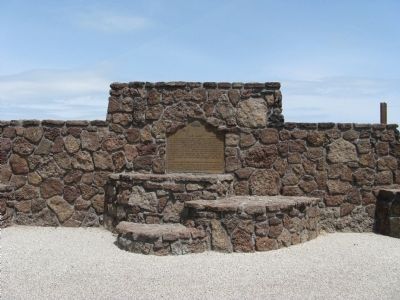
Photographed by Syd Whittle, April 10, 2008
2. Tule Lake Marker
Regarding Tule Lake. This site was designated California Historical Landmark No. 850-2 on January 20, 1972, and added to the National Register of Historical Places on February 17, 2006.
Related markers. Click here for a list of markers that are related to this marker. Additional Relocation Sites
Additional commentary.
1. Tule Lake has been designated as a National Historic Landmark
Statement of Significance (as of designation - February 17, 2006):
Tule Lake was the largest and longest-lived of the ten camps built by the civilian War Relocation Authority (WRA) to house Japanese Americans relocated from the west coast of the United States under the terms of Executive Order 9066. In 1943, Tule Lake was converted to a maximum security segregation center for evacuees from all the relocation centers whom the WRA had identified as "disloyal." Consequently, it had the most guard towers, the largest number of military police, eight tanks, and its own jail and stockade. In spite of the high security, the center continued to be plagued by conflict; in November 1943, Tule Lake was taken over by the army
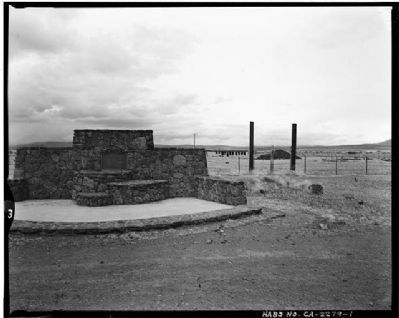
Historic American Buildings Survey (LOC)
3. Tule Lake Detention Center
Building in setting; view to northeast through Stockade fence from State Highway 139; State Historical Landmark plaque in foreground, Stockade main gate in middle ground, jail in background.
HABS CAL,25-NEW,1-1
Statement of Significance:
The jail at the Tule Lake Project was part of the Stockade, or Area B, a detention center established by the U.S. Army in late 1943 following a series of altercations between Japanese-American "evacuees" and staff of the War Relocation Authority. The Tule Lake Project is listed as California Historical Landmark No. 850-2.
Building/structure dates: 1944 initial construction.
Building/structure dates: 1946 subsequent work.
See below for 27 additional HABS photos.
Click for more information.
HABS CAL,25-NEW,1-1
Statement of Significance:
The jail at the Tule Lake Project was part of the Stockade, or Area B, a detention center established by the U.S. Army in late 1943 following a series of altercations between Japanese-American "evacuees" and staff of the War Relocation Authority. The Tule Lake Project is listed as California Historical Landmark No. 850-2.
Building/structure dates: 1944 initial construction.
Building/structure dates: 1946 subsequent work.
See below for 27 additional HABS photos.
Click for more information.
— Submitted October 19, 2008, by Syd Whittle of Mesa, Arizona.
Additional keywords. Japanese Americans

Photographed by Jeff Leichsenring, July 14, 2024
4. Tule Lake Marker
Credits. This page was last revised on July 16, 2025. It was originally submitted on August 17, 2008, by Syd Whittle of Mesa, Arizona. This page has been viewed 2,579 times since then and 64 times this year. Photos: 1, 2. submitted on August 17, 2008, by Syd Whittle of Mesa, Arizona. 3. submitted on April 16, 2009, by Syd Whittle of Mesa, Arizona. 4. submitted on July 17, 2024, by Jeff Leichsenring of Garland, Texas. • Craig Swain was the editor who published this page.
