Coliseum Central in Hampton, Virginia — The American South (Mid-Atlantic)
Langley Field
Built for Air Power
Photographed by Bernard Fisher, May 28, 2017
1. Langley Field Marker
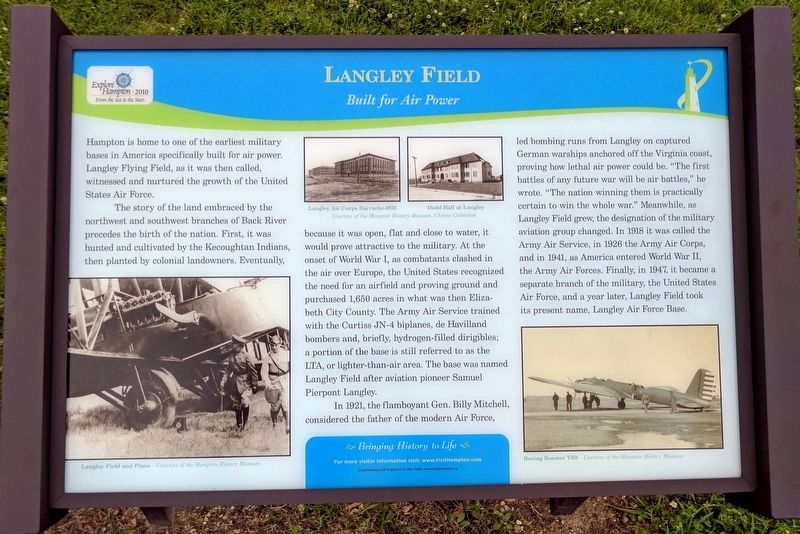
The story of the land embraced by the northwest and southwest branches of Back River precedes the birth of the nation. First, it was hunted and cultivated by the Kecoughtan Indians, then planted by colonial landowners. Eventually, because it was open, flat and close to water, it would prove attractive to the military. At the onset of World War 1, as combatants clashed in the air over Europe, the United States recognized the need for an airfield and proving ground and purchased 1,650 acres in what was then Elizabeth City County. The Army Air Service trained with the Curtiss JN-4 biplanes, de Havilland bombers and, briefly, hydrogen-filled dirigibles; a portion of the base is still referred to as the LTA, or lighter-than-air area. The base was named Langley Field after aviation pioneer Samuel Pierpont Langley.
In 1921, the flamboyant Gen. Billy Mitchell, considered the father of the modern Air Force, led bombing
this page online
(captions)
Langley Field and Plane - Courtesy of the Hampton History Museum
Langley Air Corps Barracks-1932
Dodd Hall at Langley
Courtesy of the Hampton History Museum, Cheyne Collection
Boeing Bomber YB9 - Courtesy of the Hampton History Museum
Erected 2010 by Bring History to Life.
Topics. This historical marker is listed in these topic lists: Air & Space • War, World I • War, World II. A significant historical year for this entry is 1918.
Location. 37° 2.614′ N,
Photographed by Bernard Fisher, May 28, 2017
2. Langley Field Marker

Regionally, this marker is on Virginia’s Peninsula and in Coastal Virginia. It is also in the American South, specifically in the Upper South, in the Tidewater, and on the Eastern Seaboard. Globally, it is in the North Atlantic Region, North America, the Western Hemisphere, the Western World, and the Anglosphere. Historically, it finds itself in what was once the territory of the Mississippian Culture, one of the original Thirteen Colonies, one of the Confederate States of America, and the Antebellum South.
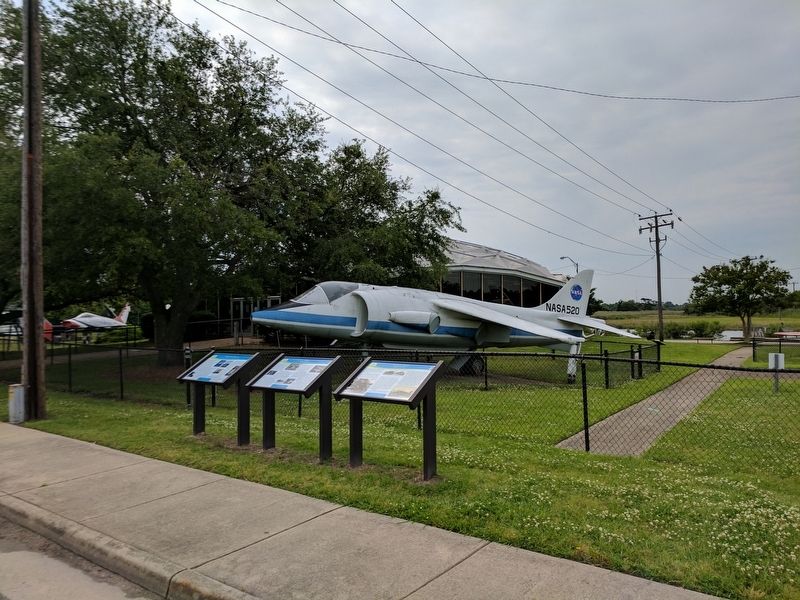
Other nearby markers. At least 8 other markers are within walking distance of this marker: NACA (here, next to this marker); F-86L Sabre/Mercury Test Capsule (here, next to this marker); NASA Space History (here, next to this marker); MIM-3 Nike-Ajax/XV-6A Kestrel (a few steps from this marker); A-7E Corsair II / T-33A T-Bird (a few steps from this marker); F-100D Super Saber • Mercury/Little Joe Booster (within shouting distance of this marker); RF-4C Phantom II / M-2 (MGM-5) Corporal (within shouting distance of this marker); A-2 Polaris (within shouting distance of this marker). Touch for a list and map of all markers in Hampton.
Other markers no longer nearby. A-7E Corsair II (was a few steps from this marker but has been permanently removed); Mercury Test Capsule (was within shouting distance of this marker but has been confirmed missing); T-33A T-Bird (was within shouting distance of this marker but has been permanently removed); M-2 Corporal (was within shouting distance of this marker but has been permanently removed).
Credits. This page was last revised on February 1, 2023. It was originally submitted on May 30, 2017, by Bernard Fisher of Richmond, Virginia. This page has been viewed 1,191 times since then and 77 times this year. Photos: 1, 2. submitted on May 30, 2017, by Bernard Fisher of Richmond, Virginia.
