Near Le Moyne in Mobile County, Alabama — The American South (East South Central)
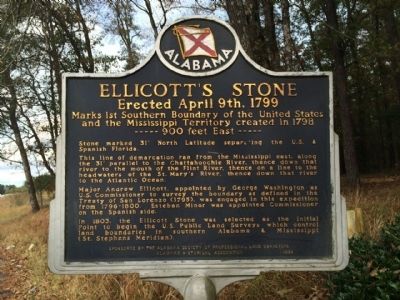
Ellicott's Stone
Erected April 9th, 1799
Photographed by Mark Hilton, December 4, 2013
1. Ellicott's Stone Marker
-----900 feet East-----
Stone marked 31° North Latitude separating the U.S. & Spanish Florida.
This line of demarcation ran from the Mississippi east, along the 31° parallel to the Chattahoochie River, thence down that river to the mouth of the Flint River, thence on a line to the headwaters of the St. Mary’s River, thence down that river to the Atlantic Ocean.
Major Andrew Ellicott, appointed by George Washington as U.S. Commissioner to survey the boundary as defined in the Treaty of San Lorenzo (1795), was engaged in this expedition from 1796-1800. Esteban Minor was appointed Commissioner on the Spanish side.
In 1803, the Ellicott Stone was selected as the Initial Point to begin the U.S. Public Land Surveys which control land boundaries in southern Alabama & Mississippi (St. Stephens Meridian).
Erected 1999 by Alabama Society of Professional Land Surveyors & Alabama Historical Association.
Topics and series. This historical marker is listed in these topic lists: Colonial Era • Exploration. In addition,
this page online
Location. 30° 59.779′ N, 88° 1.509′ W. Marker is near Le Moyne, Alabama, in Mobile County. It is on U.S. 43 at milepost 19, 0.1 miles south of Lofton Road, on the right when traveling north. Touch for map. Marker is in this post office area: Axis AL 36505, United States of America. Touch for directions.

Regionally, this marker is on Alabama’s Gulf Coast, in the Mobile Bay area, and specifically in the Mobile Metropolitan Area. It is also in the American South, specifically in the Deep South, and on the Gulf Coast. Globally, it is in North America, a Gulf of Mexico state, the Western Hemisphere, the Western World, and the Anglosphere. Historically, it finds itself in what was once New Spain, the Viceroyalty of New France, the territory of the Mississippian Culture, one of the Confederate States of America, and the Antebellum South.
Other nearby markers. At least 8 other markers are within 7 miles of this marker, measured as the crow flies: Site of Old Mobile
Photographed by Mark Hilton, December 4, 2013
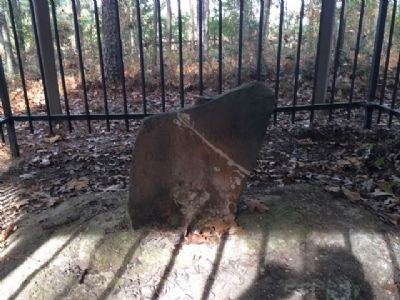
2. Ellicott's Stone
More about this marker. Park appears to have suffered some vandalism. 5/28/15.
Google Street View shows marker replaced/repaired as of May, 2024.
Also see . . . Ellicott's Stone. (Submitted on December 5, 2013.)
Photographed by Mark Hilton, December 4, 2013
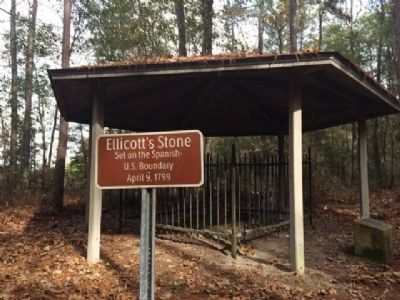
3. Ellicott's Stone Area
Photographed by Mark Hilton, December 4, 2013
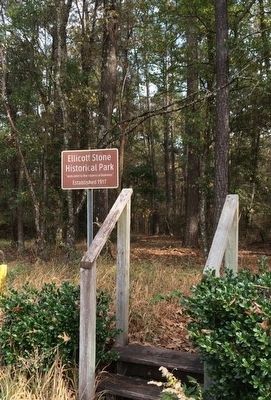
4. Ellicott's Stone Historical Park
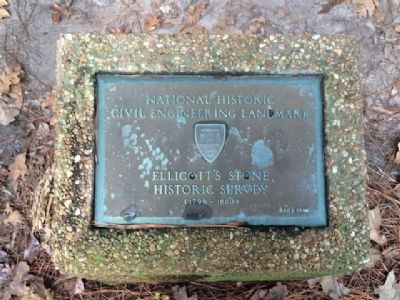
Photographed by Mark Hilton, December 4, 2013
5. National Historic Civil Engineering Landmark
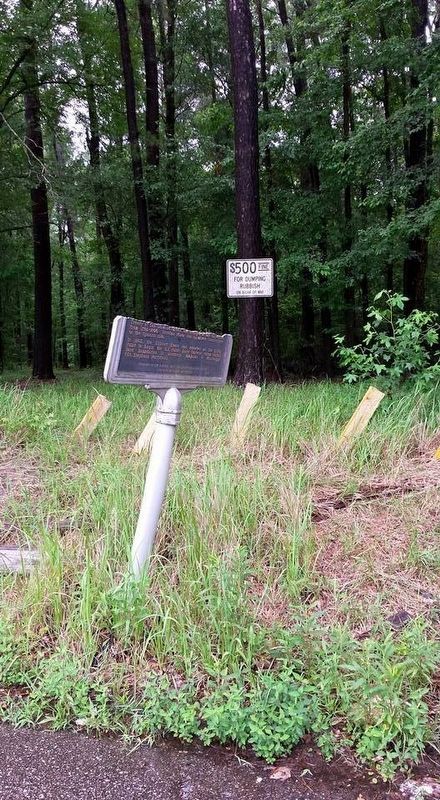
Photographed by Diane White, May 28, 2015
6. Ellicott's Stone Marker now broken.
Credits. This page was last revised on June 16, 2026. It was originally submitted on December 5, 2013, by Mark Hilton of Montgomery, Alabama. This page has been viewed 3,692 times since then and 177 times this year. Last updated on June 4, 2017, by W. Scott Brannon of Tuscaloosa, Alabama. Photos: 1, 2, 3, 4, 5. submitted on December 5, 2013, by Mark Hilton of Montgomery, Alabama. 6. submitted on June 26, 2017, by Mark Hilton of Montgomery, Alabama.
Editor’s want-list for this marker. Photo of replaced/repaired marker. • Can you help?
