Mt Carmel in Hawkins County, Tennessee — The American South (East South Central)
First Settlers
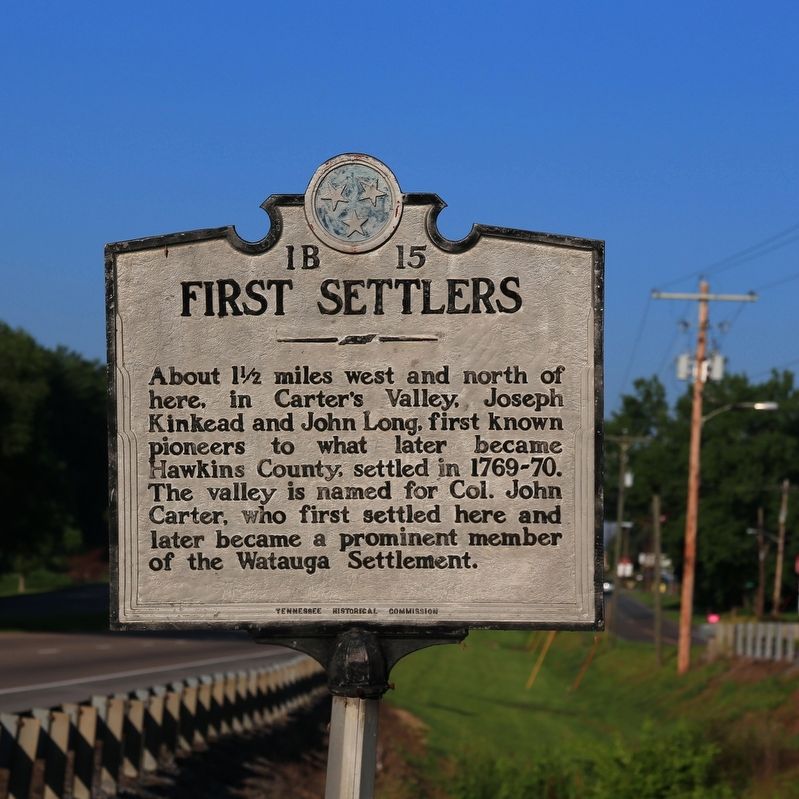
Photographed by J. J. Prats, June 10, 2017
1. First Settlers Marker
Erected by Tennessee Historical Commission. (Marker Number 1B-15.)
Topics and series. This historical marker is listed in this topic list: Settlements & Settlers. In addition, it is included in the Tennessee Historical Commission series list.
Location. 36° 32.377′ N, 82° 39.932′ W. Marker is in Mt Carmel, Tennessee, in Hawkins County. It is on U.S. 11W just south of Edgewood Avenue, on the right when traveling south. Touch for map. Marker is in this post office area: Mount Carmel TN 37645, United States of America. Touch for directions.

Regionally, this marker is in East Tennessee and in the Tri-Cities Area. It is also in the American South, specifically in the Upper South, in Appalachia, and specifically in Southern Appalachia. Globally, it is in North America,
this page online
Other nearby markers. At least 8 other markers are within 4 miles of this marker, measured as the crow flies: Gov. McMinn’s Home (approx. one mile away); The Great Indian Warpath (approx. 2.7 miles away); Battle of Kingsport (approx. 3 miles away); a different marker also named Battle of Kingsport (approx. 3 miles away); Patterson's Mill (approx. 3.2 miles away); Carter's Store (approx. 3.8 miles away); Colonel Gilbert Christian (approx. 4 miles away); Flatboat (approx. 4 miles away).
Also see . . . History of Tennessee. “There was another settlement north of Holston, known as the Carter's Valley Settlement, in what is now Hawkins County. It was, also, believed to be in Virginia, but was beyond the Indian line. Its people acknowledged the jurisdiction of Virginia, but being on the Cherokee lands, were deprived of its protection. Carter's
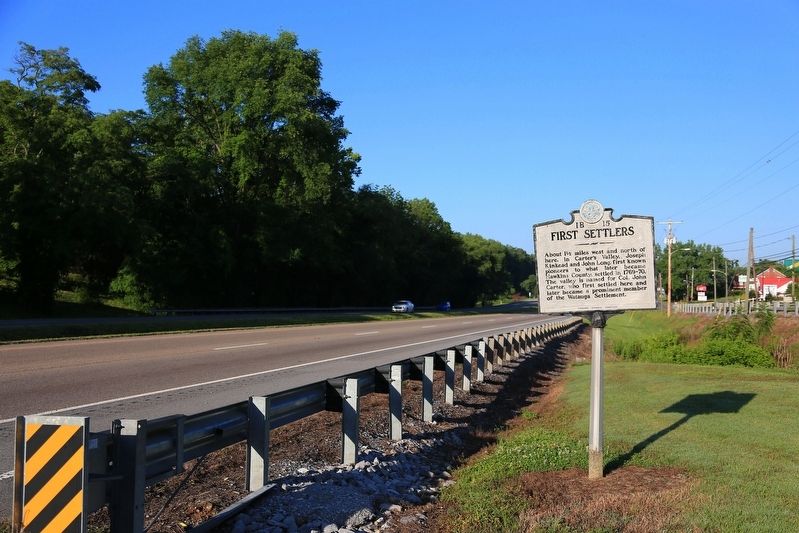
Photographed by J. J. Prats, June 10, 2017
2. First Settlers Marker
Credits. This page was last revised on June 13, 2017. It was originally submitted on June 13, 2017, by J. J. Prats of Powell, Ohio. This page has been viewed 2,284 times since then and 113 times this year. Photos: 1, 2. submitted on June 13, 2017, by J. J. Prats of Powell, Ohio.
