Downtown in Louisville in Jefferson County, Kentucky — The American South (East South Central)
Kentucky Medal Of Honor Memorial
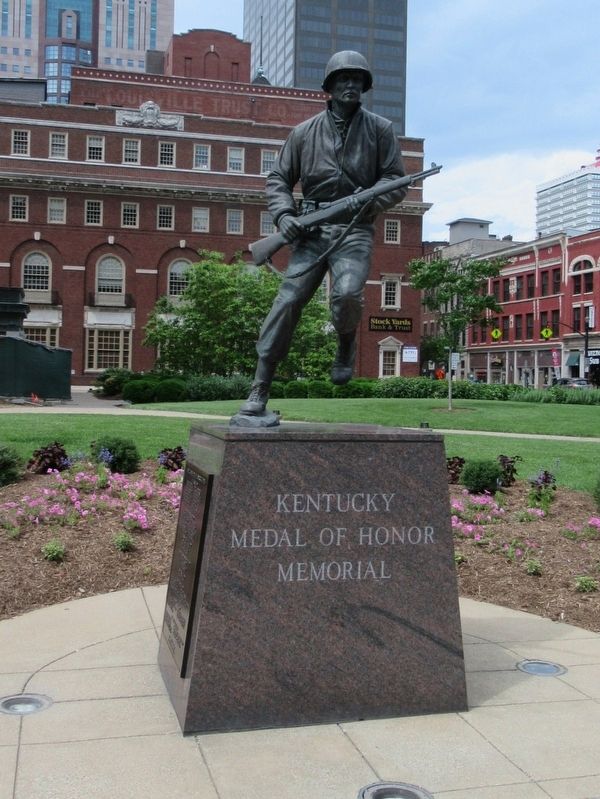
Photographed by Michael Herrick, May 19, 2017
1. Kentucky Medal Of Honor Memorial
Medal Of Honor
Memorial
( east side )
Sergeant, United States Army
May 19, 1925 – May 23, 1944
Jefferson County Commissioner Russ Maple
November 12, 2001
Sculpted by
Doyle Glass
( west side )
this page online
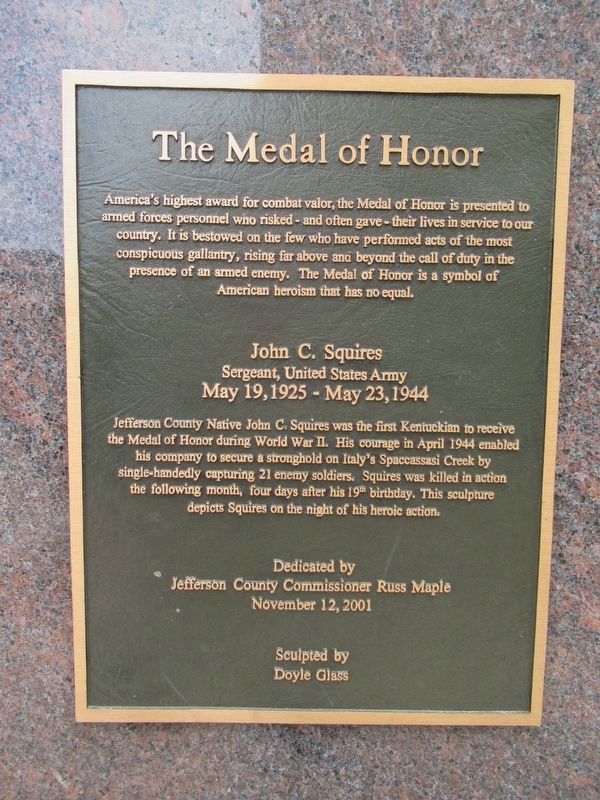
Photographed by Michael Herrick, May 19, 2017
2. Kentucky Medal Of Honor Memorial
Topics. This memorial
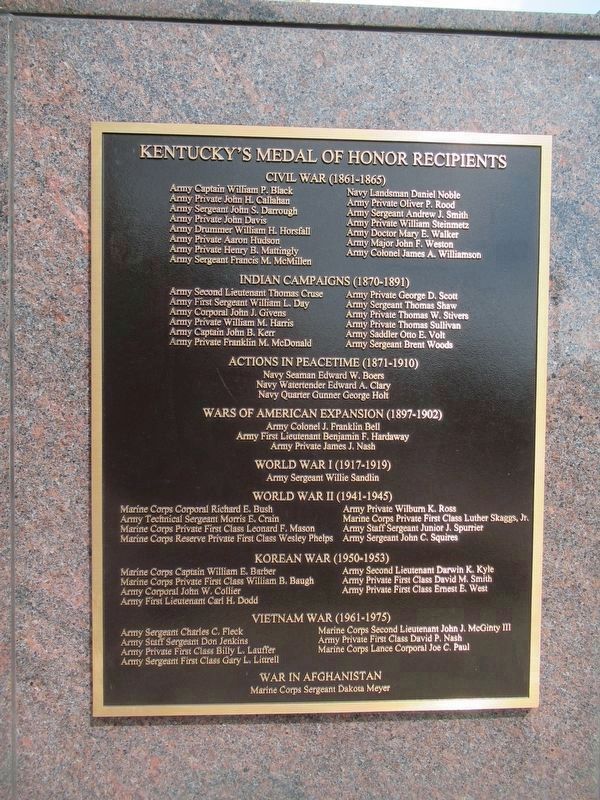
Photographed by Michael Herrick, May 19, 2017
3. Kentucky Medal Of Honor Memorial
Location. 38° 15.253′ N, 85° 45.544′ W. Memorial is in Louisville, Kentucky, in Jefferson County. It is in Downtown. It is on W Jefferson Street near S 5th Street, on the right when traveling west. Located in front of Louisville Metro Hall. Touch for map. Memorial is at or near this postal address: 527 W Jefferson Street, Louisville KY 40202, United States of America. Touch for directions.

Regionally, this memorial is in the American South, specifically in the Upper South, and in the Ohio River Valley. Globally, it is in North America, the Western Hemisphere, the Western World, and the Anglosphere. Historically, it finds itself in what was once the territory of the Mississippian Culture and also the Antebellum South.
Other nearby markers. At least 8 other markers are within walking distance of this marker: Jefferson County (a few steps from this marker); They Paid For Peace (a few steps from this marker); Thomas Jefferson Memorial (within shouting distance of this marker); George Rogers Clark (within shouting distance of this marker);
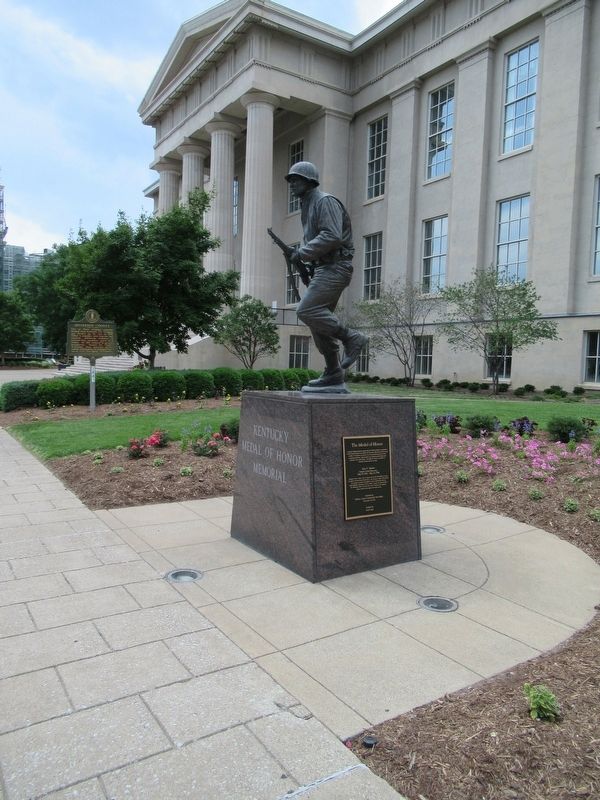
Photographed by Michael Herrick, May 19, 2017
4. Kentucky Medal Of Honor Memorial
Another marker is no longer nearby. Louis XVI (was about 300 feet away but has been confirmed missing).
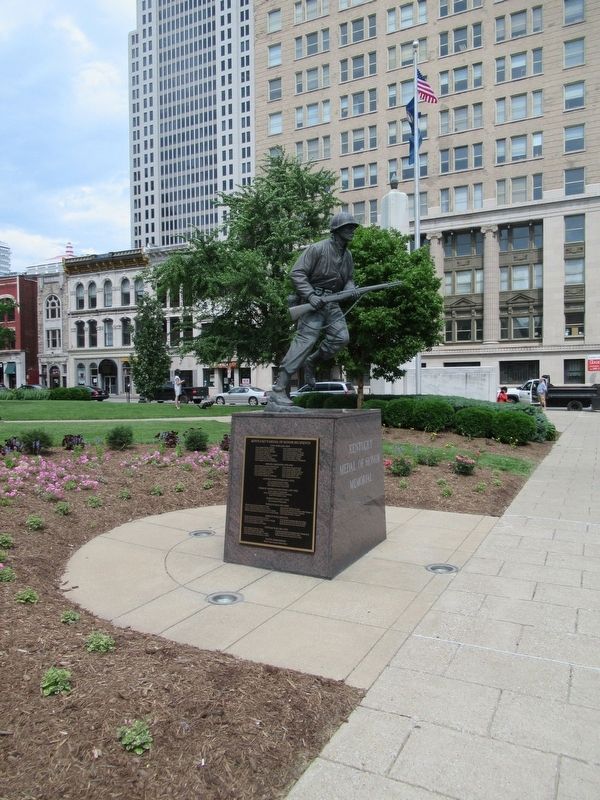
Photographed by Michael Herrick, May 19, 2017
5. Kentucky Medal Of Honor Memorial
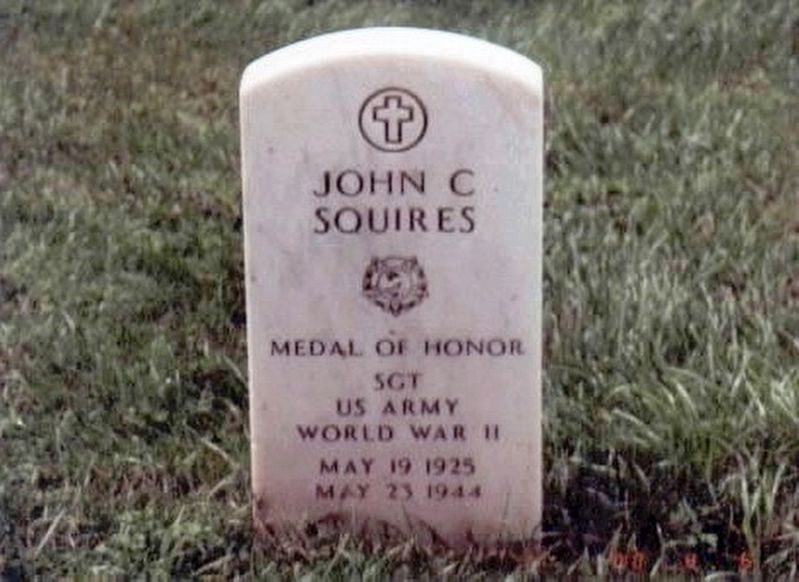
Photographed by Don Morfe, August 6, 2000
6. John C. Squires-Medal of Honor grave marker
He is buried in Zachary Taylor National Cemetery, Louisville KY-Section A, Site 1359. He was Killed in Action. His Medal of Honor information and citation is: *SQUIRES, JOHN C.
• Rank and organization: Sergeant (then Private First Class), U.S. Army, Company A, 30th Infantry, 3d Infantry Division
• Place and date: Near Padiglione, Italy, 23-24 April 1944
• Entered service at: Louisville, Ky.
• G.O. No.: 78, 2 October 1944
Citation: For conspicuous gallantry and intrepidity at risk of life above and beyond the call of duty. At the start of his company's attack on strongly held enemy positions in and around Spaccasassi Creek, near Padiglione, Italy, on the night of 23-24 April 1944, Pfc. Squires, platoon messenger, participating in his first offensive action, braved intense artillery, mortar, and antitank gun fire in order to investigate the effects of an antitank mine explosion on the leading platoon. Despite shells which burst close to him, Pfc. Squires made his way 50 yards forward to the advance element, noted the situation, reconnoitered a new route of advance and informed his platoon leader of the casualties sustained and the alternate route. Acting without orders, he rounded up stragglers, organized a group of lost men into a squad and led them forward. When the platoon reached Spaccasassi Creek and established an outpost, Pfc. Squires, knowing that almost all of the noncommissioned officers were casualties, placed 8 men in position of his own volition, disregarding enemy machinegun, machine-pistol, and grenade fire which covered the creek draw. When his platoon had been reduced to 14 men, he brought up reinforcements twice. On each trip he went through barbed wire and across an enemy minefield, under intense artillery and mortar fire. Three times in the early morning the outpost was counterattacked. Each time Pfc. Squires ignored withering enemy automatic fire and grenades which struck all around him, and fired hundreds of rounds of rifle, Browning automatic rifle, and captured German Spandau machinegun ammunition at the enemy, inflicting numerous casualties and materially aiding in repulsing the attacks. Following these fights, he moved 50 yards to the south end of the outpost and engaged 21 German soldiers in individual machinegun duels at point-blank range, forcing all 21 enemy to surrender and capturing 13 more Spandau guns. Learning the function of this weapon by questioning a German officer prisoner, he placed the captured guns in position and instructed other members of his platoon in their operation. The next night when the Germans attacked the outpost again he killed 3 and wounded more Germans with captured potato-masher grenades and fire from his Spandau gun. Pfc. Squires was killed in a subsequent action.
Credits. This page was last revised on February 12, 2023. It was originally submitted on June 18, 2017, by Michael Herrick of Southbury, Connecticut. This page has been viewed 1,113 times since then and 76 times this year. Photos: 1, 2, 3, 4, 5. submitted on June 18, 2017, by Michael Herrick of Southbury, Connecticut. 6. submitted on June 21, 2017, by Don Morfe of Baltimore, Maryland.
