Middlesex Township near Carlisle in Cumberland County, Pennsylvania — The American Northeast (Mid-Atlantic)
Revolutionary War
Firewood
Photographed by Larry Gertner, July 9, 2015
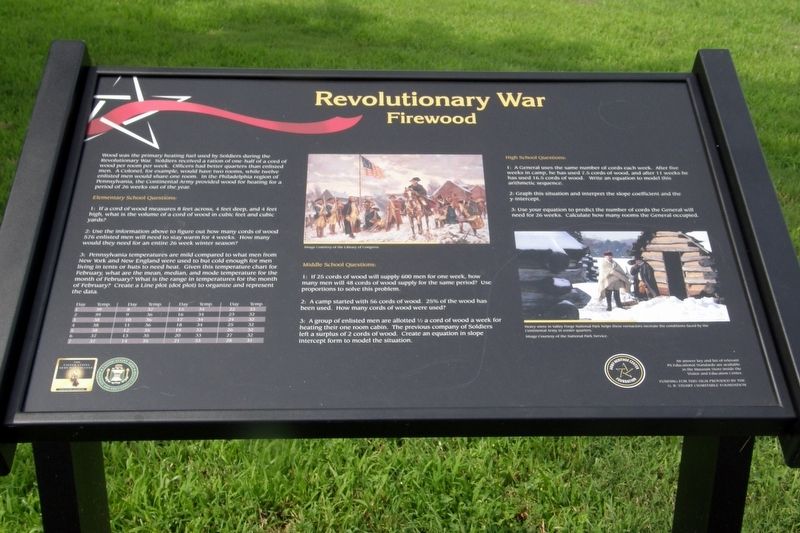
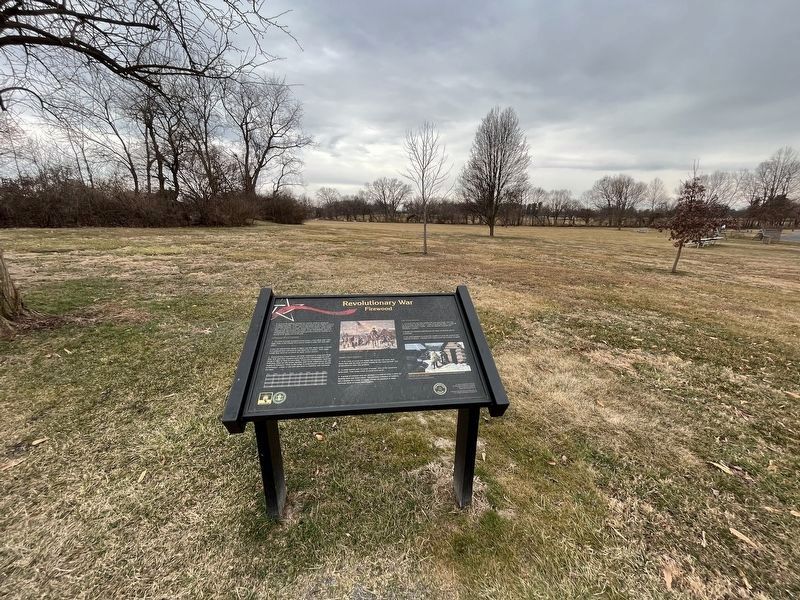
1. Revolutionary War- Firewood Marker
Wood was the primary heating fuel used by Soldiers during the Revolutionary War. Soldiers received a ration of one-half of a cord of wood per room per day. Officers had better quarters than enlisted men. A Colonel, for example, would have two rooms, while twelve enlisted men would share one room. In the Philadelphia region of Pennsylvania, the Continental Army provided wood for heating for a period of 26 weeks out of the year.
Elementary School Questions:
1. If a cord of wood measures 8 feet across, 4 feet deep, and 4 feet high, what is the volume of a cord of wood in cubic feet and cubic yards?
2. Use the information above to figure out how many cords of woods 576 enlisted men will need to stay warm for 4 weeks. How many would they need for an entire 26 week winter season?
3. Pennsylvania temperatures are mild compared to what men from New York and New England were used to but cold enough for men living in tents or huts to need heat. Given this temperature chart for February, what are the mean, median and mode temperature for the month of February? What is the range in temperatures for the month of February? Create
this page online
Middle School Questions:
1. If 25 cords of wood will supply 600 men for one week, how many men will 48 cords of wood supply for the same period? Use proportions to solve this problem.
2. A camp started with 56 cords of wood. 25% of the wood has been used. How many cords of wood were used?
3. A group of enlisted men are allotted ½ a cord of wood a week for heating their one room cabin. The previous company of Soldiers left a surplus of 2 cords of wood. Create an equation in slope intercept form to model the situation.
High School Questions:
1. A General uses the same number of cords of wood each week. After five weeks in camp, he has used 7.5 cords of wood, and after 11 weeks he has used 16.5 cords of wood. Write an equation to model this arithmetic sequence.
2. Graph this situation and interpret the slope coefficient and the y-intercept.
3. Use your equation to predict the number of cords the General will need for 26 weeks. Calculate how many rooms the General occupied.
An answer key and list of relevant PA Educational Standards is available in
Erected by The United States Army War College; U.S. Army Heritage and Education Center; Army Heritage Center Foundation.
Topics. This historical marker is listed in these topic lists: Education • War, US Revolutionary.
Location. 40° 12.233′ N, 77° 9.475′ W. Marker is near Carlisle, Pennsylvania, in Cumberland County. It is in Middlesex Township. It can be reached from Army Heritage Drive. Touch for map. Marker is in this post office area: Carlisle PA 17013, United States of America. Touch for directions.

Regionally, this marker is in South-Central Pennsylvania and in Greater Harrisburg. It is also in the American Northeast, in the Mid-Atlantic, in Appalachia, and specifically in Northern Appalachia. Globally, it is in North America, the Western Hemisphere, the Western World, and the Anglosphere. Historically, it finds itself in what was once the Haudenosaunee (Iroquois) Confederacy and also one of the original Thirteen Colonies.
Other nearby markers. At least 8 other markers are within walking distance of this marker: Respect (here, next to this marker); The Capture of Redoubt #10 (a few steps from this marker); Personal Courage (within shouting distance of this marker); Defender of Pusan (within shouting distance of this marker); a different marker also named Technical History (within shouting distance of this marker); Corporal Eugene C. Rivera (within shouting distance of this marker); "Tigers in Support" (within shouting distance of this marker); Smallpox (within shouting distance of this marker). Touch for a list and map of all markers in Carlisle.
Other markers no longer nearby. Technical History (was within shouting distance of this marker but has been replaced with another marker now near it); a different marker also named The Capture of Redoubt #10 (was within shouting distance of this marker but has been replaced with another marker now near it); a different marker also named Defender of Pusan (was within shouting distance of this marker but has been replaced with another marker now near it).
Credits. This page was last revised on March 2, 2023. It was originally submitted on June 22, 2017, by Larry Gertner of New York, New York. This page has been viewed 588 times since then and 29 times this year. Photos: 1. submitted on June 22, 2017, by Larry Gertner of New York, New York. 2. submitted on March 2, 2023, by Devry Becker Jones of Washington, District of Columbia. • Bill Pfingsten was the editor who published this page.
