Scotland in St. Mary's County, Maryland — The American Northeast (Mid-Atlantic)
A Place of History
Point Lookout State Park
| — | Maryland Park Service | — |
Photographed by Don Morfe, March 11, 2012
1. A Place of History Marker
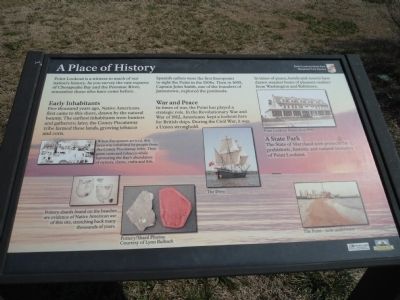
Point Lookout is a witness to much of our nation’s history. As you survey the vast expanse of Chesapeake Bay and the Potomac River, remember those who have come before.
Early Inhabitants
Five thousand years ago, Native Americans first came to this shore, drawn by the natural bounty. The earliest inhabitants were hunters and gatherers; later, the Conoy Piscataway tribe farmed these lands, growing tobacco and corn.
Spanish sailors were the first Europeans to sight the Point in the 1500’s. Then in 1608 Captain John Smith, one of the founders of Jamestown, explored the peninsula.
War and Peace
In times of war, the Point has played a strategic role. In the Revolutionary War and War of 1812, Americans kept a lookout here for British ships. During the Civil War, it was a Union stronghold.
When Europeans arrived, this area was inhabited by people from the Conoy Piscataway tribe. They grew corn and tobacco while harvesting the Bay’s abundance of oysters, clams, crabs, and fish.
Pottery shards found on the beaches are evidence of Native American use of this site, stretching back many thousands of years.
In times
this page online
A State Park
The State of Maryland now protects the prehistoric, historic and natural treasures of Point Lookout.
Erected by Maryland Park Service; Maryland Department of Natural Resources.
Topics. This historical marker is listed in this topic list: Notable Places. A significant historical year for this entry is 1608.
Location. This marker has been replaced by another marker nearby. It was located near 38° 2.49′ N, 76° 19.308′ W. Marker was in Scotland, Maryland, in St. Mary's County. It was on Maryland Route 5. This marker has been relocated further south to the parking area of the Point Lookout Lighthouse. Touch for map. Marker was in this post office area: Scotland MD 20687, United States of America. Touch for directions.

Regionally, this marker was in Southern Maryland. It was also in the American South, specifically in the Upper South, in the Mid-Atlantic, in the Tidewater, in the Chesapeake Bay Region, and on the Eastern Seaboard. Globally, it was in the North Atlantic Region, North America, the Western
Photographed by Pete Payette, June 19, 2017
2. A Place of History Marker
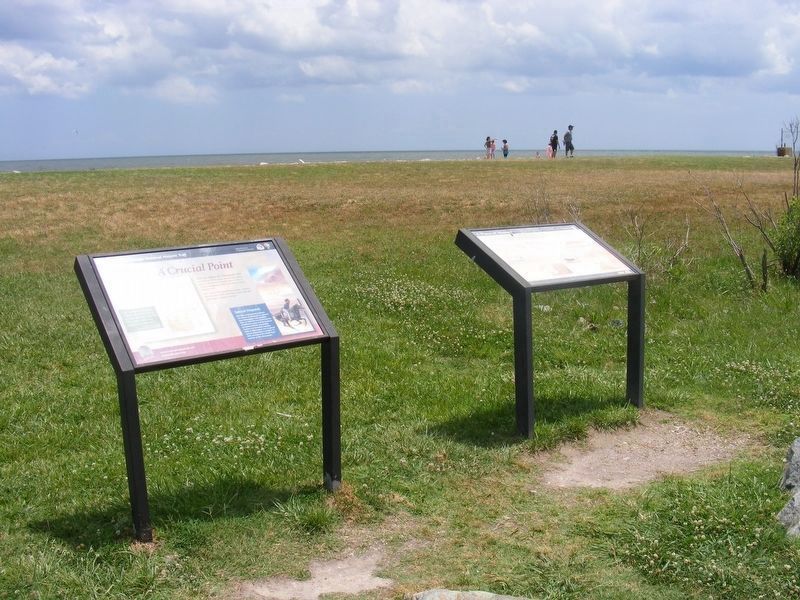
This marker is now located near the Point Lookout Lighthouse, adjacent to the Star-Spangled Banner National Historic Trail marker.
Other nearby markers. At least 8 other markers are within walking distance of this location: Hammond General Hospital (about 400 feet away, measured in a direct line); Point Lookout-Hammond Hospital (about 700 feet away); a different marker also named Hammond General Hospital (about 800 feet away); Welcome to Point Lookout (approx. 0.2 miles away); Light's On at Point Lookout (approx. 0.2 miles away); The Wharf (approx. 0.2 miles away); Treacherous Waters (approx. 0.2 miles away); The Buoy & Coal Sheds (approx. 0.2 miles away). Touch for a list and map of all markers in Scotland.
Other markers no longer nearby. Smallpox Epidemic (was about 400 feet away but has been replaced with another marker now near it); Death at Point Lookout (was about 400 feet away but has been replaced with another marker now near it); Defense Strategies (was about 600 feet away but has been replaced with another marker now near it); A Bustling Civil War Community (was about
Photographed by Don Morfe, March 11, 2012
3. A Place of History Marker
Photographed by Don Morfe, March 11, 2012
4. A Place of History Marker
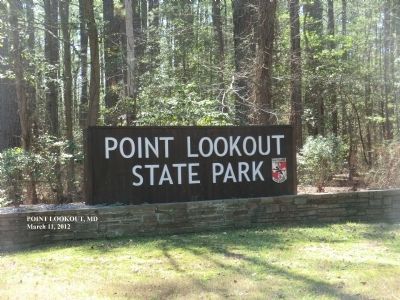
Photographed by Don Morfe, March 11, 2012
5. A Place of History Marker
Credits. This page was last revised on April 16, 2026. It was originally submitted on October 15, 2012, by Don Morfe of Baltimore, Maryland. This page has been viewed 779 times since then and 48 times this year. Last updated on June 26, 2017, by Pete Payette of Orange, Virginia. Photos: 1. submitted on October 15, 2012, by Don Morfe of Baltimore, Maryland. 2. submitted on June 26, 2017, by Pete Payette of Orange, Virginia. 3, 4, 5. submitted on October 15, 2012, by Don Morfe of Baltimore, Maryland. • Bernard Fisher was the editor who published this page.
