Thompson in Schoolcraft County, Michigan — The American Midwest (Great Lakes)
The Christmas Tree Ship
Photographed by Joel Seewald, May 31, 2017
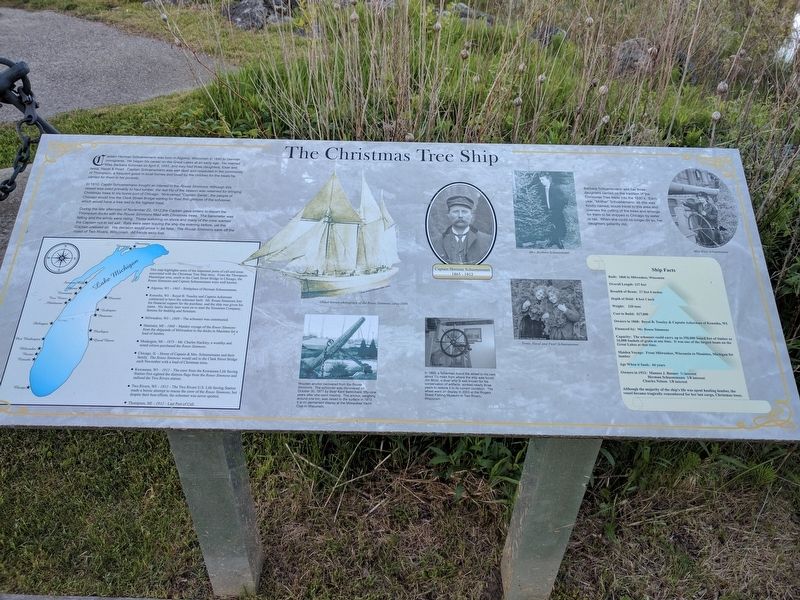
1. The Christmas Tree Ship Marker
Captain Herman Schuenemann was born in Algoma, Wisconsin in 1895 to German immigrants. He began his career on the Great Lakes at an early age. He married Miss Barbara Schindel on April 9, 1891, and they had three daughters, Elsie and twins, Hazel & Pearl. Captain Schuenemann was well liked and respected in the community of Thompson, a frequent guest in local homes and loved by the children for the treats he carried for them in his pockets.
In 1910, Captin Schuenemann bought an interest in the Rouse Simmons. Although this vessel was used primarily to haul lumber, the last trip of the season was reserved for bringing Christmas trees to his home port of Chicago. Nicknamed "Captain Santa", the people of Chicago would line the Clark Street Bridge waiting for their first glimpse of the schooner, which would have a tree tied to the highest mast.
During the late afternoon of November 22, 1912,the Captain gave orders to depart the Thompson docks with the Rouse Simmons filled with Christmas trees. The barometer was falling and the winds were rising. Those watching on shore and many of the crew warned the Captain not to set
this page online
Barbara Schuenemann and her three daughters carried on the tradition of the Christmas Tree trade into the 1930's. Each year, "Mother" Schuenemann, as she was fondly named, would travel to this area and oversee the cutting of the trees and arrange for them to be shipped to Chicago by water or rail. When she could no longer do so, her daughters gallantly did.
Ship Facts
Built: 1868 in Milwaukee, Wisconsin
Overall Length: 127 feet
Breadth of Beam: 27 feet 6 inches
Depth of Hold: 8 feet 1 inch
Weight: 220 tons
Cost to Build: $17,000
Owners in 1868: Royal B. Tousley & Captain Ackerman of Kenosha
Financed by: Mr. Rouse Simmons
Capacity: The schooner could carry up to 350,000 board feet of timber or 16,000 bushels of grain at one time. It was one of the largest boats on the Great Lakes at that time.
Maiden Voyage: From Milwaukee, Wisconsin to Manistee, Michigan for lumber
Age When it Sank: 44 years
Owners in 1912: Mannes
Photographed by Joel Seewald, May 31, 2017
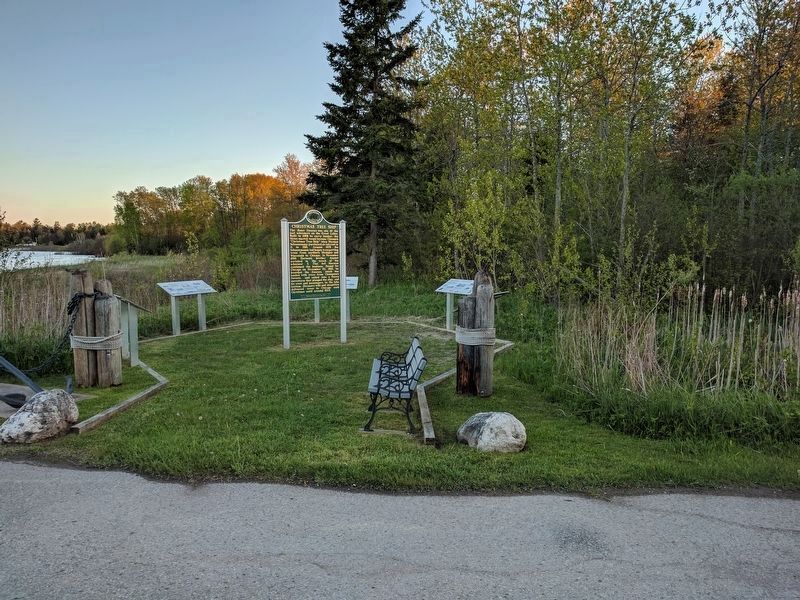
2. The Christmas Tree Ship Marker
This marker is the one on the far left (not facing the camera).
Although the majority of the ship's life was spent hauling lumber, the vessel became tragically remembered for her last cargo, Christmas trees.
This map highlights some of the important ports of call and areas associated with the Christmas Tree Ship story. From the Thompson-Manistique area, south to the Clark Street Bridge in Chicago, the Rouse Simmons and Captain Schuenemann were well known.
• Algoma, WI — 1865 — Birthplace of Herman Schuenemann.
• Kenosha, WI — Royal B. Tousley and Captain Ackerman contracted to have the schooner built. Mr. Rouse Simmons lent his financial support for the purchase, and the ship was given his name. His family later went on to start the Simmons Company, famous for bedding and furniture.
• Milwaukee, WI — 1868 — The schooner was constructed.
• Manistee, MI — 1868 — Maiden voyage of the Rouse Simmons from the shipyards of Milwaukee to the docks in Manistee for a load of lumber.
• Muskegon, MI — 1873 — Mr. Charles Hackley, a wealthy and noted citizen purchased the Rouse Simmons.
• Chicago, IL — Home of Captain & Mrs. Schuenemann and their family. The Rouse Simmons would sail to the Clark Street Bridge each November with a load of Christmas trees.
• Kewaunee, WI — 1912 — The crew from the Kewaunee Life Saving Station first sighted the distress flags from the Rouse Simmons and radioed the Two Rivers station.
• Two Rivers, WI — 1912 — The Two Rivers U.S. Life Saving Station made a heroic attempt to rescue the crew of the Rouse Simmons, but despite their best efforts, the schooner was never spotted.
• Thompson, MI — 1912 — Last Port of Call.
Topics and series. This historical marker is listed in these topic lists: Disasters • Industry & Commerce • Waterways & Vessels. In addition, it is included in the Lost at Sea series list. A significant historical date for this entry is April 9, 1891.
Location. 45° 54.403′ N, 86° 19.475′ W. Marker is in Thompson, Michigan, in Schoolcraft County. It is on unnamed road 0.1 miles east of U.S. 2, on the right when traveling east. The unnamed road is north of Thompson, about 415 feet north of Manistique Avenue. Touch for map. Marker is in this post office area: Manistique MI 49854, United States of America. Touch for directions.

Regionally, this marker is on the Upper Peninsula. It is also in the American Midwest. Globally, it is in North America, in the Great North Woods, on the Great Lakes, in the Western Hemisphere, in the Western World, and in the Anglosphere. Historically, it finds itself in what was once the Northwest Territory.
Other nearby markers. At least 8 other markers are within 5 miles of this marker, measured as the crow flies: Christmas Tree Ship / Thompson (here, next to this marker); Thompson Docks (here, next to this marker); Schoolcraft County (here, next to this marker); The Mill Brings Prosperity to Thompson (here, next to this marker); Life in a Lumber Town (here, next to this marker); The Manistique Lighthouse (approx. 4.8 miles away); Near-Shore Sawdust and Wood Chip Deposits (approx. 4.9 miles away); Manistique Boardwalk (approx. 5 miles away). Touch for a list and map of all markers in Thompson.
Credits. This page was last revised on November 27, 2024. It was originally submitted on July 11, 2017, by Joel Seewald of Madison Heights, Michigan. This page has been viewed 866 times since then and 34 times this year. Photos: 1, 2. submitted on July 11, 2017, by Joel Seewald of Madison Heights, Michigan.
