Scranton in Lackawanna County, Pennsylvania — The American Northeast (Mid-Atlantic)
Supplying the Blast
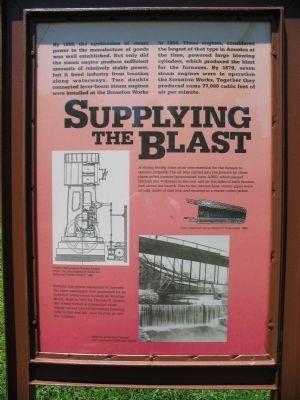
Photographed by Craig Swain, July 25, 2008
1. Supplying the Blast Marker
A strong steady blast of air was essential for the furnace to operate properly. The air was carried into the furnace by three pipes called tuyeres (pronounced twee AIRS), which passed through the archways in the rear and on the sides of each furnace, just above the hearth. Due to the intense heat, tuyere pipes were usually made of cast iron and encased in a water cooled jacket.
Initially, the power necessary to operate the blast machinery was generated by an overshot whaterwheel located on Roaring Brook. Built in 1841 by Thomas
this page online
Topics. This historical marker is listed in this topic list: Industry & Commerce. A significant historical year for this entry is 1850.
Location. 41° 24.237′ N, 75° 39.775′ W. Marker is in Scranton, Pennsylvania, in Lackawanna County. It can be reached from the intersection of Cedar Avenue and Mattes Avenue, on the right when traveling north. Located at the Scranton's Iron Furnace Park. Touch for map. Marker is in this post office area: Scranton PA 18505, United States of America. Touch for directions.

Regionally, this marker is in the Wyoming Valley. It is also in the American Northeast, in the Mid-Atlantic, in Appalachia, and specifically in Northern Appalachia. Globally, it is in North America, the Western Hemisphere, the Western World, and the Anglosphere. Historically, it finds itself in what was once the Haudenosaunee (Iroquois) Confederacy and also one of the original Thirteen Colonies.
Other nearby markers. At least 8 other markers are within walking distance of this marker:
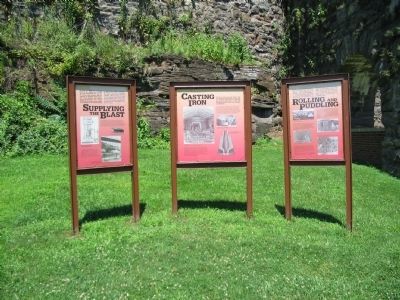
Photographed by Craig Swain, July 25, 2008
2. Trio of Markers at the Base of the Furnaces
More about this marker. On the left side of the marker is a drawing of a States High pressure Blowing Engine. Below a drawing of a tuyeres is a photo of the Whaterfall at the Blast Furnace.
Also see . . . Extracting iron from iron ore using a Blast Furnace. The technical and chemical side of iron and steel making. (Submitted on August 21, 2008, by Craig Swain of Leesburg, Virginia.)
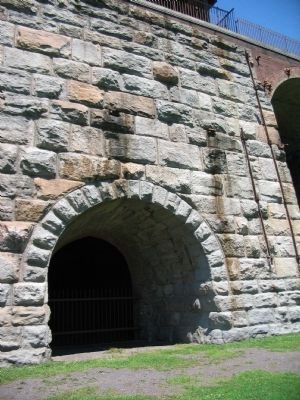
Photographed by Craig Swain, July 25, 2008
3. Archways for the Blast Equipment
Credits. This page was last revised on June 16, 2016. It was originally submitted on August 21, 2008, by Craig Swain of Leesburg, Virginia. This page has been viewed 1,238 times since then and 21 times this year. Photos: 1, 2, 3. submitted on August 21, 2008, by Craig Swain of Leesburg, Virginia.
