Saginaw in Saginaw County, Michigan — The American Midwest (Great Lakes)
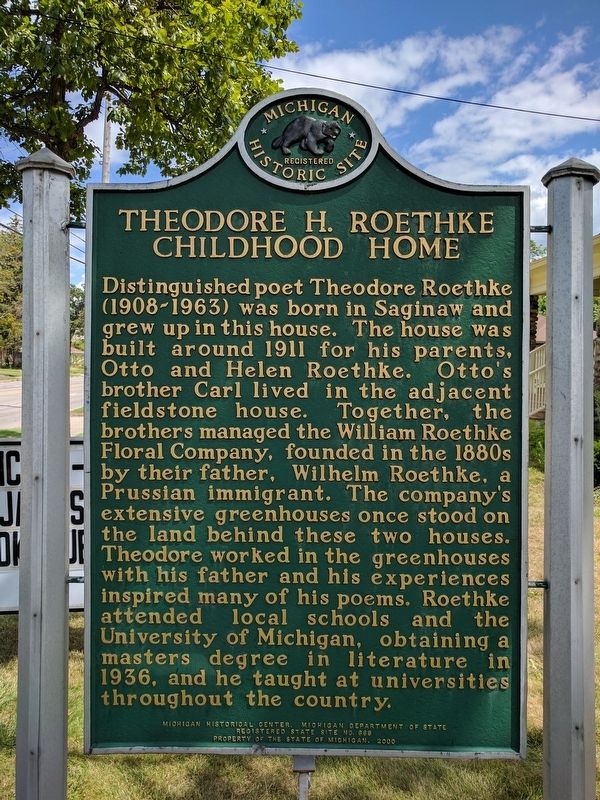
Theodore H. Roethke Childhood Home
⎯⎯⎯
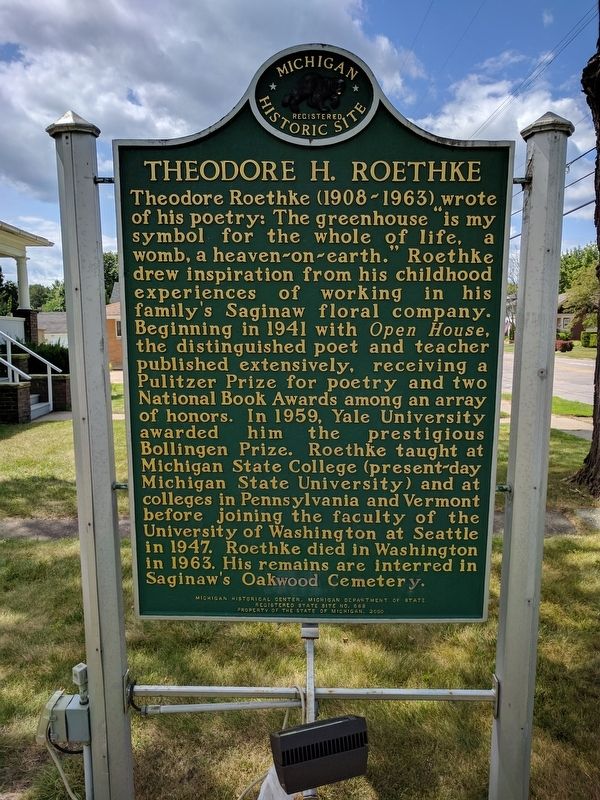
Theodore H. Roethke
Photographed by Joel Seewald, August 5, 2017
1. Theodore H. Roethke Childhood Home Marker (Side 1)
this page online
Erected 2000 by Michigan Historical Center, Michigan Department of State. (Marker Number S669.)
Topics and series. This historical marker is listed in this topic list: Arts, Letters, Music. In addition, it is included in the Michigan Historical Commission series list. A significant historical year for this entry is 1911.
Location. 43° 24.896′ N, 83° 59.244′ W. Marker is in Saginaw, Michigan, in Saginaw County. It is at the intersection of Gratiot Avenue (State Highway 46) and Post Street, on the left when traveling west on Gratiot Avenue. Touch for map. Marker is at or near this postal address: 1805 Gratiot Avenue, Saginaw MI 48602, United States of America. Touch for directions.

Regionally, this marker is in
Photographed by Joel Seewald, August 5, 2017
2. Theodore H. Roethke Marker (Side 2)
Other nearby markers. At least 8 other markers are within 2 miles of this marker, measured as the crow flies: First Presbyterian Church (approx. 1.1 miles away); A Memorial to Christopher Columbus (approx. 1.1 miles away); Wartburg College (approx. 1.1 miles away); Saginaw County Memorial (approx. 1.1 miles away); Veterans Memorial (approx. 1.1 miles away); Saginaw Valley Lumbering Era (approx. 1.2 miles away); Saginaw County Veterans Memorial (approx. 1.2 miles away); Fred J. Borchard Park (approx. 1.2 miles away). Touch for a list and map of all markers in Saginaw.
Also see . . .
1. Theodore Roethke Museum. (Submitted on August 7, 2017, by Joel Seewald of Madison Heights, Michigan.)
2. Theodore Roethke. Article about the poet and his works on the Poetry Foundation's website. Includes some of his poetry. (Submitted on August 7, 2017, by Joel Seewald of Madison Heights, Michigan.)
3. Theodore Roethke.
Photographed by Joel Seewald, August 5, 2017
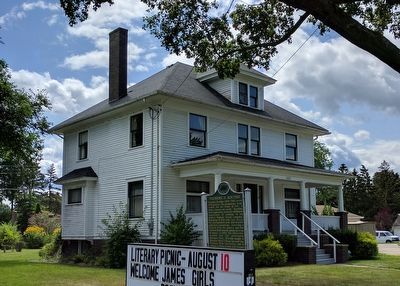
3. Theodore H. Roethke Marker and Home
4. Roethke Houses. The Roethke Houses were placed on the National Register of Historic Places in 2001. From the Nomination Form:
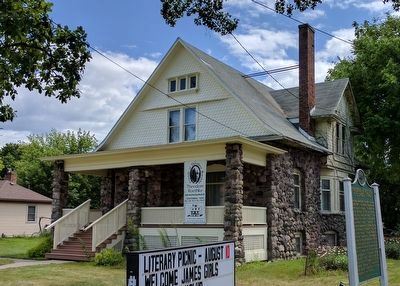
The Roethke Houses were built as the homes of Charles (Carl) and Otto Roethke, partners in the William Roethke Floral Company established by their father, William (Wilhelm) Roethke. Roethke Floral, with its twenty-acre grounds on which these houses fronted and its large greenhouse complex and two retail stores, was a large and thriving florist business in Saginaw in the late nineteenth and early twentieth centuries. The Roethkes are representative of families of Germanic ethnic background, largely from Pomerania and Mecklenburg, who formed an important component of the Germanic migration into the Saginaw area in the nineteenth century that gave the area a substantial population of Germanic heritage that it retains today. Their houses- the one a symmetrical-front, hip-roof Colonial and the other a Shingle Style building with lower walls of uncoursed fieldstone - are representative of substantial middle-class(Submitted on July 17, 2025, by Joel Seewald of Madison Heights, Michigan.)single-family early twentieth-century houses in Saginaw. Finally, the Otto Roethke House also possesses historic significance as the childhood home of Theodore H. Roethke, one of the leading American poets of the twentieth century. Roethke's poetry dates from his years in Pennsylvania, Vermont, and Washington after he left Saginaw, but the poet's experiences in the family greenhouses and with the people and environment of the city of Saginaw figure prominently in the imagery and content of his poetry. Roethke's youthful years were an important influence on his poetry, and Roethke himself maintained ties with the community throughout his life and, following his death in 1963, was buried in the city's Oakwood Cemetery...Photographed by Joel Seewald, August 5, 20174. Theodore H. Roethke Childhood Home Marker and Otto's Home
The house at 1805 Gratiot is important in relation to Theodore Roethke in that, while it was not !he poet's home during his productive years as a poet, it was Roethke's home during his youthful years. During his childhood, while living there, Roethke spent much of his time in the family's greenhouses, assisting his father and his uncle and observing and learning about plants. Roethke said, in an essay, "An American Poet Introduces Himself to His Poems," written while at the University of Washington, "...The greenhouses themselves were to me,...I realize now, both heaven and hell, a kind of tropics created in the savage climate of Michigan, where austere German-Americans turned their love of order and their terrifying efficiency into something truly beautiful." Theodore Roethke himself, as well as the poet's biographers and literary critics, agreed that Roethke's experiences in the greenhouses and greenhouse business, the family property, and with his father, who died when Theodore was a youth, figured prominently in the imagery and content of his poems
Credits. This page was last revised on July 17, 2025. It was originally submitted on August 7, 2017, by Joel Seewald of Madison Heights, Michigan. This page has been viewed 734 times since then and 76 times this year. Photos: 1, 2, 3, 4. submitted on August 7, 2017, by Joel Seewald of Madison Heights, Michigan.
