
Fort Myers in Lee County, Florida — The American South (South Atlantic)
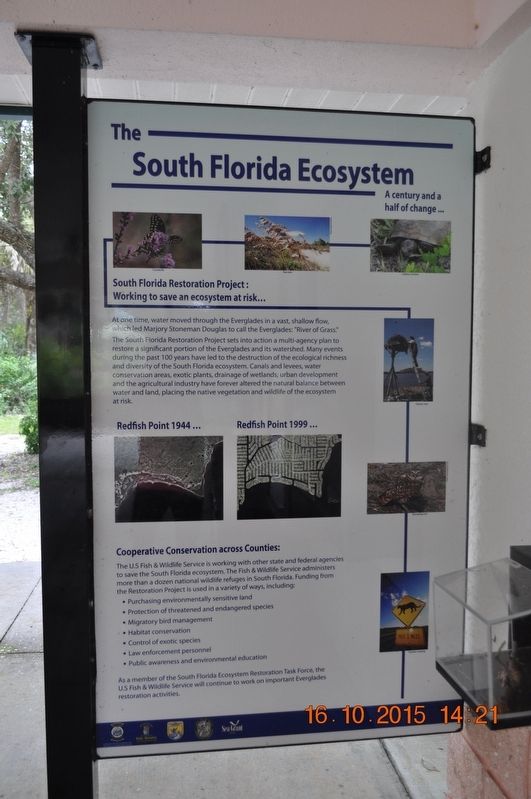
The South Florida Ecosystem
A century and a half of change…
Photographed by Sandra Hughes, October 16, 2015
1. The South Florida Ecosystem Marker
South Florida Restoration Project:
Working to save an ecosystem at risk…
At one time, water moved through the Everglades in vast, shallow flow, which led Marjory Stoneman Douglas to call the Everglades: “River of Grass.”
The South Florida Restoration Projects sets into action a multi-agency plan to restore a significant portion of the Everglades and its watershed. Many events during the past 100 years have led to the destruction of the ecological richness and diversity of South Florida ecosystem. Canals and levees, water conversation areas, exotic plants, drainage of wetlands, urban development and the agricultural industry have forever altered the natural balance between water and land, placing the native vegetation and wildlife of the ecosystem at risk.
Redfish Point 1944…
Redfish Point 1999…
Cooperative Conversation across Counties:
The U. S. Fish & Wildlife Services is working with other states and federal agencies to save the South Florida ecosystem. The Fish & Wildlife Service administers more than a dozen national wildlife refuges in South Florida. Funding from the Restoration Project is used in a variety of ways, including :
• Purchasing environmentally sensitive land
• Protection of threatened and endangered species
• Migratory bird management
• Habitat conservation
• Control of exotic species
• Law enforcement personnel
• Public awareness and environmental education
As a member of the South Florida Ecosystem Restoration Task Force, the U.S. Fish & Wildlife Service will continue to work on important Everglades restoration activities.
Topics. This historical marker is listed in these topic lists: Animals • Environment.
Location. 26° 41.59′ N, 81° 46.654′ W. Marker is in Fort Myers, Florida, in Lee
this page online

Regionally, this marker is on Florida’s Gulf Coast. It is also in the American South and on the Gulf Coast. Globally, it is in the North Atlantic Region, North America, a Gulf of Mexico state, the Western Hemisphere, the Western World, and the Anglosphere. Historically, it finds itself in what was once New Spain, the territory of the Mississippian Culture, one of the Confederate States of America, and the Antebellum South.
Other nearby markers. At least 8 other markers are within walking distance of this marker: Explore Southwest Florida Naturally! (here, next to this marker); The Florida Manatee (here, next to this marker); Why do Manatees Come to Manatee Park ? (here, next to this marker); Other Visitors to Manatee Park (here, next to this marker); Freshwater Wetlands Habitat (here, next to this marker); The Anatomy of a Manatee (here, next to this marker); The Manatee-Human Comparison (here,
Photographed by Allen C. Browne, January 31, 2019
2. Marjory Stoneman Douglas
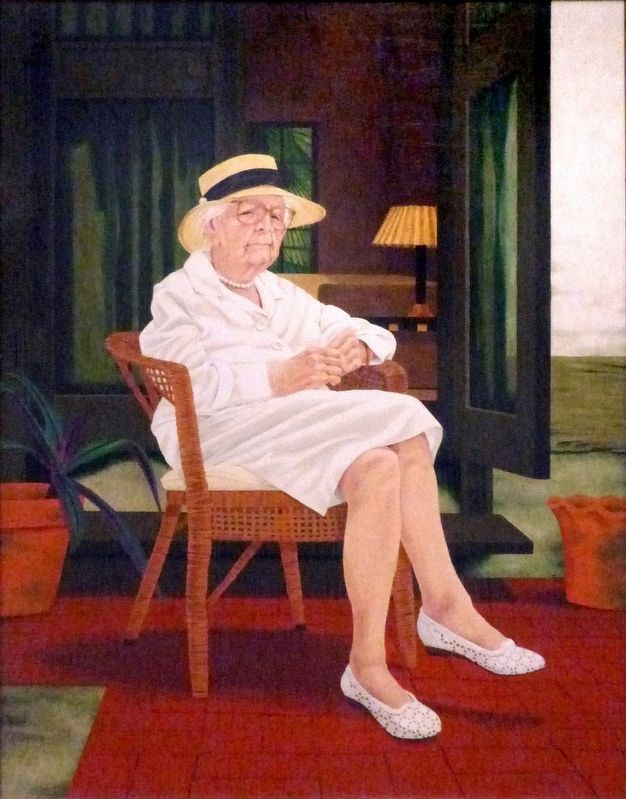
This 1993 portrait of Marjory Stoneman Douglas by Menden Hall hangs in the National Portrait Gallery in Washington, DC.
“By the time she was fifty, Marjory Stoneman Douglas could look back on a career that included working as a reporter, columnist, and editor for the Miami Herald, and as a successful short-story writer. But her most significant work began in the mid-1940s, when she wrote a transformational book on the Florida Everglades. The Everglades: River of Grass (1947) became an instant best-seller, calling attention to the ecological importance of this vast expanse of water and wildlife, and the irresponsibility of those who wanted to destroy it. Years later, Douglas's passion for saving the Everglades also led her to found the Friends of the Everglades, which grew into a major force in the campaign to protect the area's natural integrity against a host of human-created abuses. In 1993, President Bill Clinton awarded Douglas the Presidential Medal of Freedom. This portrait was painted in her cottage in Coconut Grove.” – National Portrait Gallery
“By the time she was fifty, Marjory Stoneman Douglas could look back on a career that included working as a reporter, columnist, and editor for the Miami Herald, and as a successful short-story writer. But her most significant work began in the mid-1940s, when she wrote a transformational book on the Florida Everglades. The Everglades: River of Grass (1947) became an instant best-seller, calling attention to the ecological importance of this vast expanse of water and wildlife, and the irresponsibility of those who wanted to destroy it. Years later, Douglas's passion for saving the Everglades also led her to found the Friends of the Everglades, which grew into a major force in the campaign to protect the area's natural integrity against a host of human-created abuses. In 1993, President Bill Clinton awarded Douglas the Presidential Medal of Freedom. This portrait was painted in her cottage in Coconut Grove.” – National Portrait Gallery
Credits. This page was last revised on February 4, 2019. It was originally submitted on August 7, 2017, by Sandra Hughes Tidwell of Killen, Alabama, USA. This page has been viewed 388 times since then and 20 times this year. Photos: 1. submitted on August 7, 2017, by Sandra Hughes Tidwell of Killen, Alabama, USA. 2. submitted on February 4, 2019, by Allen C. Browne of Silver Spring, Maryland. • Bill Pfingsten was the editor who published this page.
