Luxor, Luxor Governorate, Egypt — مصر (Northeast Africa)
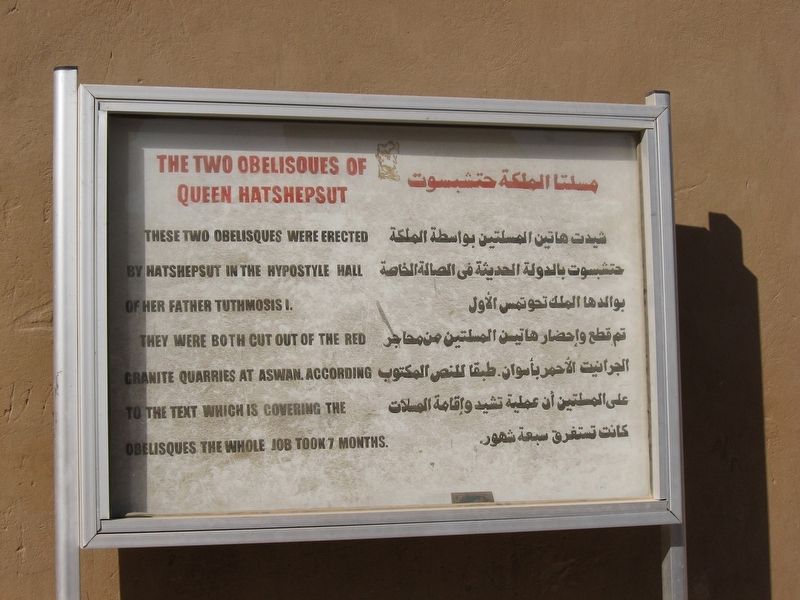
The Two Obelisques Of Queen Hatshepsut
Photographed by Brandon D Cross, September 7, 2007
1. The Two Obelisques Of Queen Hatshepsut Marker
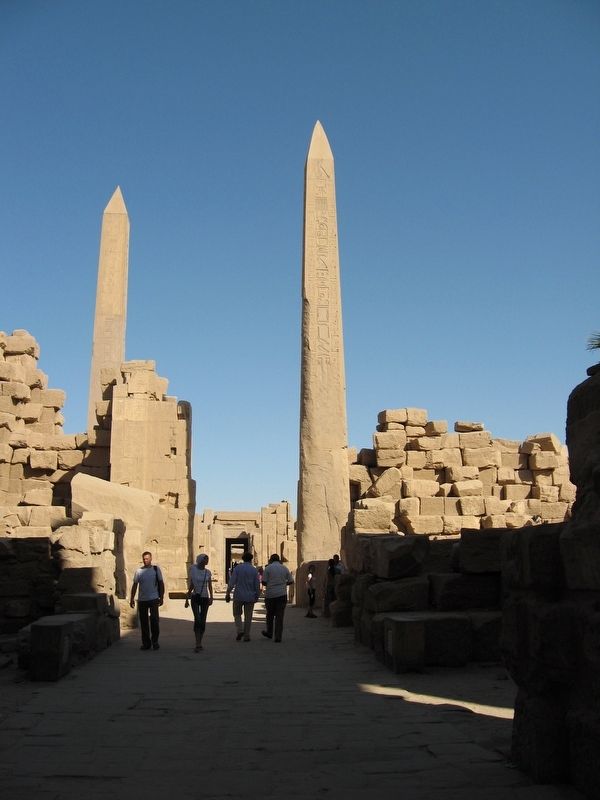
They were both cut out of red granite quarries at Aswan. According to the text which is covering the obelisques the whole job took 7 months.
Topics. This historical marker is listed in this topic list: Notable Buildings.
Location. 25° 43.117′ N, 32° 39.517′ E. Marker is in Luxor, Luxor Governorate. It can be reached from Tariaq Bedon Esm. Located next to the Temple of Amon in the Karnak Complex, Luxor, Egypt. Touch for map. Touch for directions.

Regionally, it is in Africa, specifically in North Africa, in the Middle East, on the Red Sea, and in a coastal Mediterranean country. Historically, it finds itself in what was once the Byzantine Empire, the Ottoman Empire, a British colony, and the Roman Empire.
Other nearby markers. At least 8 other markers are within 3 kilometers of this marker, measured as the crow flies: Wadjyt / Ouadjyt (within shouting distance of this marker); Courtyard of the Third Pylon / Cour du IIIᵉᵐᵉ Pylône (within shouting
this page online
More about this marker. The GPS coordinates provided are general to the temple complex.
Also see . . .
1. Hatshepsut (Wikipedia). Hatshepsut ( also Hatchepsut; meaning Foremost of Noble Ladies; 1507–1458 BCE) was the fifth pharaoh of the Eighteenth Dynasty of Egypt. She was the second historically confirmed female pharaoh, the first being Sobekneferu. (Various other women may have also ruled as pharaohs regnant or at least regents before Hatshepsut, as early as Neithhotep around 1600 years prior.) Hatshepsut came to the throne of Egypt in 1478 BCE. Officially, she ruled jointly with Thutmose III, who had ascended to the throne the previous year as a child of about two years old. Hatshepsut was the chief wife of Thutmose II, Thutmose III’s father. She is generally regarded by Egyptologists as one of the most successful pharaohs, reigning longer than any other woman of an indigenous Egyptian dynasty. According to Egyptologist James Henry Breasted she is also known as "the first great woman in history of whom we are informed."
Photographed by Brandon D Cross, September 7, 2007
2. The Two Obelisques Of Queen Hatshepsut
2. A World of Obelisks (NOVA Online / PBS). (Submitted on August 9, 2017.)
Photographed by Antonio Beate, circa 1890
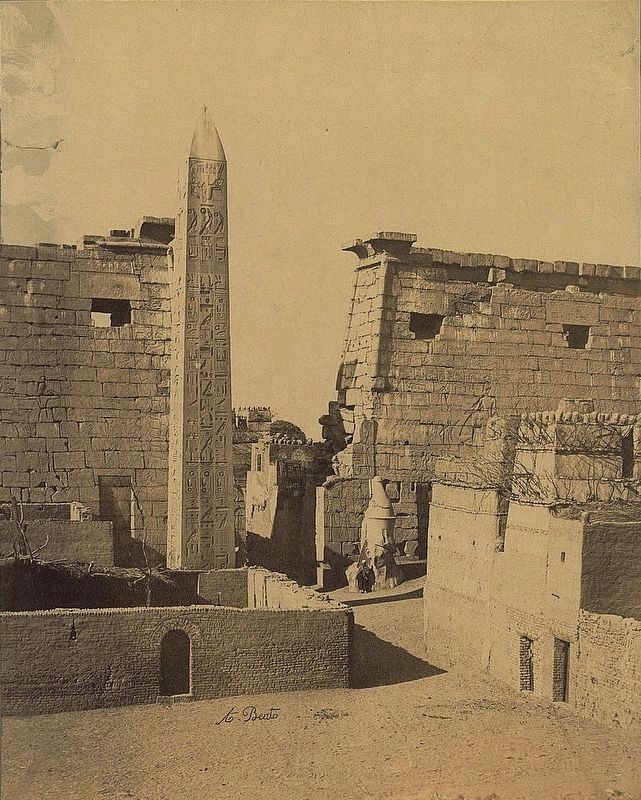
3. Pylons and obelisk, Thebes (Luxor), Egypt
Photograph courtesy of the Library of Congress.
Credits. This page was last revised on November 15, 2025. It was originally submitted on August 8, 2017, by Brandon D Cross of Flagler Beach, Florida. This page has been viewed 1,127 times since then and 72 times this year. Photos: 1, 2. submitted on August 8, 2017, by Brandon D Cross of Flagler Beach, Florida. 3. submitted on August 9, 2017. • Andrew Ruppenstein was the editor who published this page.
