
Near New Kent in New Kent County, Virginia — The American South (Mid-Atlantic)
French Cannon at Cumberland Landing
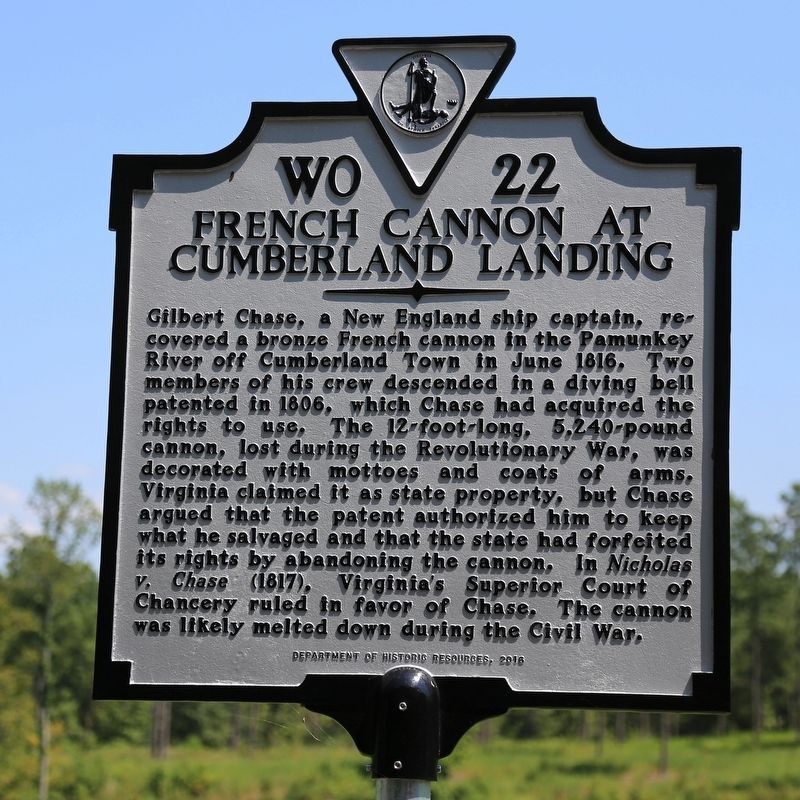
Photographed by J. J. Prats, August 20, 2017
1. French Cannon at Cumberland Landing Marker
Erected 2016 by Department of Historic Resources. (Marker Number WO-22.)
Topics and series. This historical marker is listed in this topic list: War, US Revolutionary. In addition, it is included in the Virginia Department of Historic Resources (DHR) series list. A significant historical year for this entry is 1816.
Location. 37° 32.171′ N, 76° 58.774′ W. Marker is near New Kent, Virginia, in New Kent County. It is on Cumberland Road (County Route
this page online

Regionally, this marker is on Virginia’s Peninsula and in Coastal Virginia. It is also in the American South, specifically in the Upper South, in the Tidewater, and on the Eastern Seaboard. Globally, it is in the North Atlantic Region, North America, the Western Hemisphere, the Western World, and the Anglosphere. Historically, it finds itself in what was once the territory of the Mississippian Culture, one of the original Thirteen Colonies, one of the Confederate States of America, and the Antebellum South.
Other nearby markers. At least 8 other markers are within walking distance of this marker: McClellan’s Camp at Cumberland Landing (here, next to this marker); Cumberland Town (a few steps from this marker); A River in View (approx. 0.3 miles away); Harriet Tubman (approx. 0.3 miles away); Cumberland House During the Civil War (approx. 0.3 miles away); Earliest History of Cumberland Plantation (approx.
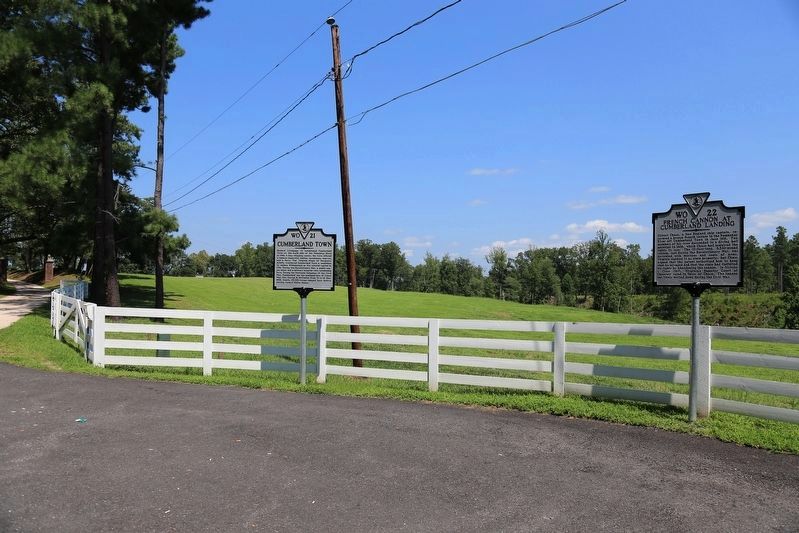
Photographed by J. J. Prats, August 20, 2017
2. Cumberland Town and French Cannon at Cumberland Landing Markers
Also see . . . Nicholas v Chase & the Diving Bell of Richard Tripe. “The case of Nicholas v. Chase was certainly a historic case if not a precedential one. This was one of the first recorded salvage case in the United States outside of the admiralty court. Although the cannon was arrested by a federal marshal, Virginia chose to litigate in their own Superior Court of Chancery.”
“The court ruled that that the cannon was never the property of the state. Evidence had been submitted that the cannon at the State Armory were cannon imported on the French ship and were clearly property o f the state. Apparently the court determined that while the cannon were on board the sloop, they were still property of France. Since the subject cannon was never landed onto Virginia soil, Virginia never took title. The cannon were not delivered according to a contract but were a gift from France. This gift could have been recalled at anytime before delivery. It can easily be inferred now that the cannon on the bottom of the Pamunkey either still belonged to France or was considered abandoned and belonged to no one, even though it lay partially embedded in the submerged lands of the Commonwealth of Virginia for thirty-six years.” (Submitted on August 23, 2017.)
Credits. This page was last revised on August 23, 2017. It was originally submitted on August 23, 2017, by J. J. Prats of Powell, Ohio. This page has been viewed 736 times since then and 54 times this year. Photos: 1, 2. submitted on August 23, 2017, by J. J. Prats of Powell, Ohio.
