Bruce in Calhoun County, Mississippi — The American South (East South Central)
Calhoun County Blues
| — | Mississippi Blues Trail | — |
Photographed by Mark Hilton, August 25, 2017
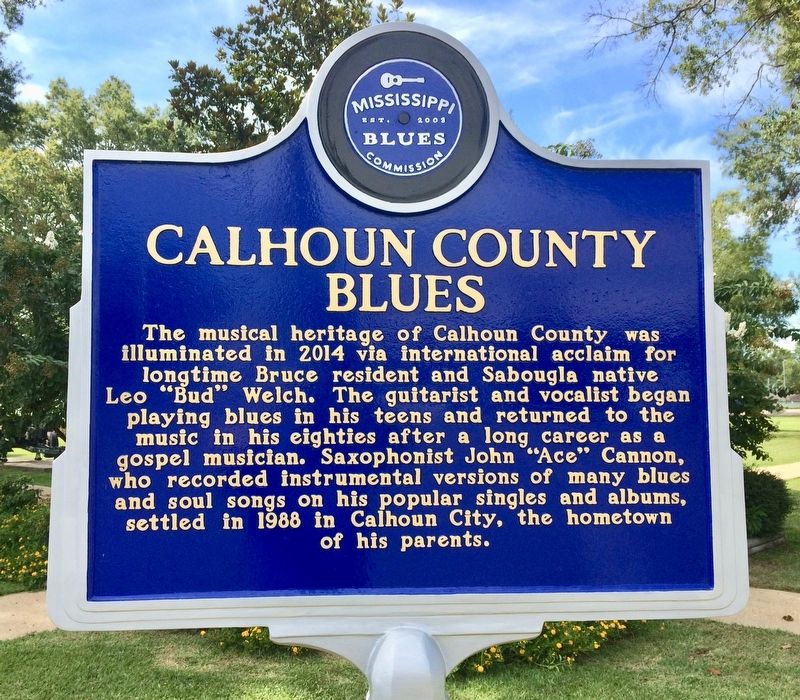
1. Calhoun County Blues Marker (Front)
Front
The musical heritage of Calhoun County was illuminated in 2014 via international acclaim for longtime Bruce resident and Sabougla native Leo “Bud” Welch, The guitarist and vocalist began playing blues in his teens and returned to the music in his 80s after a long career as a gospel musician. Saxophonist John “Ace” Cannon, whose many instrumental singles and albums featured blues and soul songs, settled in 1988 in Calhoun City, the hometown of his parents.
Rear
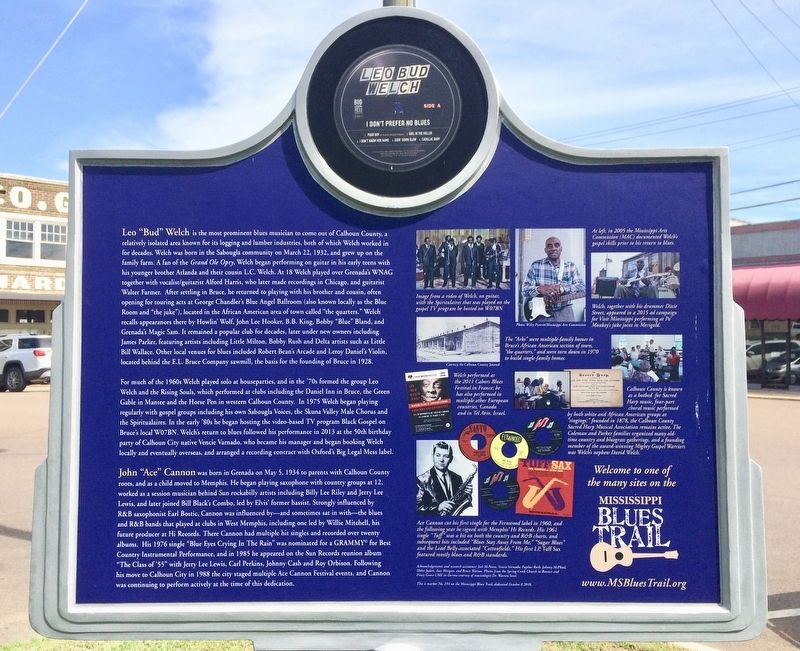
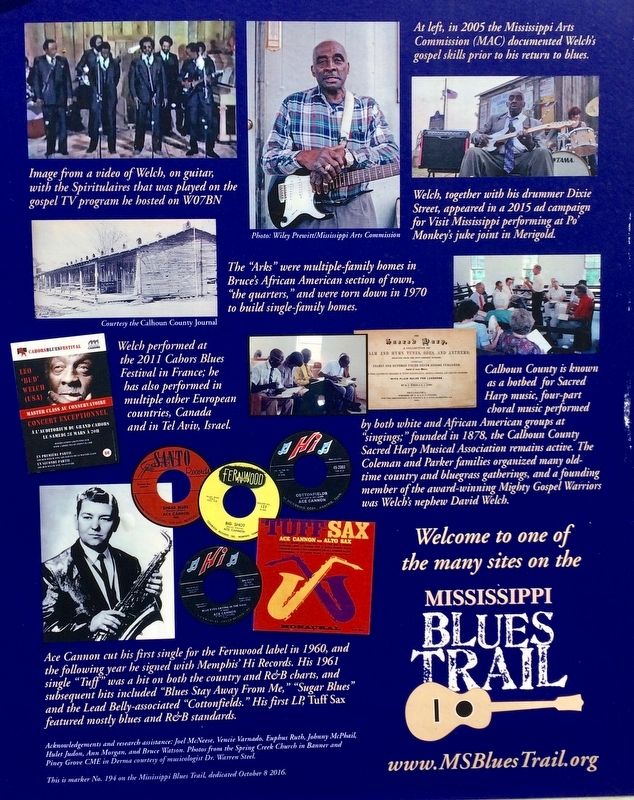
Leo “Bud” Welch is the most prominent blues musician to come out of Calhoun County, a relatively isolated area known for its logging and lumber industries, both of which Welch worked in for decades. Welch was born in the Sabougla community on March 22, 1932, and grew up on the family farm. A fan of the Grand Ole Opry, Welch began performing on guitar in his early teens with his younger brother Arlanda and their cousin L.C. Welch. At 18 Welch played over Grenada’s WNAG together with vocalist/guitarist Alford Harris, who later made recordings in Chicago, and guitarist Walter Farmer. After settling in Bruce, he returned to playing with his brother and cousin,
this page online
For much of the 1960s Welch played solo at houseparties, and in the ’70s formed the group Leo Welch and the Rising Souls, which performed at clubs including the Daniel Inn in Bruce, the Green Gable in Mantee and the Horse Pen in western Calhoun County. In 1975 Welch began playing regularly with gospel groups including his own Sabougla Voices, the Skuna Valley Male Chorus and the Spiritualaires. In the early ’80s he began hosting the video-based TV program Black
Photographed by Mark Hilton, August 25, 2017
2. Calhoun County Blues Marker (Rear)
John “Ace” Cannon was born in Grenada on May 5, 1934 to parents with Calhoun County roots, and as a child moved to Memphis. He began playing saxophone with country groups at 12, worked as a session musician behind Sun rockabilly artists including Billy Lee Riley and Jerry Lee Lewis, and later joined Bill Black’s Combo, led by Elvis’ former bassist. Strongly influenced by R&B saxophonist Earl Bostic, Cannon was influenced by—and sometimes sat in with—the blues and R&B bands that played at clubs in West Memphis, including one led by Willie Mitchell, his future producer at Hi Records. There Cannon had multiple hit singles and recorded over twenty albums. His 1976 single “Blue Eyes Crying In The Rain” was nominated for a GRAMMY® for Best Country Instrumental Performance, and in 1985 he appeared on the Sun Records reunion album “The Class
Photographed by Mark Hilton, August 25, 2017
3. Photos on rear of marker.
Erected 2016 by the Mississippi Blues Commission. (Marker Number 194.)
Topics and series. This historical marker is listed in these topic lists: African Americans • Arts, Letters, Music • Entertainment. In addition, it is included in the Mississippi Blues Trail series list. A significant historical date for this entry is March 22, 1932.
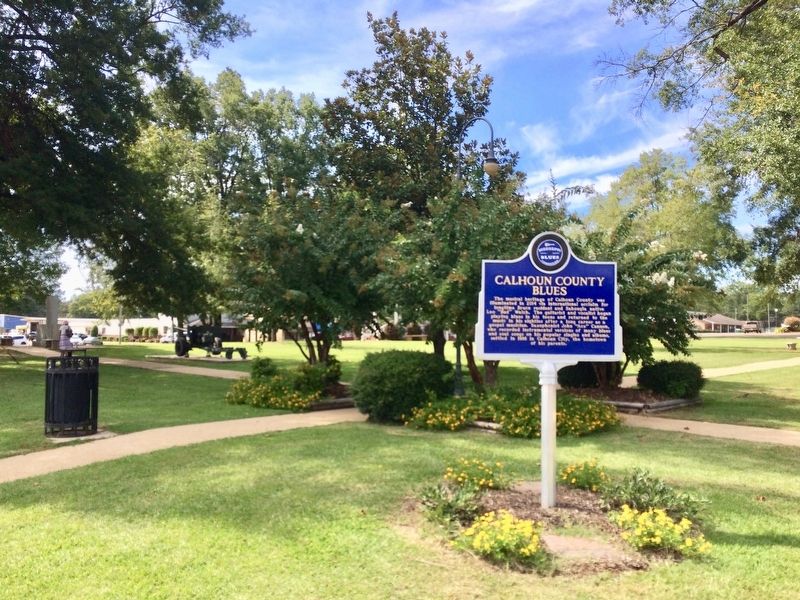
Location. 33° 59.46′ N, 89° 20.799′ W. Marker is in Bruce, Mississippi, in Calhoun County. It is on Public Square east of South Newberger Avenue, on the left when traveling east. Touch for map. Marker is in this post office area: Bruce MS 38915, United States of America. Touch for directions.

Regionally, this marker is in the North Mississippi Hills. It is also in the American South and specifically in the Deep South. Globally, it is in North America, a Gulf of Mexico state, the Western Hemisphere, the Western World, and the Anglosphere. Historically,
Photographed by Mark Hilton, August 25, 2017
4. View of Calhoun County Blues marker in the Public Square.
Other nearby markers. At least 7 other markers are within 17 miles of this marker, measured as the crow flies: Calhoun County War Memorial (within shouting distance of this marker); Thomas T. Gore (approx. 9.6 miles away); Calhoun County Veterans Monument (approx. 9.6 miles away); Theora Hamblett (approx. 14.9 miles away); Salmon Cemetery (approx. 16 miles away); a different marker also named Salmon Cemetery (approx. 16 miles away); Randolph School (approx. 16.6 miles away).
Also see . . . Wikipedia article on Ace Cannon. (Submitted on August 29, 2017, by Mark Hilton of Montgomery, Alabama.)
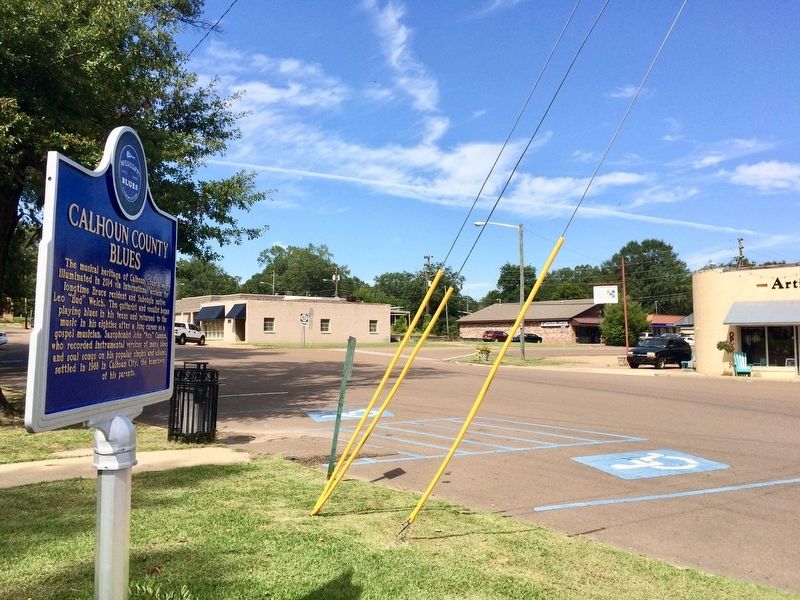
Photographed by Mark Hilton, August 25, 2017
5. The view northeasterly towards East Calhoun Street.
Credits. This page was last revised on July 31, 2023. It was originally submitted on August 29, 2017, by Mark Hilton of Montgomery, Alabama. This page has been viewed 414 times since then and 34 times this year. Photos: 1, 2, 3, 4, 5. submitted on August 29, 2017, by Mark Hilton of Montgomery, Alabama.
