Jackson in Jackson County, Ohio — The American Midwest (Great Lakes)
Jackson
Morgan's Raiders: "The Scum of the South"
| — | John Hunt Morgan Heritage Trail | — |
Photographed by Mark Hilton, September 9, 2017
1. Jackson Marker
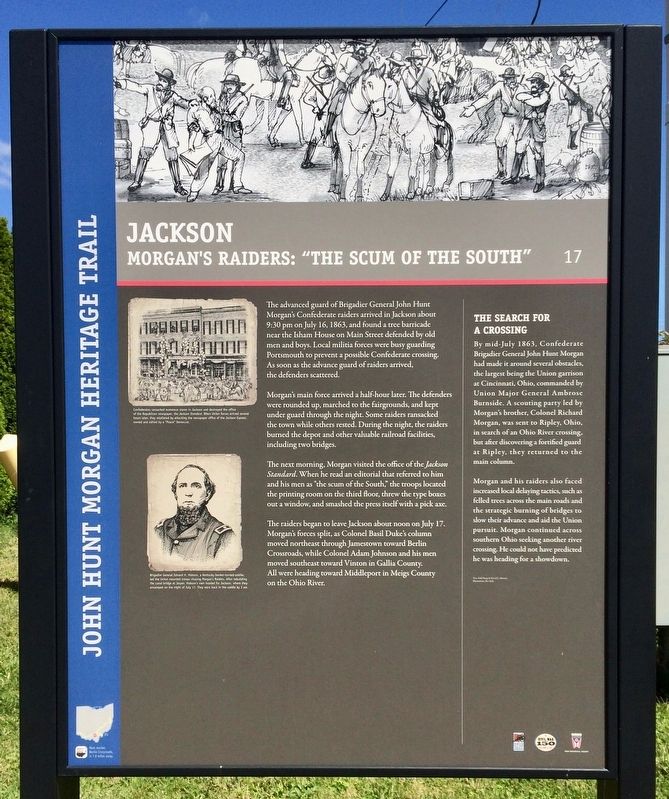
Morgan's main force arrived a half-hour later. The defenders were rounded up, marched to the fairgrounds, and kept under guard through the night. Some raiders ransacked the town while others rested. During the night, the raiders burned the depot and other valuable railroad facilities including two bridges.
The next morning, Morgan visited the office of the Jackson Standard. When he read an editorial that referred to him and his men as "the scum of the South," the troops located the printing room on the third floor, threw the type boxes out a window, and smashed the press itself with a pick axe.
The raiders began to leave Jackson about noon on July 17. Morgan's forces split, as Colonel Basil Duke's column moved
this page online
The Search for a Crossing
By mid-July 1863, Confederate Brigadier General John Hunt Morgan had made it around several obstacles, the largest being the Union garrison at Cincinnati, Ohio, commanded by Union Major General Ambrose Burnside. A scouting party led by Morgan's brother, Colonel Richard Morgan, was sent to Ripley, Ohio, in search of an Ohio River crossing, but after discovering a fortified guard at Ripley, they returned to the main column.
Morgan and his raiders also faced increased local delaying tactics, such as felled trees across the main roads and the strategic burning of bridges to slow their advance and aid the Union pursuit. Morgan continued across southern Ohio seeking another river crossing He could not have predicted he was heading for a showdown.
[Photo captions]
Top left: Confederates ransacked numerous stores in Jackson and destroyed the office of the Republican newspaper, the Jackson Standard. When Union forces arrived several hours later, they retaliated by attacking the newspaper office of the Jackson Express, owned and edited by a "Peace" Democrat.
Bottom left: Brigadier General Edward H. Hobson, a Kentucky banker-turned-soldier, led the Union mounted troops chasing Morgan's Raiders. After rebuilding the canal bridge at Jasper, Hobson's men headed for Jackson, where they encamped on the night of July 17. They were back in the saddle by 3 am.
Text: Edd Sharp & David L. Mowery
Illustrations: Bev Kirk
Erected 2013
Photographed by Mark Hilton, September 9, 2017
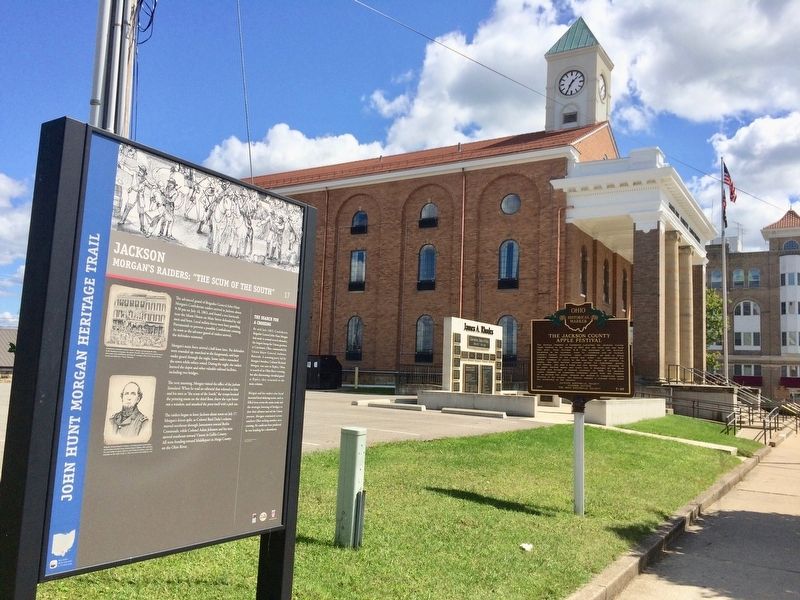
2. Jackson Marker near Jackson County Courthouse.
Topics and series. This historical marker is listed in these topic lists: Bridges & Viaducts • War, US Civil. In addition, it is included in the John Hunt Morgan Heritage Trail in Ohio series list. A significant historical date for this entry is July 16, 1863.
Location. 39° 3.154′ N, 82° 38.252′ W. Marker is in Jackson, Ohio, in Jackson County. It is on East Main Street (Ohio Route 93) west of Broadway Street, on the right when traveling west. Located just to west of the Jackson County Courthouse. Touch for map. Marker is at or near this postal address: 200 East Main Street, Jackson OH 45640, United States of America. Touch for directions.

Regionally, this marker is in Southern Ohio Hill Country. It is also in the American Midwest, in Appalachia, and specifically in Northern Appalachia. Globally, it is in North America, the Western Hemisphere, the Western World, and the Anglosphere. Historically, it finds itself in what was once the Haudenosaunee (Iroquois) Confederacy, the territory of the Mississippian
Photographed by Mark Hilton, September 9, 2017
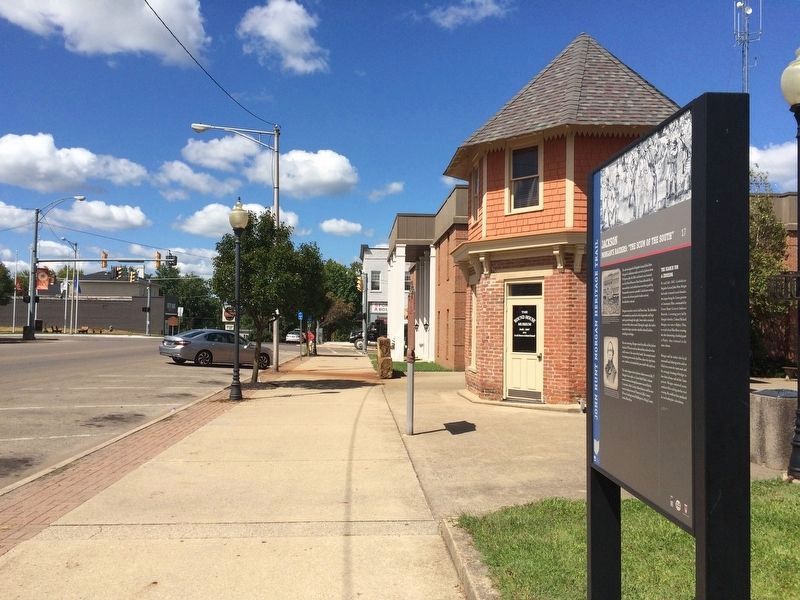
3. View west on Main Street.
Building next to marker is called the Round House Museum. The octagonal building was built in 1887, and the first floor was used for a scale house and the second floor for a bandstand. In the 1920's, the first floor became a hotdog stand and in 1937 it became a full restaurant, still with hotdogs being a popular item. The restaurant closed somewhere around 1950.
Other nearby markers. At least 8 other markers are within walking distance of this marker: Commercial Apple Orchards in Jackson County / The Jackson County Apple Festival (here, next to this marker); The Scioto Salt Licks / The Scioto Salt Works (a few steps from this marker); James A. Rhodes (a few steps from this marker); Jackson County Veterans Flagpole (within shouting distance of this marker); Jackson County 9-11 Memorial (within shouting distance of this marker); "Lest We Forget" (within shouting distance of this marker); Jackson County Veterans Memorial (within shouting distance of this marker); John Wesley Powell (1834-1902) / Morgan's Raid in Jackson, 1863 (within shouting distance of this marker). Touch for a list and map of all markers in Jackson.
Also see . . . Morgan's Raid. Excerpt:
Morgan's Raid (also the Calico Raid or Great Raid of 1863) was a diversionary incursion by Confederate cavalry into the Union states of Indiana, Kentucky, Ohio, and West Virginia during the American Civil War. The raid took place from June 11 to July 26, 1863. It is named for the commander of the Confederate troops, Brigadier General John Hunt Morgan. Although it caused temporary alarm in the North, the raid failed.(Submitted on April 27, 2025, by J.T. Lambrou of New Boston, Michigan.)
Credits. This page was last revised on April 27, 2025. It was originally submitted on September 13, 2017, by Mark Hilton of Montgomery, Alabama. This page has been viewed 1,293 times since then and 80 times this year. Photos: 1, 2, 3. submitted on September 13, 2017, by Mark Hilton of Montgomery, Alabama.
