Boston Theater District in Suffolk County, Massachusetts — The American Northeast (New England)
Poe Returning to Boston
Stefanie Rocknak, Sculptor
Photographed by Roger W. Sinnott, September 28, 2017
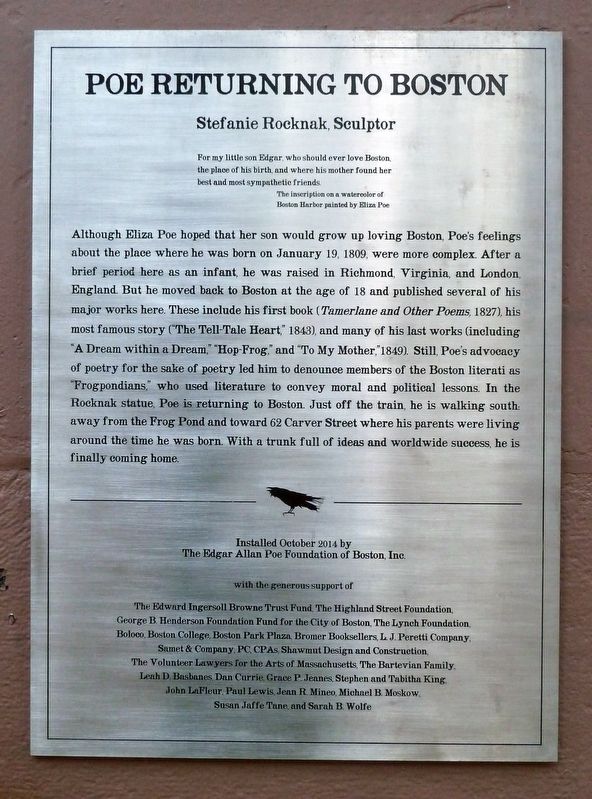
1. Poe Returning to Boston Marker
For my little son Edgar, who should ever love Boston, the place of his birth, and where his mother found her best and most sympathetic friends.
The inscription on a watercolor of Boston Harbor painted by Eliza Poe
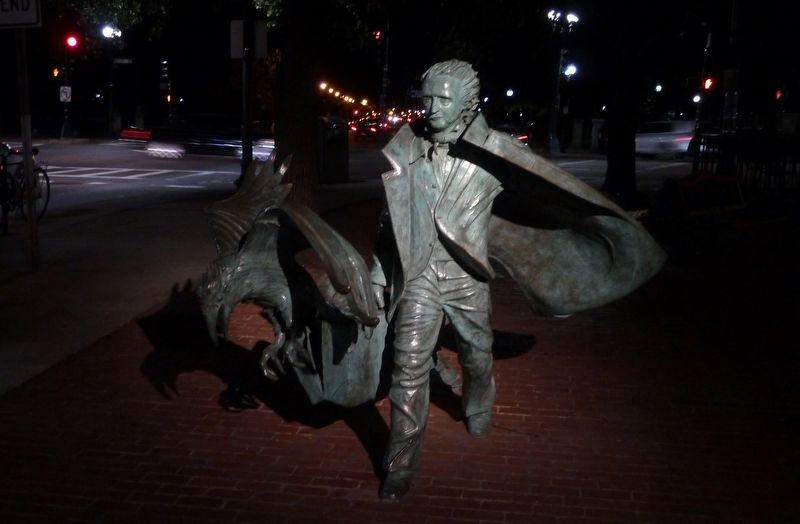
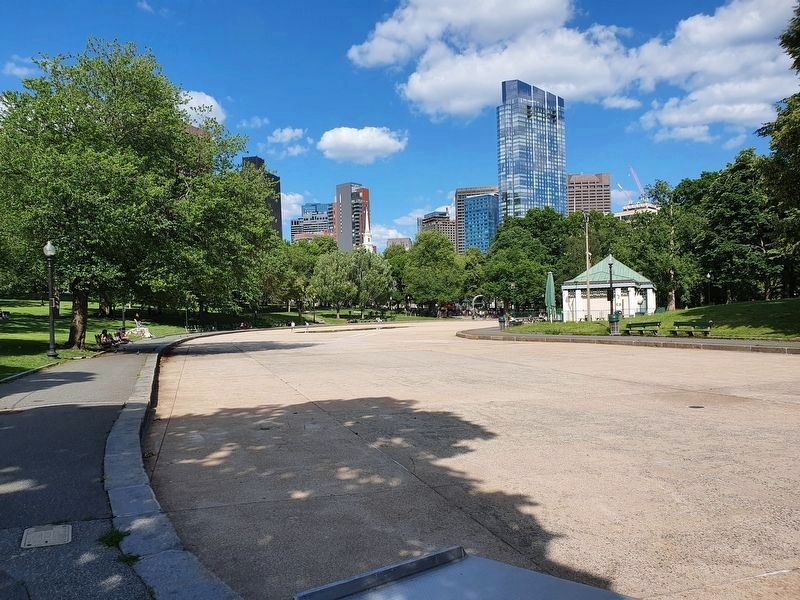
Although Eliza Poe hoped that her son would grow up loving Boston, Poe’s feelings about the place where he was born on January 19, 1809, were more complex. After a brief period here as an infant, he was raised in Richmond, Virginia, and London, England. But he moved back to Boston at the age of 18 and published several of his major works here. These include his first book (Tamerlane and Other Poems, 1827), his most famous story (“The Tell-Tale Heart,” 1843), and many of his last works (including “A Dream within a Dream,” “Hop-Frog,” and “To My Mother,” 1849). Still, Poe’s advocacy of poetry for the sake of poetry led him to denounce members of the Boston literati as “Frogpondians,” who used literature to convey moral and political lessons. In the Rocknak statue, Poe is returning to Boston. Just off the train, he is walking south away from the Frog Pond and toward 62 Carver Street where his parents were living
this page online
Installed October 2014 by The Edgar Allan Poe Foundation of Boston, Inc. with the generous support of the Edward Ingersoll Browne Trust Fund, the Highland Street Foundation, George B. Henderson Foundation Fund for the City of Boston, the Lynch Foundation, Boloco, Boston College, Boston Park Plaza, Bromer Booksellers, L. J. Peretti Company, Samet & Company, PC, CPAs, Shawmut Design and Construction, the Volunteer Lawyers for the Arts of Massachusetts, the Bartevian Family, Leah D. Basbanes, Dan Currie, Grace P. Jeanes, Stephen and Tabitha King, John LaFleur, Paul Lewis, Jean R. Mineo, Michael B. Moskow, Susan Jaffe Tane, and Sarah B. Wolfe
Erected 2014 by the Edgar Allan Poe Foundation of Boston, Inc.
Topics. This historical marker is listed in this topic list: Arts, Letters, Music.
Location. 42° 21.133′ N, 71° 4.033′ W. Marker is in Boston, Massachusetts, in Suffolk County. It is in the Boston Theater District. It is at the intersection of Charles Street South and Boylston
Photographed by Roger W. Sinnott, September 28, 2017
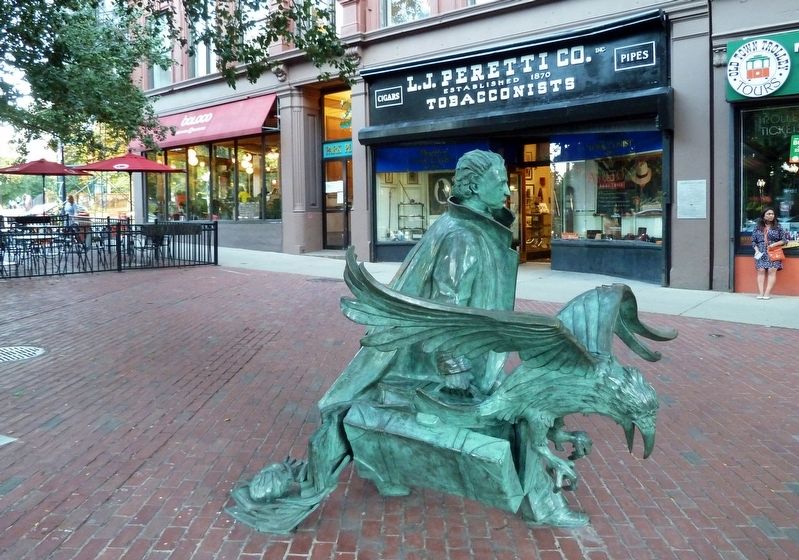
2. Side View of Poe Statue
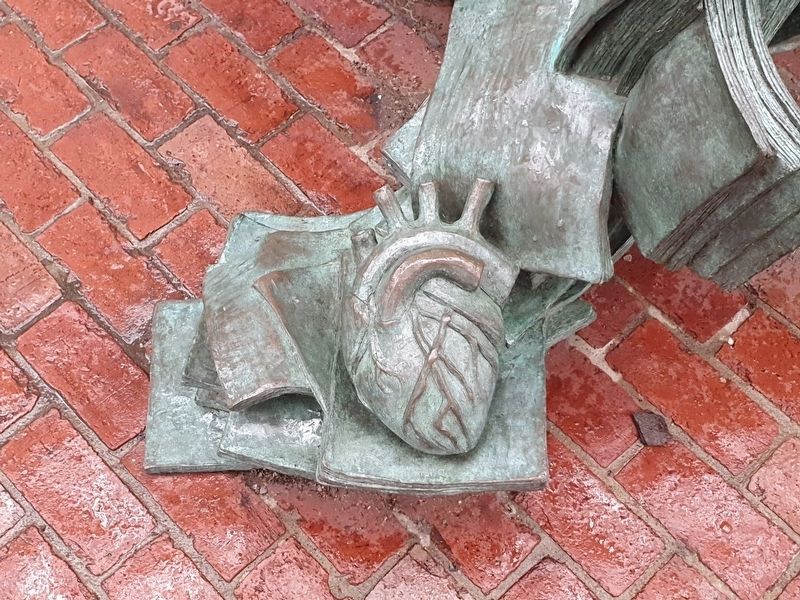
A raven accompanies Poe on his brisk walk, while a pile of manuscripts and a tell-tale heart appear to have fallen out of his trunk. The marker can be seen in the distance at right, mounted on the wall of L. J. Peretti Co., tobacconists.

Regionally, this marker is in Historic Boston. It is also in the American Northeast, in New England, and on the Eastern Seaboard. Globally, it is in the North Atlantic Region, North America, the Western Hemisphere, the Western World, and the Anglosphere. Historically, it finds itself in what was once one of the original Thirteen Colonies.
Other nearby markers. At least 8 other markers are within walking distance of this marker: Edgar Allan Poe (within shouting distance of this marker); 1893 (within shouting distance of this marker); Historical Development of Park Square (within shouting distance of this marker); Edward A. Filene (within shouting distance of this marker); Gilbert Stuart (within shouting distance of this marker); Emancipation Memorial (about 300 feet away, measured in a direct line); Wendell Phillips (about 300 feet away); William Billings
Photographed by Roger W. Sinnott, September 28, 2017
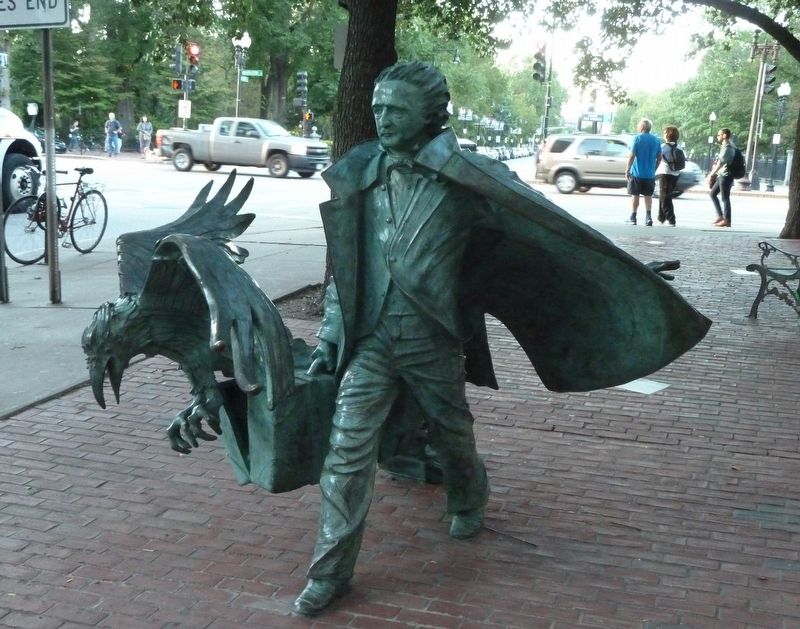
3. Front View of Poe Statue
Poe is walking south, away from the Boston Public Garden (in the background at left) and Boston Common (toward right).
Also see . . . Edgar Allan Poe Statue Finally Goes Up in Boston. Boston website entry (Submitted on April 12, 2022, by Larry Gertner of New York, New York.)
Photographed by Roger W. Sinnott, September 28, 2017
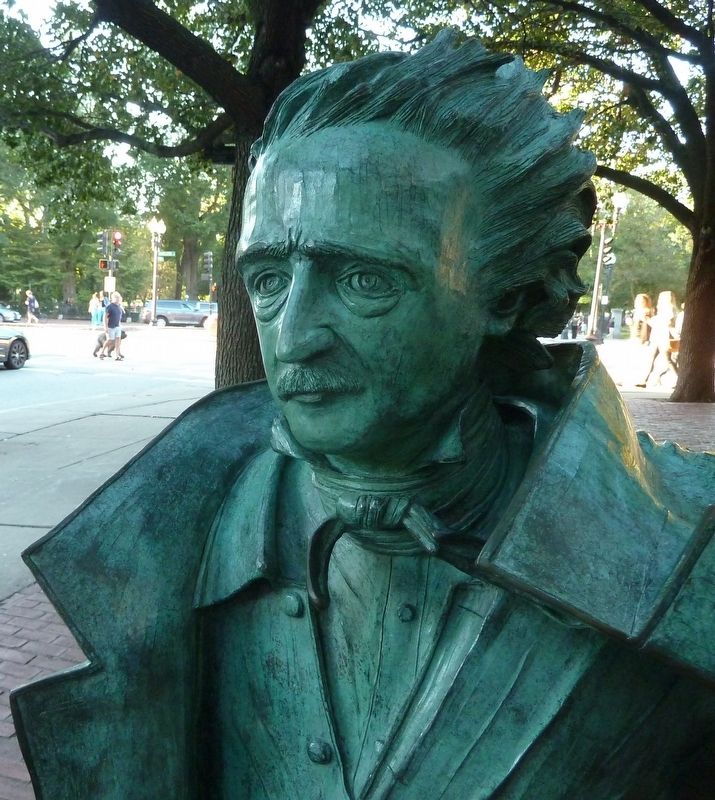
4. Closeup of Poe’s Head
Photographed by Roger W. Sinnott, September 28, 2017
5. Poe Statue at Night
Photographed by J. Makali Bruton, June 14, 2021
6. Poe's Tell-Tale Heart
Photographed by J. Makali Bruton, June 16, 2021
7. The Frogpond of the Boston Common, mentioned in the marker text
Credits. This page was last revised on January 30, 2023. It was originally submitted on September 29, 2017, by Roger W. Sinnott of Norwell, Massachusetts. This page has been viewed 1,345 times since then and 56 times this year. Photos: 1, 2, 3, 4, 5. submitted on September 29, 2017, by Roger W. Sinnott of Norwell, Massachusetts. 6. submitted on June 29, 2021, by J. Makali Bruton of Washington, District of Columbia. 7. submitted on July 1, 2021, by J. Makali Bruton of Washington, District of Columbia. • Bill Pfingsten was the editor who published this page.
