
Prospect Heights in Brooklyn in Kings County, New York — The American Northeast (Mid-Atlantic)
John Fitzgerald Kennedy
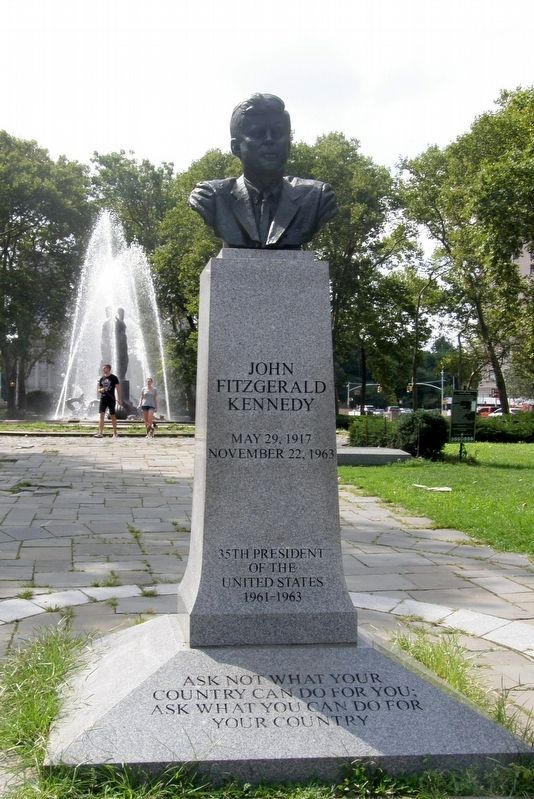
Photographed by Larry Gertner, August 23, 2015
1. John Fitzgerald Kennedy Memorial
May 29, 1917
November 22, 1963
35th President of the United States
1961-1963
Ask not what your country can do for you, ask what you can do for your country
Dedicated by the Borough of Brooklyn May 31, 1965
Rededicated August 24, 2010
Erected 1965 by The Borough of Brooklyn.
Topics and series. This historical marker is listed in this topic list: Government & Politics. In addition, it is included in the Former U.S. Presidents: #35 John F. Kennedy series list. A significant historical date for this entry is November 22, 1963.
Location. 40° 40.456′ N, 73° 58.21′ W. Marker is in Brooklyn, New York, in Kings County. It is in Prospect Heights. It is on Grand Army Plaza, on the right when traveling east. Touch for map. Marker is in this post office area: Brooklyn NY 11238, United States of America. Touch for directions.

Regionally, this marker is in New York City and on Long Island. It is also in the American Northeast, in the Mid-Atlantic, and on the Eastern Seaboard. Globally, it is in the North Atlantic Region, North America, the Western Hemisphere, the Western World, and the Anglosphere. Historically, it finds itself in what was once New Netherland and also one of the original Thirteen Colonies.
Other nearby markers. At least 8 other markers are within walking distance of this marker: Alexander Skene Memorial (within shouting distance of this marker); Defenders of the Union (about 500 feet away, measured in a direct line); Major General Gouverneur Kemble Warren (about 500 feet away); James T Stranahan (approx. 0.2 miles away); Maj. Gen. William Alexander, Lord Stirling (approx. ¼ mile away); Brooklyn Society for Ethical Culture (approx. 0.4 miles away); Nine Keystones, circa 1924 / "Night", circa 1910 (approx. 0.4 miles away); Plaque, circa 1885 (approx. 0.4 miles away). Touch
this page online
Also see . . . John F. Kennedy. Wikipedia biography. (Submitted on April 15, 2020, by Larry Gertner of New York, New York.)
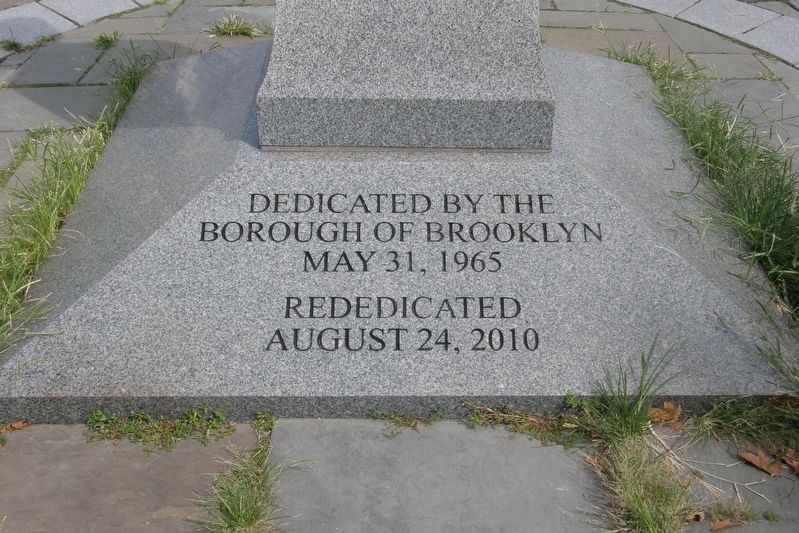
Photographed by Larry Gertner, August 23, 2015
2. John Fitzgerald Kennedy Marker rear
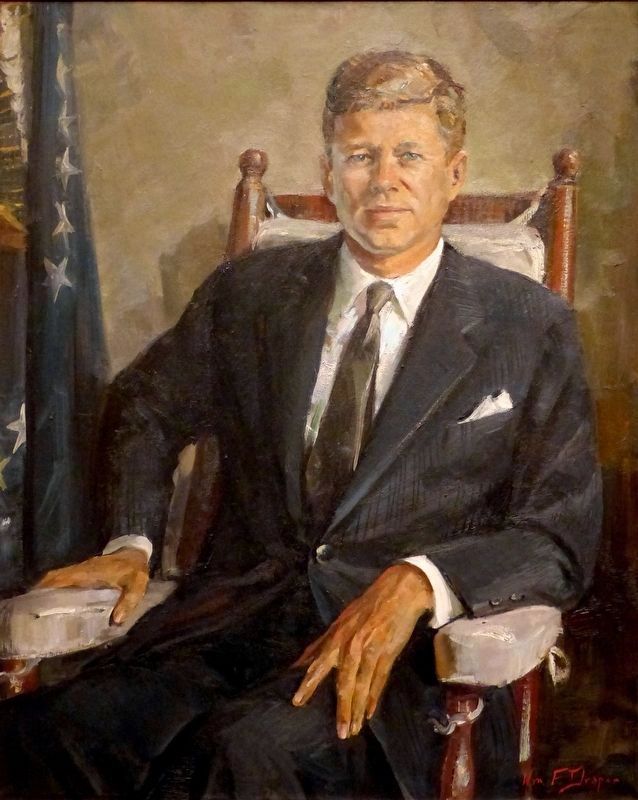
Photographed by Allen C. Browne, November 29, 2015
3. John Fitzgerald Kennedy
This 1966 painting of John Fitzgerald Kennedy by William Franklin Draper, from a 1962 life sketch, hangs in the National Portrait Gallery in Washington, DC.
“When President John F. Kennedy was assassinated in November 1963, America experienced an enduring sense of loss that it had not known since the death of Abraham Lincoln in 1865. Unlike Lincoln, the loss was not that of an indispensable leader in a time of great crisis, but an expression of unfulfilled promise, of a young president cut down just as he seemed poised to become a mature statesman. Kennedy had charmed Americans with his grace and eloquence, inspired them with his 'New Frontier,' and challenged them to overcome all 'burdens' and 'hardships.' The Bay of Pigs invasion of Cuba, an initial foreign policy fiasco, was later followed by success in forcing the Soviet Union to remove its missiles from Cuba. For many Americans, the violent end to Kennedy's life not only terminated a promising presidency but fostered a crisis of confidence in the United States.
William Franklin Draper depicted Kennedy in his favorite rocking chair, which the president used because of his chronically bad back; ironically, the young and 'vigorous' president was beset by serious health problems." — National Portrait Gallery
“When President John F. Kennedy was assassinated in November 1963, America experienced an enduring sense of loss that it had not known since the death of Abraham Lincoln in 1865. Unlike Lincoln, the loss was not that of an indispensable leader in a time of great crisis, but an expression of unfulfilled promise, of a young president cut down just as he seemed poised to become a mature statesman. Kennedy had charmed Americans with his grace and eloquence, inspired them with his 'New Frontier,' and challenged them to overcome all 'burdens' and 'hardships.' The Bay of Pigs invasion of Cuba, an initial foreign policy fiasco, was later followed by success in forcing the Soviet Union to remove its missiles from Cuba. For many Americans, the violent end to Kennedy's life not only terminated a promising presidency but fostered a crisis of confidence in the United States.
William Franklin Draper depicted Kennedy in his favorite rocking chair, which the president used because of his chronically bad back; ironically, the young and 'vigorous' president was beset by serious health problems." — National Portrait Gallery
Credits. This page was last revised on January 31, 2023. It was originally submitted on October 9, 2017, by Larry Gertner of New York, New York. This page has been viewed 438 times since then and 30 times this year. Photos: 1, 2. submitted on October 9, 2017, by Larry Gertner of New York, New York. 3. submitted on October 11, 2017, by Allen C. Browne of Silver Spring, Maryland. • Bill Pfingsten was the editor who published this page.
