Amsterdam-Centrum , North Holland, Netherlands — Northwestern Europe
Municipal Morgue
Photographed by Andrew Ruppenstein, May 16, 2023
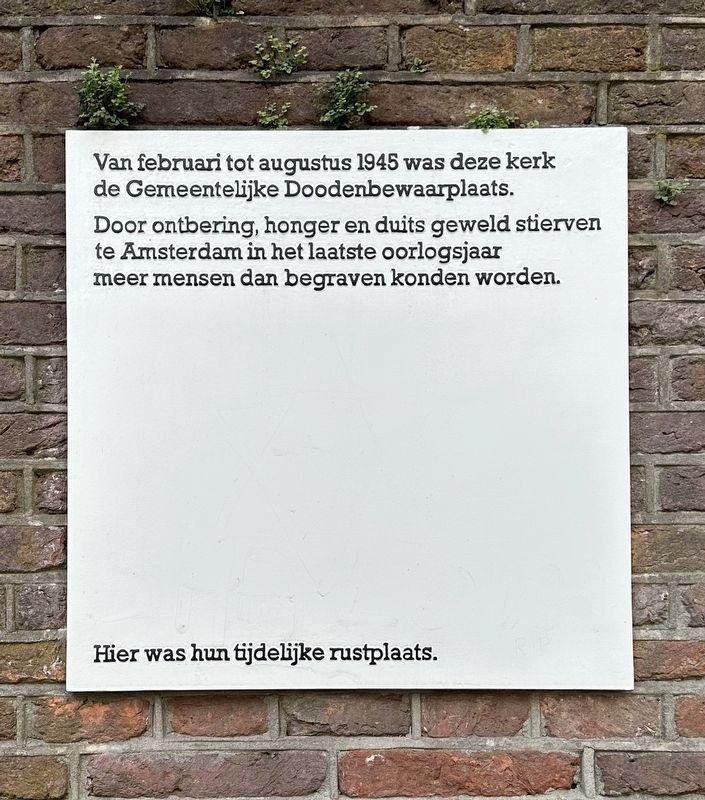
1. Municipal Morgue Marker

Door ontbering, honger en duits geweld stierven te Amsterdam in het laatste oorlogsjaar meer mensen dan begraven konden worden.
Hier was hun tijdelijke rustplaats.
From February to August 1945 this church was the Municipal Morgue.
Through deprivation, hunger and German violence, more people died in Amsterdam in the last year of war than could be buried.
This was their temporary resting place.
Topics. This historical marker is listed in this topic list: War, World II. A significant historical year for this entry is 1945.
Location. 52° 22.221′ N, 4° 54.005′ E. Marker is in Amsterdam, Noord-Holland (North Holland). It is in Amsterdam-Centrum. It is on Zuiderkerkhof just east of Zanddwarsstraat. Touch for map. Marker is at or near this postal address: Zuiderkerkhof 72, Amsterdam, Noord-Holland 1011 JH, Netherlands. Touch for directions.

Regionally, it is in Europe, the European Union, Atlantic Europe, the Benelux Low Countries, the Schengen Area, Western Europe, and the Western World.
this page online
Other nearby markers. At least 8 other markers are within walking distance of this marker: Izak Salomon Nathans (within shouting distance of this marker); Eva Nathans-de Boer (within shouting distance of this marker); Rosalie Nathans (within shouting distance of this marker); Simon Jacobus Nathans (within shouting distance of this marker); Selma Nathans-Salmagne (within shouting distance of this marker); Isaak Stopper (within shouting distance of this marker); Huis De Pinto (within shouting distance of this marker); Joseph Rothschild (about 90 meters away, measured in a direct line). Touch for a list and map of all markers in Amsterdam.
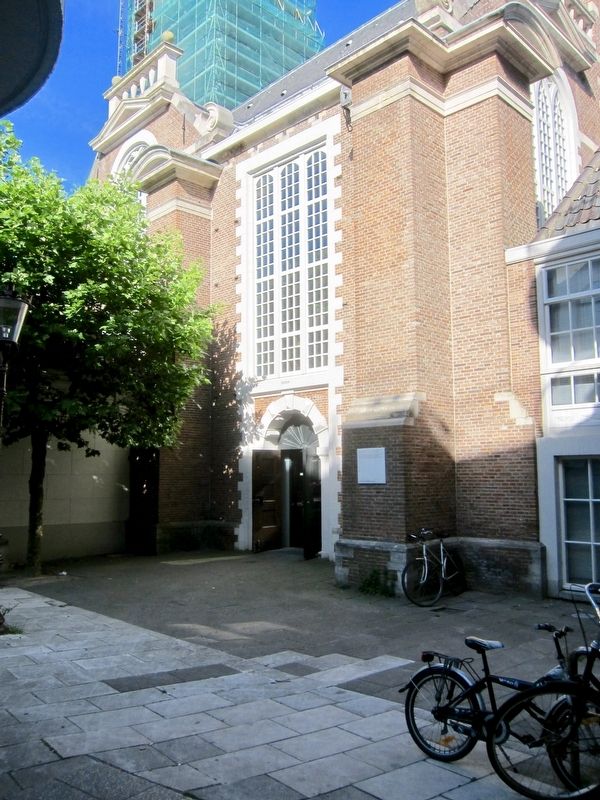
More about this marker. The marker is located to the right of the Zuiderkerk (church) entrance.
Also see . . . Dutch famine of 1944–45 (Wikipedia). "The Dutch famine of 1944–45, known as the Hongerwinter ("Hunger winter") in Dutch, was a famine that took place in the German-occupied part of the Netherlands, especially in the densely populated western provinces north of the great rivers, during the winter
Photographed by Andrew Ruppenstein, June 18, 2017
2. Municipal Morgue Marker - Wide View
Credits. This page was last revised on February 10, 2024. It was originally submitted on November 2, 2017, by Andrew Ruppenstein of Lamorinda, California. This page has been viewed 450 times since then and 47 times this year. Photos: 1. submitted on February 10, 2024, by Andrew Ruppenstein of Lamorinda, California. 2. submitted on November 2, 2017, by Andrew Ruppenstein of Lamorinda, California.
