The National Mall in Southwest Washington in Washington, District of Columbia — The American Northeast (Mid-Atlantic)
Asteroids and Comets
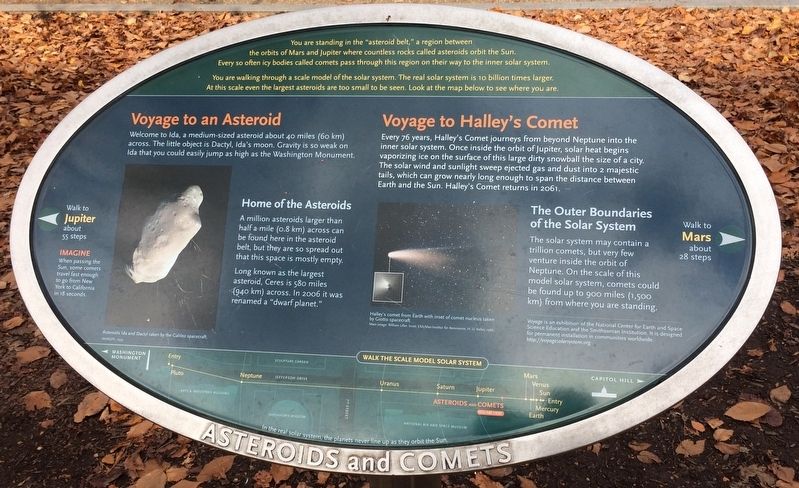
You are standing in the "asteroid belt," a region between the orbits of Mars and Jupiter where countless rocks called asteroids orbit the Sun. Every so often icy body called comets pass through this region on their way to the inner solar system.
You are walking through a scale model of the solar system. The real solar system is 10 billion times larger. At this scale even the largest asteroids are too small to be seen. Look at the map below to see where you are.
Voyage to an Asteroid
Welcome to Ida, a medium-sized asteroid about 40 miles (60 km) across. The little object is Dactyl, Ida's moon. Gravity is so weak on Ida that you could easily jump as high as the Washington Monument.
Home of the Asteroids
A million asteroids larger than half a mile (0.8 km) across can be found here in the asteroid belt, but they are so spread out that this space is mostly empty.
Long known as the largest asteroid, Ceres is 580 miles (940 km) across. In 2006, it was renamed a "dwarf planet."
Voyage to Halley's Comet
Every 76 years, Halley's Comet journeys from beyond Neptune into the inner solar system. Once inside the orbit
this page online
The Outer Boundaries of the Solar System
The solar system may contain a trillion comets, but very few venture inside the orbit of Neptune. On the scale of this model solar system, comets could be found up to 900 miles (1,500 km) from where you are standing.
Walk to Jupiter about 55 steps.
Imagine
When passing the Sun, some comets travel fast enough to go from New York to California in 18 seconds.
Walk to Mars about 28 steps
Erected 2013 by Smithsonian Institution.
Topics. This historical marker is listed in this topic list: Air & Space. A significant historical year for this entry is 2006.
Location. 38° 53.32′ N, 77° 1.139′ W. Marker is in Southwest Washington in Washington, District of Columbia. It is in The National Mall. It is on Jefferson Drive Southwest west of 4th Street Southwest, on the left when traveling west. On
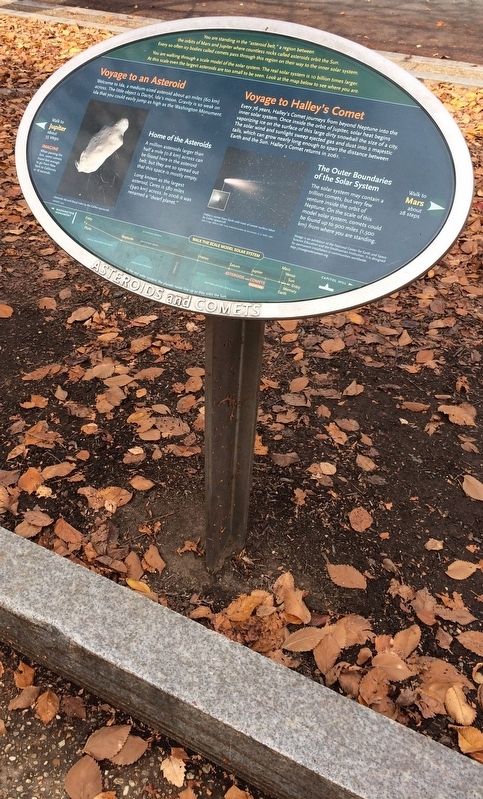

Regionally, this marker is in the Washington Metropolitan Area. It is also in the American Northeast, in the Upper South, in the Mid-Atlantic, in the Tidewater, and in the Chesapeake Bay Region. Globally, it is in North America, the Western Hemisphere, the Western World, and the Anglosphere.
Other nearby markers. At least 8 other markers are within walking distance of this marker: Earth (within shouting distance of this marker); T.S.C. Lowe's Observation Flight (within shouting distance of this marker); Star Nurseries (about 300 feet away, measured in a direct line); Cook Telescope (about 300 feet away); Sun (about 300 feet away); Saturn (about 300 feet away); Phoebe Waterman Haas (about 300 feet away); Venus (about 300 feet away). Touch for a list and map of all markers in Southwest Washington.
More about this marker.
[Dedication information:]
Voyage is an exhibition of the National Center for Earth and Space Science Education and the Smithsonian Institution. It is designed for permanent installation in communities worldwide.
Credits. This page was last revised on January 30, 2023. It was originally submitted on November 14, 2017, by Devry Becker Jones of Washington, District of Columbia. This page has been viewed 401 times since then and 18 times this year. Photos: 1, 2. submitted on November 14, 2017, by Devry Becker Jones of Washington, District of Columbia. • Bill Pfingsten was the editor who published this page.
