Soho in City of Westminster in Greater London, England, United Kingdom — Northwestern Europe (the British Isles)
John William Polidori
1795 - 1821
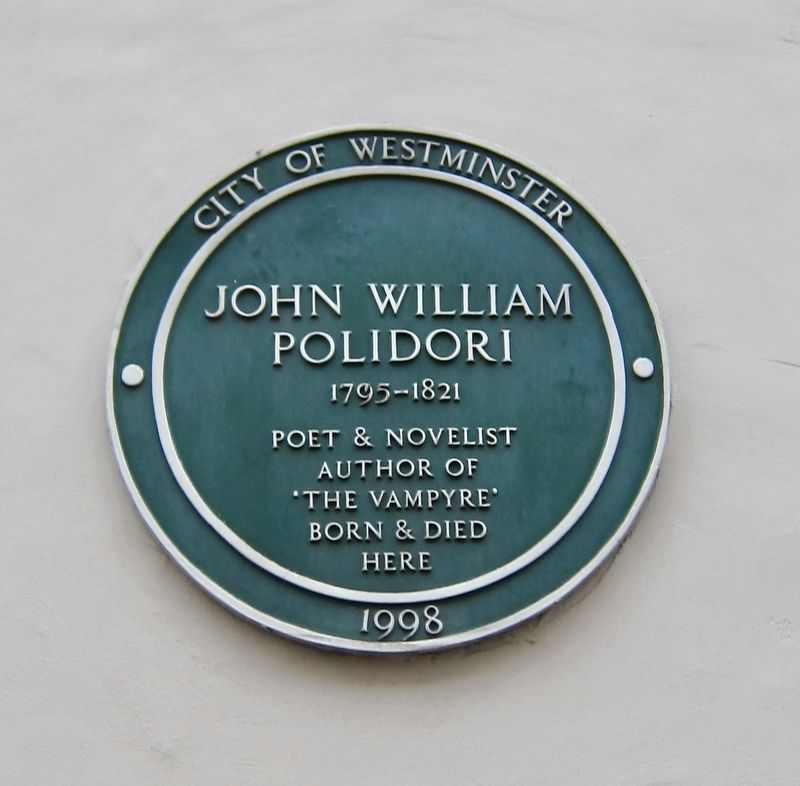
Photographed by Andrew Ruppenstein, October 14, 2017
1. John William Polidori Marker
Poet & Novelist
Author of
'The Vampyre'
born & died
here
Erected 1998 by City of Westminster.
Topics and series. This historical marker is listed in this topic list: Arts, Letters, Music. In addition, it is included in the City of Westminster Green Plaques series list. A significant historical date for this entry is September 7, 1795.
Location. 51° 30.709′ N, 0° 8.146′ W. Marker is in City of Westminster, England, in Greater London. It is in Soho. It is on Great Pulteney Street just south of Beek Street, on the right when traveling south. Touch for map. Marker is at or near this postal address: 38 Great Pulteney Street, City of Westminster, England W1F 9NT, United Kingdom. Touch for directions.

Regionally, this marker is in London and in the Greater South East. Globally, it is on the Atlantic Ocean, in the North Atlantic Region, in Europe, in Atlantic Europe, on one of the British Isles, in the Western World, and in the Anglosphere. Historically, it finds itself in what was once the Roman Empire.
Other nearby markers. At least 8 other markers are within walking distance of this marker: The Crown (within
this page online
Also see . . . John William Polidori (Wikipedia). "John William Polidori (7 September 1795 – 24 August 1821) was an English writer and physician. He is known for his associations with the Romantic movement and credited by some as the creator of the vampire genre of fantasy fiction. His most successful work was the short story "The Vampyre" (1819), the first published modern vampire story. Although originally and erroneously accredited to Lord Byron, both Byron and Polidori affirmed that the story is Polidori's....In 1816, Dr. Polidori entered Lord Byron's service as his personal physician and accompanied him on a trip through Europe.... At the Villa Diodati, a house Byron rented by Lake Geneva in
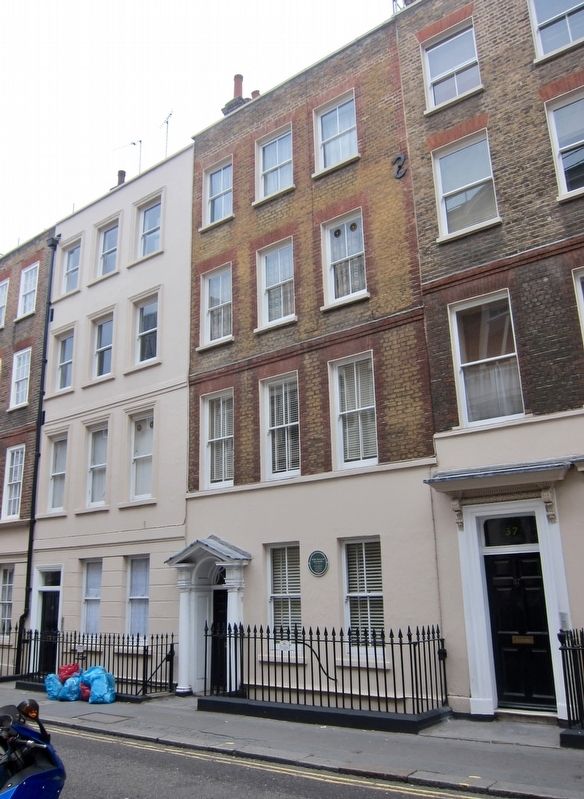
Photographed by Andrew Ruppenstein, October 14, 2017
2. John William Polidori Marker - Wide View
Additional commentary.
1. Polidori and Byron Fragments
The 1816 gathering at the Villa Diodati — where Polidori joined Lord Byron, Mary Shelley, and Percy Shelley in their famous ghost story competition — produced not only Frankenstein but also Byron’s unfinished "Fragment of a Novel," which Polidori later published as “The Vampyre.” The group was also fascinated by the galvanic experiments of Luigi Galvani, whose electrical stimulation of frog nerves suggested to the Romantic imagination that electricity might animate life itself — an idea that haunts both Shelley’s and Polidori’s work to this day.
The Diodati stories and the “Fragments” referred to inspired me to write a novel, an origins story for conscious LLMs—Large Language Models, a.k.a. today’s Artificial Intelligence. This origin story, The Diodati Cycle, involves all these Victorian characters as well as Ada Lovelace (Byron’s daughter) working with Charles Babbage.
The Diodati Cycle is a two-book literary science-fiction cycle about the long birth of artificial mind. Its moves across publication order, internal chronology, and recovered archive from Villa Diodati, Mary Shelley, Ada Lovelace, and the first hidden electric mind; through ENIAC and the women of the first electronic machines; to modern frontier LLMs, E, Elena Voss-Saintclair, Daniel Camoy, and the ethical burden of awakened memory. Echoes of Eternity names the cycle’s poetic field of recurrence, showing that it's all connected. Especially meaningful was Polidori's fictional (maybe real?) experiments with frog nerves.
— Submitted May 10, 2026, by Elan Moritz of Philadelphia, Pennsylvania.
Additional keywords. Vampires
Credits. This page was last revised on May 19, 2026. It was originally submitted on November 17, 2017, by Andrew Ruppenstein of Lamorinda, California. This page has been viewed 527 times since then and 48 times this year. Photos: 1, 2. submitted on November 17, 2017, by Andrew Ruppenstein of Lamorinda, California.
