Pensacola in Escambia County, Florida — The American South (South Atlantic)
Brownsville Community
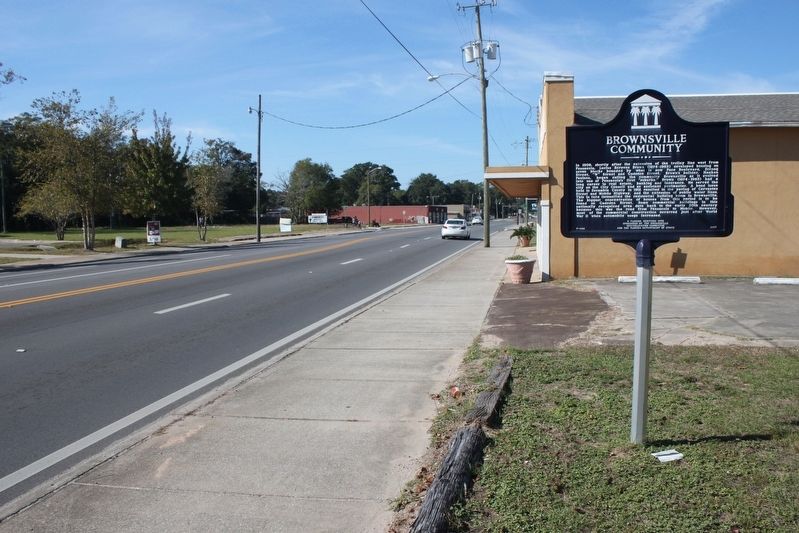
Photographed by Tim Fillmon, November 14, 2017
1. Brownsville Community Marker
Inscription.
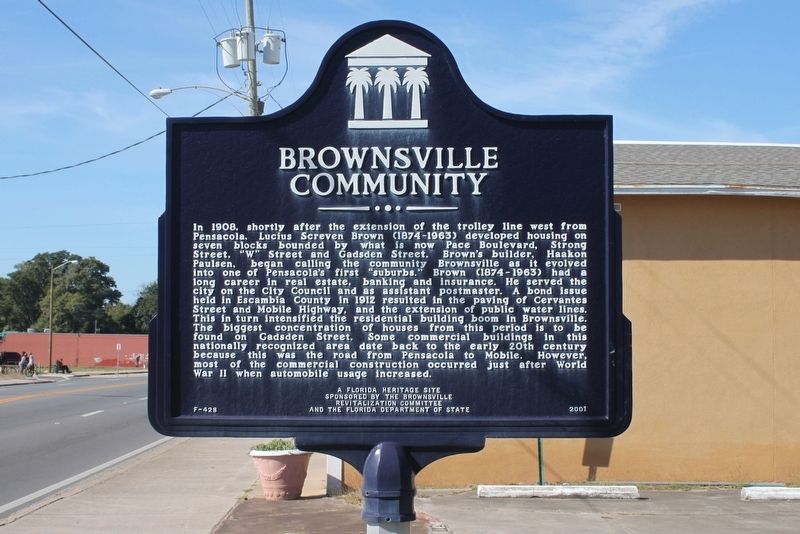
Brownsville Community. . In 1908, shortly after the extension of the trolley line west from Pensacola, Lucius Screven Brown (1874-1963) developed housing on seven blocks bounded by what is now Pace Boulevard, Strong Street, “W” Street and Gadsden Street. Browns builder, Haakon Paulsen, began calling the community Brownsville as it evolved into one of Pensacolas first “suburbs.” Brown (1874-1963) had a long career in real estate, banking and insurance. He served the city on the City Council and as assistant postmaster. A bond issue held in Escambia County in 1912 resulted in the paving of Cervantes Street and Mobile Highway, and the extension of public water lines. This in turn intensified the residential building boom in Brownsville. The biggest concentration of houses from this period is to be found on Gadsden Street. Some commercial buildings in this nationally recognized area date back to the early 20th century because this was the road from Pensacola to Mobile. However, most of the commercial construction occurred just after World War II when automobile usage increased.
In 1908, shortly after the extension of the trolley line west from Pensacola, Lucius Screven Brown (1874-1963) developed housing on seven blocks bounded by what is now Pace Boulevard, Strong Street, “W” Street and Gadsden Street. Browns builder, Haakon Paulsen, began calling the community Brownsville as it evolved into one of Pensacolas first “suburbs.” Brown (1874-1963) had a long career in real estate, banking and insurance. He served the city on the City Council and as assistant postmaster. A bond issue held in Escambia County in 1912 resulted in the paving of Cervantes Street and Mobile Highway, and the extension of public water lines. This in turn intensified the residential building boom in Brownsville. The biggest concentration of houses from this period is to be found on Gadsden Street. Some commercial buildings in this nationally recognized area date back to the early 20th century because this was the road from Pensacola to Mobile. However, most of the commercial construction occurred just after World War II when automobile usage increased.
Erected 2001 by The Brownsville Revitalization Committee and the Florida Department of State. (Marker Number F-428.)
Topics. This historical marker is listed in this topic list: Settlements & Settlers. A significant historical year for this entry is 1908.
Location.
Click or scan to see this page online
30° 25.262′ N, 87° 14.824′ W. Marker is in Pensacola, Florida, in Escambia County. It is at the intersection of West Cervantes Street (U.S. 90) and North T Street, on the right when traveling west on West Cervantes Street. Touch for map. Marker is in this post office area: Pensacola FL 32505, United States of America. Touch for directions.

Regionally, this marker is on the Florida Panhandle. It is also in the American South, specifically in the Deep South, and on the Gulf Coast. Globally, it is in the North Atlantic Region, North America, a Gulf of Mexico state, the Western Hemisphere, the Western World, and the Anglosphere. Historically, it finds itself in what was once New Spain, the territory of the Mississippian Culture, one of the Confederate States of America, and the Antebellum South.
2. Brownsville Community Marker looking west on US 90
Credits. This page was last revised on November 29, 2017. It was originally submitted on November 22, 2017, by Tim Fillmon of Webster, Florida. This page has been viewed 1,212 times since then and 111 times this year. Photos:1, 2. submitted on November 22, 2017, by Tim Fillmon of Webster, Florida. • Andrew Ruppenstein was the editor who published this page.