USCGC Sebago (WPG/WHEC 42)
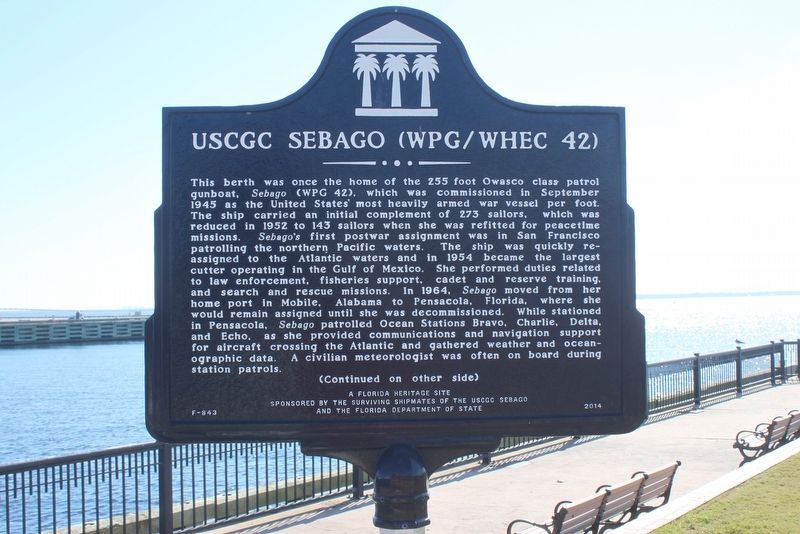
This berth was once the home of the 255 foot Owasco class patrol gunboat, Sebago (WPG 42), which was commissioned in September 1945 as the United States’ most heavily armed war vessel per foot. The ship carried an initial complement of 273 sailors, which was reduced in 1952 to 143 sailors when she was refitted for peacetime missions. Sebago’s first postwar assignment was in San Francisco patrolling the northern Pacific waters. The ship was quickly reassigned to the Atlantic waters and in 1954 became the largest cutter operating in the Gulf of Mexico. She performed duties related to law enforcement, fisheries support, cadet and reserve training, and search and rescue missions. In 1964, Sebago moved from her home port in Mobile, Alabama to Pensacola, Florida, where she would remain assigned until she was decommissioned. While stationed in Pensacola, Sebago patrolled Ocean Stations Bravo, Charlie, Delta, and Echo, as she provided communications and navigation support for aircraft crossing the Atlantic and gathered weather and oceanographic data. A civilian meteorologist was often on board during station patrols.
(Continued
this page online
Side 2:
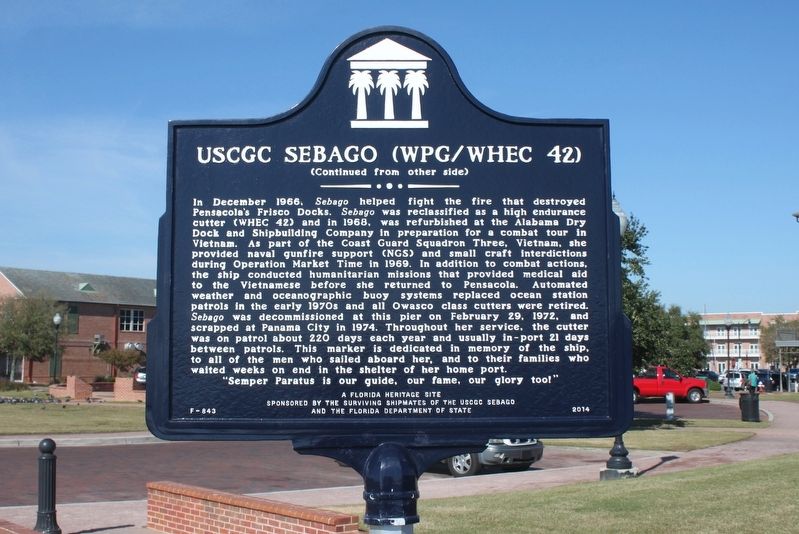
(Continued from other side)
In December 1966, Sebago helped fight the fire that destroyed Pensacola’s Frisco Docks. Sebago was reclassified as a high endurance cutter (WHEC 42) and in 1968, was refurbished at the Alabama Dry Dock and Shipbuilding Company in preparation for a combat tour in Vietnam. As part of the Coast Guard Squadron Three, Vietnam, she provided naval gunfire support (NGS) and small craft interdictions during Operation Market Time in 1969. In addition to combat actions, the ship conducted humanitarian missions that provided medical aid to the Vietnamese before she returned to Pensacola. Automated weather and oceanographic buoy systems replaced ocean station patrols in the early 1970s and all Owasco class cutters were retired. Sebago was decommissioned at this pier on February 29, 1972, and scrapped at Panama City in 1974. Throughout her service, the cutter was on patrol about 220 days each year and usually in-port 21 days between patrols. This marker is dedicated in memory of the ship, to all of the men who sailed aboard her, and to their families who waited weeks on end in the shelter of
Erected 2014 by The Surviving Shipmates of the USCGC Sebago and the Florida Department of State. (Marker Number F-843.)
Topics. This historical marker is listed in these topic lists: War, Vietnam • War, World II • Waterways & Vessels. A significant historical month for this entry is September 1945.
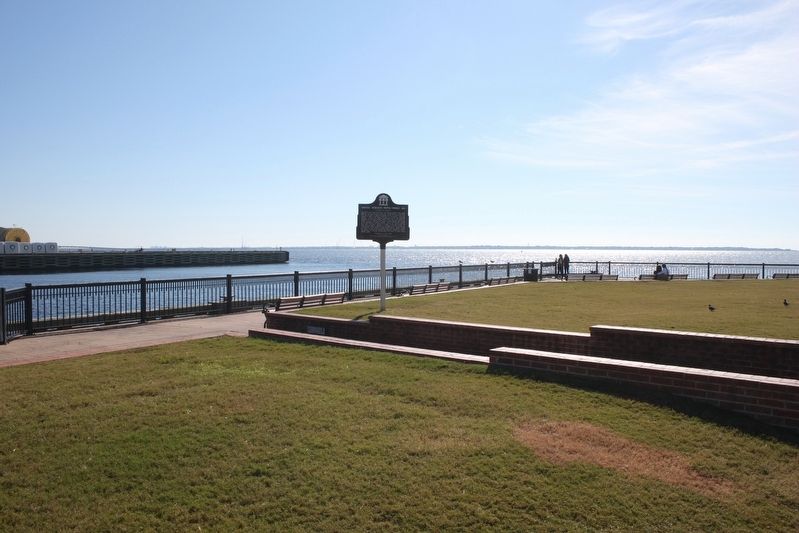
Location. 30° 24.131′ N, 87° 12.747′ W. Marker is in Pensacola, Florida, in Escambia County. It is on South Palafox Street just south of South Jefferson Street, on the left when traveling south. Marker is located at the end of the Palafox Wharf/Plaza De Luna. Touch for map. Marker is in this post office area: Pensacola FL 32502, United States of America. Touch for directions.

Regionally, this marker is on the Florida Panhandle. It is also in the American South, specifically in the Deep South, and on the Gulf Coast. Globally, it is in the North Atlantic Region, North America, a Gulf of Mexico state, the Western Hemisphere, the Western World, and the Anglosphere. Historically, it finds itself in what was once New Spain, the territory of the
Other nearby markers. At least 8 other markers are within walking distance of this marker: Middle Passage to Pensacola / African Presence in Colonial Pensacola (within shouting distance of this marker); Luna Expedition (within shouting distance of this marker); Trader Jon's (approx. 0.4 miles away); Industry At Sea (approx. 0.4 miles away); Pioneer Planing Mills (approx. 0.4 miles away); A New Territory for the U.S. (approx. 0.4 miles away); Piers, Ports and Wharves: A Look At Pensacola's Waterfront (approx. 0.4 miles away); Archaeology in a Maritime Community (approx. 0.4 miles away). Touch for a list and map of all markers in Pensacola.
Also see . . . USCGC Sebago (WPG/WHEC 42). (Submitted on November 23, 2017, by Tim Fillmon of Webster, Florida.)
Credits. This page was last revised on November 29, 2017. It was originally submitted on November 23, 2017, by Tim Fillmon of Webster, Florida. This page has been viewed 966 times since then and 88 times this year. Photos: 1, 2, 3. submitted on November 23, 2017, by Tim Fillmon of Webster, Florida. • Andrew Ruppenstein was the editor who published this page.
