Rocklin in Placer County, California — The American West (Pacific Coastal)
Rocklin
First Transcontinental Railroad
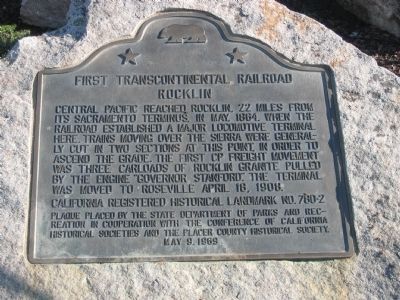
Photographed by Syd Whittle, February 6, 2005
1. First Transcontinental Railroad Marker
Erected 1969 by State Department of Parks and Recreation in Cooperation with the Conference of California Historical Societies and The Placer County Historical Society May 9, 1969. (Marker Number 780-2.)
Topics and series. This historical marker is listed in these topic lists: Landmarks • Railroads & Streetcars. In addition, it is included in the California Historical Landmarks, and the First Transcontinental Railroad series lists. A significant historical date for this entry is April 18, 1943.
Location. 38° 47.501′ N, 121° 14.273′ W. Marker is in Rocklin, California, in Placer County. It is on Rocklin Road south of Front Street, on the right when traveling north. Marker is located at the entrance to the Crossroads
this page online

Regionally, this marker is in California’s Sacramento Metro, in the Sierra Nevada, and in the Lake Tahoe Basin. It is also in the American Mountain West. Globally, it is in North America, on the Ring of Fire, in the Pacific Rim, in the Western Hemisphere, in the Western World, and in the Anglosphere. Historically, it finds itself in what was once New Spain and also Mexico’s Alta California.
Other nearby markers. At least 8 other markers are within walking distance of this marker: Trott Hotel (a few steps from this marker); Peter Hill Heritage Park (within shouting distance of this marker); Rocklin Roundhouse (within shouting distance of this marker); Rocklin Wall of Recognition (within shouting distance of this marker); Old Saint Mary’s Chapel (within shouting distance of this marker); Rocklin's Roundhouse (within shouting distance of this marker); Barudoni Building (within shouting distance of this marker); Rocklin's Front Street Business District
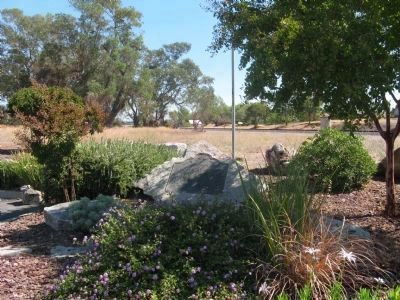
Photographed by Syd Whittle, September 4, 2008
2. Wide Area View of the First Transcontinental Railroad Marker
Regarding Rocklin. Chief Engineer Theodore Judah’s plan in 1863 was to build a roundhouse at Junction, now Roseville, to service the extra engines that would be needed to help trains surmount the Sierra. But Judah died that year and new CP managers decided to build the roundhouse at Rocklin instead, closer to the point where the rail bed steepens as it heads toward Auburn.
Also see . . . "Rocklin's Roundhouse 1867 to 1908". Roseville Today entry (Submitted on September 30, 2020, by Larry Gertner of New York, New York.)
Additional commentary.
1. Rocklin History Timeline
An informative timeline was prepared by the Rocklin History Museum. These exerts are in relation to the railroad:
1864: Central Pacific Railroad arrived ∙ Locomotive “Governor Stanford” hauls CPRR’s first load of freight: Granite from Rocklin’s quarries. ∙ The name “Rocklin” first appears in print on CPRR’s time card No. 1.
1867: Railroad Roundhouse built – Central Pacific.
1869: The first train to cross

Photographed by Kevin W., January 29, 2025
3. Rocklin Marker
Marker showing the updated landscaping of 5he area.
1873: Fire destroyed the Roundhouse with 10 locomotives and tenders.
1896: Railroad strike (troops here).
1907: Roundhouse moved to Roseville.
1933: Southern Pacific discontinued passenger service to Rocklin.
1973: Roseville railyard explosions.
1985: Southern Pacific becomes Union Pacific.
— Submitted October 11, 2009, by Syd Whittle of Mesa, Arizona.
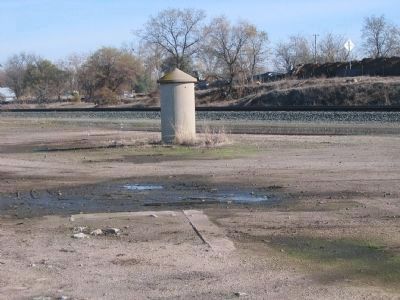
Photographed by Syd Whittle, December 6, 2005
4. Remains of The First Transcontinental Railroad Terminal
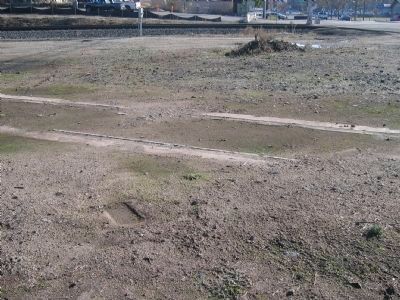
Photographed by Syd Whittle, December 6, 2005
5. Tracks From The Roundhouse Once Located Here.
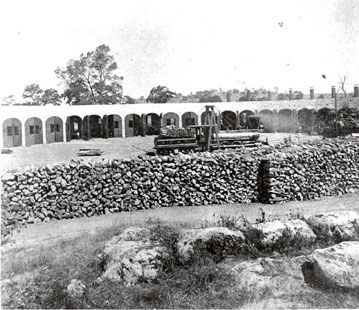
Rocklin Historical Society, unknown
6. Rocklin Roundhouse
Rocklin Historical Society Photo
Credits. This page was last revised on January 29, 2025. It was originally submitted on August 13, 2008, by Syd Whittle of Mesa, Arizona. This page has been viewed 2,450 times since then and 57 times this year. Last updated on September 5, 2008, by Syd Whittle of Mesa, Arizona. Photos: 1. submitted on August 13, 2008, by Syd Whittle of Mesa, Arizona. 2. submitted on September 4, 2008, by Syd Whittle of Mesa, Arizona. 3. submitted on January 29, 2025, by Kevin W. of Stafford, Virginia. 4, 5. submitted on August 13, 2008, by Syd Whittle of Mesa, Arizona. 6. submitted on September 30, 2020, by Larry Gertner of New York, New York. • Kevin W. was the editor who published this page.
