St. Augustine in St. Johns County, Florida — The American South (South Atlantic)
Trinity Episcopal Church
Territorial Period, Built ca. 1831
Photographed by Tim Fillmon, June 21, 2017
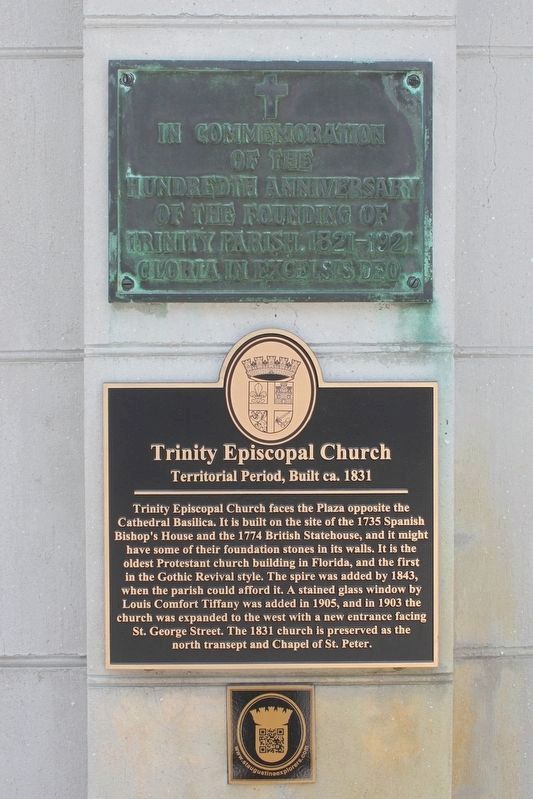
1. Trinity Episcopal Church Marker
The additional upper marker reads:
In commemoration of the
hundredth anniversary
of the founding of
Trinity Parish, 1821-1921.
Gloria in excelsis Deo
hundredth anniversary
of the founding of
Trinity Parish, 1821-1921.
Gloria in excelsis Deo
Trinity Episcopal Church faces the Plaza opposite the Cathedral Basilica. It is built on the site of the 1735 Spanish Bishop's House and the 1774 British Statehouse, and it might have some of their foundation stones in its walls. It is the oldest Protestant church building in Florida, and the first in the Gothic Revival style. The spire was added by 1843, when the parish could afford it. A stained glass window by Louis Comfort Tiffany was added in 1905, and in 1903 the church was expanded to the west with a new entrance facing St. George Street. The 1831 church is preserved as the north transept and Chapel of St. Peter.
Erected 2016 by City of St. Augustine.
Topics. This historical marker is listed in these topic lists: Architecture • Religion & Religious Structures. A significant historical year for this entry is 1831.
Location. 29° 53.528′ N, 81° 18.746′ W. Marker is in St. Augustine, Florida, in St. Johns County. It is at the intersection of East King Street (U.S. Bus 1) and St George Street, on the right when traveling east on East King Street. Touch for map. Marker is at or near this postal address: 215 St George Street, Saint Augustine FL 32084, United States of America. Touch for directions.

Regionally, this marker is in First Coast and in Greater Jacksonville. It is also in the American South and on the Eastern Seaboard. Globally, it is in the North Atlantic Region, North America, a Gulf of Mexico state, the Western Hemisphere, the Western World, and the Anglosphere. Historically, it finds itself in what was once New Spain, the territory of the Mississippian Culture, one of the Confederate States of America, and the Antebellum South.
Other nearby markers. At least 8 other markers are within walking distance of this marker: Trinity Parish Church (a few steps from this marker);
this page online
Another marker is no longer nearby. Spanish Public Well (was within shouting distance of this marker but has been confirmed missing).
Related markers. Click here for a list of markers that are related to this marker.
Also see . . . Trinity Episcopal Church. Parish website homepage (Submitted on December 6, 2017, by Tim Fillmon of Webster, Florida.)
Photographed by Tim Fillmon, June 21, 2017
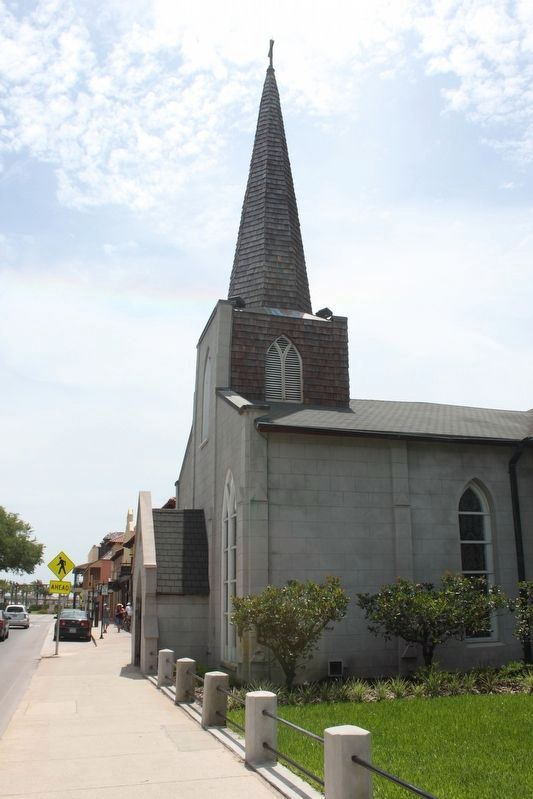
2. Trinity Episcopal Church looking east on East King Street
Credits. This page was last revised on December 26, 2021. It was originally submitted on December 6, 2017, by Tim Fillmon of Webster, Florida. This page has been viewed 565 times since then and 47 times this year. Photos: 1, 2. submitted on December 6, 2017, by Tim Fillmon of Webster, Florida. • Bernard Fisher was the editor who published this page.
