Boise in Ada County, Idaho — The American West (Mountains)
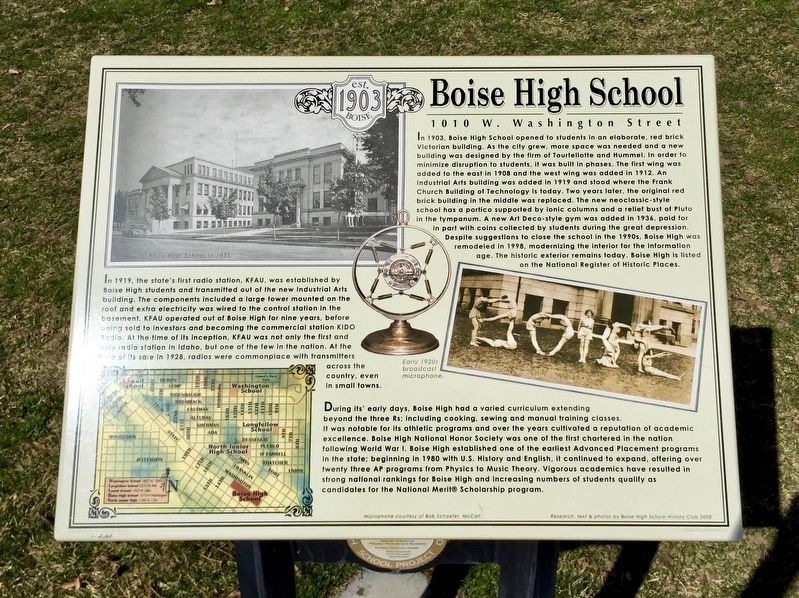
Boise High School
1010 W. Washington Street
Photographed by Andrew Ruppenstein, March 19, 2016
1. Boise High School Marker
In 1919, the state's first radio station, KFAU, was established by Boise High students and transmitted out
this page online
During its early days, Boise High had a varied curriculum extending beyond the three Rs; including cooking, sewing and manual training classes. It was notable for its athletic programs and over the years cultivated a reputation of academic excellence. Boise High National Honor Society was one of the first chartered in the nation following World War I. Boise High established one of the earliest Advanced Placement programs in the state; beginning in 1980 with U.S. History and English, it continued to expand, offering over twenty three AP programs from Physics to Music Theory. Vigorous academics have resulted
Photographed by Andrew Ruppenstein, March 19, 2016
2. Boise High School and Marker
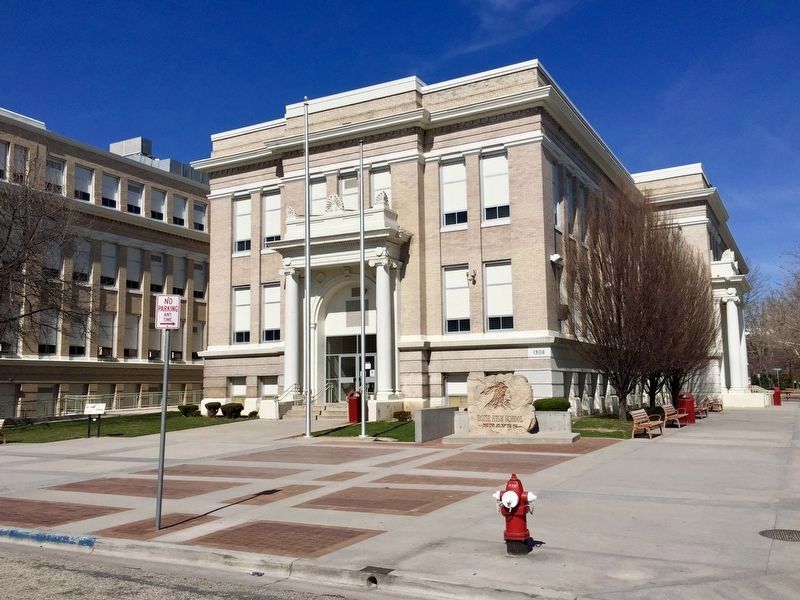
The marker is visible on the very left of the photo.
Erected 2008.
Topics and series. This historical marker is listed in these topic lists: Communications • Education. In addition, it is included in the Art Deco, and the National Register of Historic Places (NRHP) series lists. A significant historical year for this entry is 1903.
Location. 43° 37.256′ N, 116° 12.143′ W. Marker is in Boise, Idaho, in Ada County. It is at the intersection of West Washington Street and North 10th Street, on the right when traveling west on West Washington Street. Touch for map. Marker is at or near this postal address: 1010 West Washington Street, Boise ID 83702, United States of America. Touch for directions.

Regionally, this marker is on the Snake River Plain. It is also in the American Mountain West. Globally, it is in North America, the Western Hemisphere, the Western World, and the Anglosphere.
Other nearby markers. At least 8 other markers are within walking distance of this marker: John Haines House (about 600 feet away, measured in a
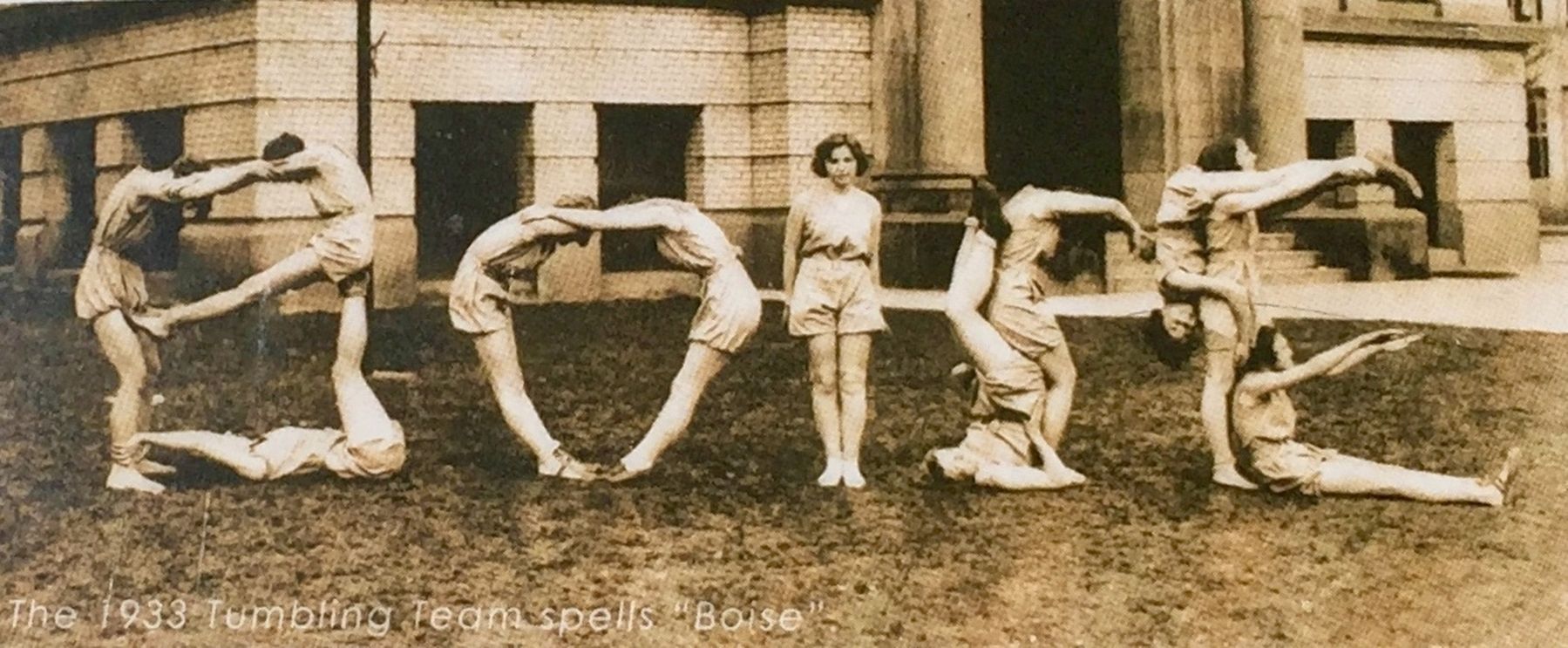
1933
3. The 1933 Tumbling Team Spells "Boise"
Also see . . . National Register of Historic Places Nomination Form.
NRHP Nomination Form Statement of Significance:(Submitted on February 26, 2025, by Douglass Halvorsen of Klamath Falls, Oregon.)
Boise High School is both historically and architecturally significant: historically, as the only public high school until the late 1950s of the state's capital city; architecturally, as a group of handsome and diverse buildings clearly illustrating three periods of developmental style, all designed by Tourtellotte and Company and Troutellotte and Hummel over a period of thirty years. The most important of these buildings is the high school itself. It is architecturally significant as a neo-classical revival monument, in a state where they are rare. In fact, the high school appropriates some of the classical vocabulary—the tripartite form, the full pedimented portico, and the particular affection for the anthemion—which distinguishes the older and much grander capitol. The central section of the capitol was begun in 1904; the east wing of the high school in 1908. The beau-arts design was produced only after the Statesman rallied public opinion and the school board against an early proposal incorporating a heavily medieval exterior. The cost of the entire structure, which was completed in 1920, was projected at $250,000 in 1909. The Industrial Arts and gymnasium buildings contribute to an impressive ensemble. The 1920 Industrial Arts building is significant in showing some of the same neo-classical devices—the slightly outset porticoes over round-arched doorways, the classical anthemia—stylized and rendered in pragmatic concrete; the result is at once appropriate to the more prosaic function of a shop building, stylistically continuous with the main building, and illustrative of the tendency to simplify and geometricize that which was going on at the end of the 1910s. This tendency is also apparent in the masonry treatment of the scenehouse at the rear of the central, 1920 section of the main building. The gymnasium, dating seventeen years later, is a fine example of the institutional art deco design of Frank Hummel, which he applied to Public Works Administration projects throughout the Depression. A generational peer of even greater distinction is the Boise Junior High School (site 129). The total cost was reported to be $130,000.
Credits. This page was last revised on February 26, 2025. It was originally submitted on December 11, 2017, by Andrew Ruppenstein of Lamorinda, California. This page has been viewed 820 times since then and 96 times this year. Photos: 1, 2, 3. submitted on December 11, 2017, by Andrew Ruppenstein of Lamorinda, California.
