Capitol Hill in Northeast Washington in Washington, District of Columbia — The American Northeast (Mid-Atlantic)
United States Capitol
East Front
Photographed by Richard E. Miller, February 13, 2010
1. United States Capitol Marker
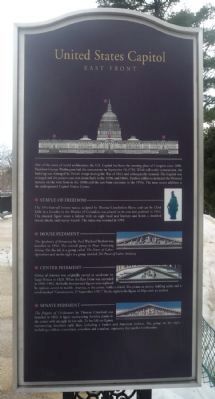
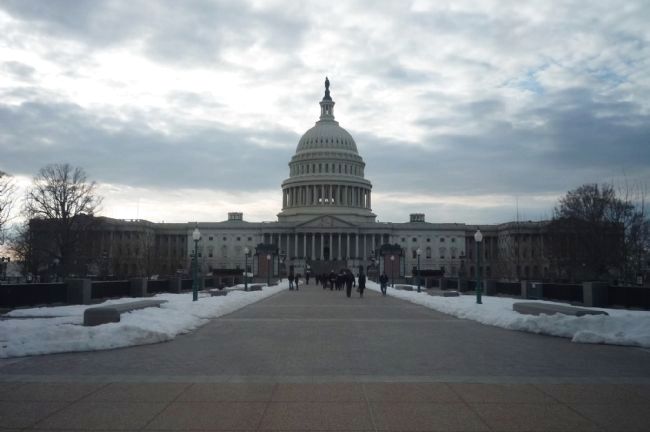
One of the icons of world architecture, the U.S. Capitol has been the meeting place of Congress since 1800. President George Washington laid the cornerstone on September 18, 1793. While under construction, the the building was damaged by British troops during the War of 1812 and subsequently restored. The Capitol was enlarged and the present cast-iron dome built in the 1850s and 1860s. Further additions included the Olmstead terraces on the west front in the 1880s and the east front extension in the 1950s. The most recent addition is the underground Capitol Visitor Center.
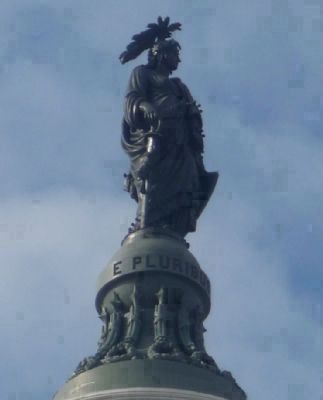
1. Statue of Freedom
The 19½-foot-tall bronze statue, sculpted by Thomas Crawford in Rome and cast by Clark Foundry in the District of Columbia, was placed on its cast-iron pedestal in 1863. The classical figure wears a helmet with an eagle head and feathers and holds a sheathed sword, shield and victory wreath. The statue was restored in 1993.
2. House Pediment
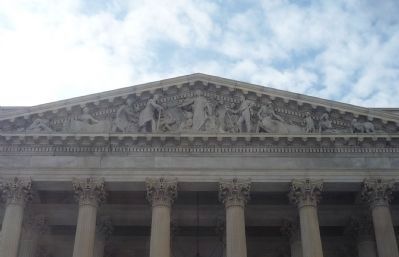
The Apotheosis of Democracy by Paul Weyland Bartlett was installed in 1916. The central group is Peace Protecting Genius. On the left is a group called The Power of Labor: Agriculture, and on the right is a entitled The Power of Labor: Industry.
3. Center Pediment
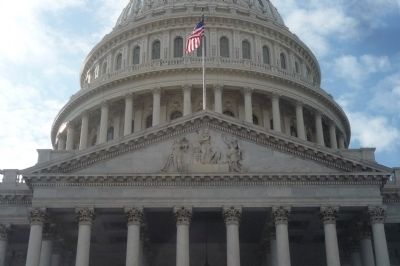
Genius of America was originally carved in sandstone by Luigi Persico in 1828. When the East Front was expanded in 1958-1962, the badly deteriorated figures were replaced by replicas carved in marble. America, at the center holds a shield. She points to Justice, holding scales and a scroll marked "Constitution, 17 September 1787." To the right is the figure of Hope with an anchor.
4. Senate Pediment
The Progress of Civilization by Thomas Crawford was installed in 1863. A figure representing America stands in the center with an eagle by her side. To her left are figures representing America's early days,
this page online
Erected 2009.
Topics and series. This historical marker is listed in these topic lists: African Americans • Architecture. In addition, it is included in the National Historic Landmarks series list. A significant historical month for this entry is September 1864.
Location. 38° 53.445′ N, 77° 0.379′ W. Marker is in Northeast Washington in Washington, District of Columbia. It is in Capitol Hill. It is at the intersection of 1st Street Northeast and Maryland Avenue Northeast, on the right when traveling south on 1st Street Northeast. Marker is in the Capitol Square East Plaza, on the walkway off 1st Street, north of the entrance to the new, underground, Capitol Visitor Center. Touch for map. Marker is in this post office area: Washington DC 20004, United States of America. Touch for directions.

Regionally, this marker is in the Washington Metropolitan Area. It is also in the American Northeast, in the Upper South, in the Mid-Atlantic, in the Tidewater, and in the Chesapeake
Photographed by Richard E. Miller, February 21, 2010
2. United States Capitol
Other nearby markers. At least 8 other markers are within walking distance of this marker: A different marker also named United States Capitol (here, next to this marker); The Old Brick Capitol (within shouting distance of this marker); The Minuteman Memorial Building (about 400 feet away, measured in a direct line); a different marker also named The Minuteman Memorial Building (about 500 feet away); a different marker also named United States Capitol (about 700 feet away); a different marker also named United States Capitol (about 700 feet away); Jefferson (about 700 feet away); Consequential Concrete (approx. 0.2 miles away). Touch for a list and map of all markers in Northeast Washington.
Also see . . .
1. Wikipedia entry for Dr. William Thornton, first Achitect of the Capitol. (Submitted on January 11, 2011, by Richard E. Miller of Oxon Hill, Maryland.)
2. Benjamin Henry Latrobe. Surveyor of Public Buildings and second Architect of the Capitol. (Submitted on January 11, 2011, by Richard E. Miller of Oxon Hill, Maryland.)
3. Charles Bulfinch, third Architect of the Capitol.
Photographed by Richard E. Miller, February 21, 2010
3. The Apotheosis of Democracy
Additional keywords. Philip Reid.
Photographed by Richard E. Miller, February 21, 2010
4. Genius of America
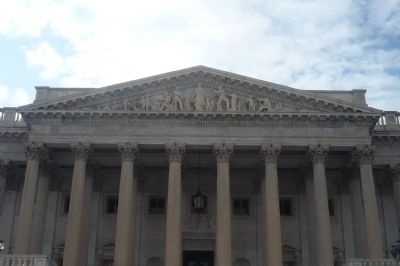
Photographed by Richard E. Miller, February 21, 2010
5. The Progress of Civilization
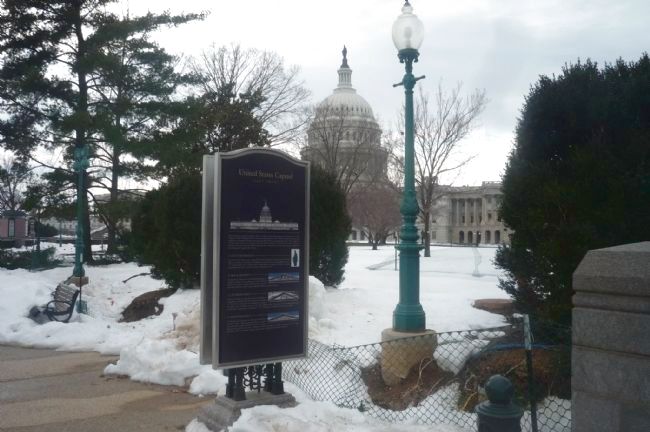
Photographed by Richard E. Miller, February 21, 2010
6. United States Capitol Marker
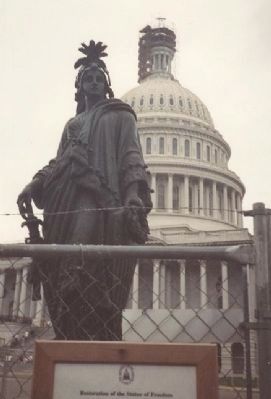
Photographed by Richard E. Miller, 1993
7. The Statue of Freedom - under renovation, 1993
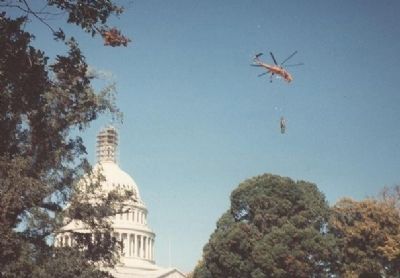
Photographed by Richard E. Miller, 1993
8. The Statue of Freedom - returning to the Capitol dome
Photographed by Richard E. Miller, February 21, 2010
9. The Statue of Freedom - E Pluribus Unum
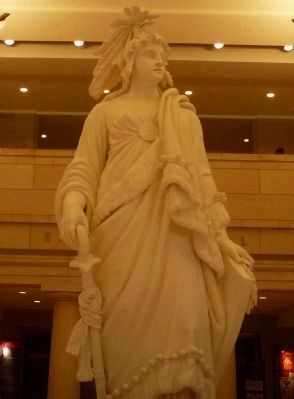
Photographed by Richard E. Miller, December 30, 2010
10. The plaster model for the Statue of Freedom
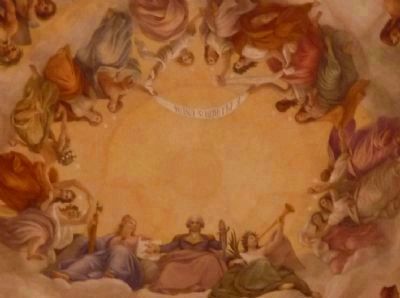
Photographed by Richard E. Miller, December 30, 2010
11. "E Pluribus Unum"
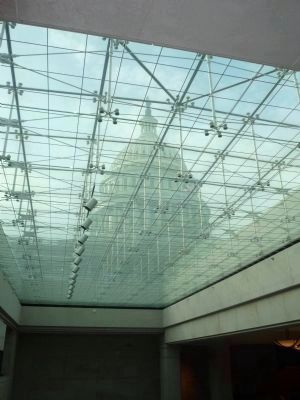
Photographed by Richard E. Miller, December 30, 2010
12. United States Capitol dome
Credits. This page was last revised on August 23, 2025. It was originally submitted on February 21, 2010, by Richard E. Miller of Oxon Hill, Maryland. This page has been viewed 2,537 times since then and 36 times this year. Last updated on December 13, 2017, by Devry Becker Jones of Washington, District of Columbia. Photos: 1, 2, 3, 4, 5, 6, 7, 8, 9. submitted on February 21, 2010, by Richard E. Miller of Oxon Hill, Maryland. 10, 11, 12. submitted on February 6, 2011, by Richard E. Miller of Oxon Hill, Maryland. • Bill Pfingsten was the editor who published this page.
