Max Stirner
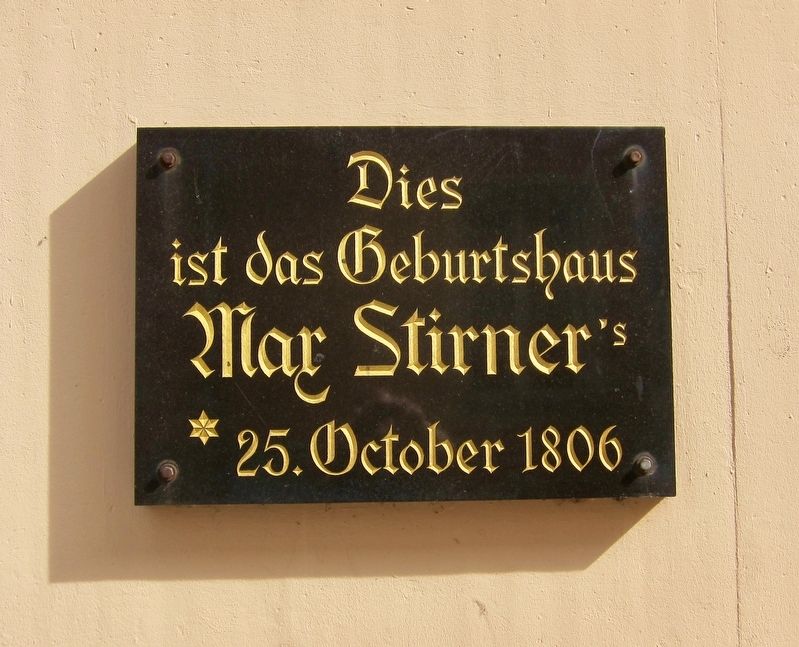

ist das Geburtshaus
Max Stirner's
✶25. October 1806
This is the birthplace of Max Stirner, born October 25, 1806.
Topics. This historical marker is listed in this topic list: Arts, Letters, Music. A significant historical date for this entry is October 25, 1806.
Location. 49° 56.65′ N, 11° 34.502′ E. Marker is in Bayreuth, Bayern (Bavaria). It is at the intersection of Brautgasse and Maximilianstrasse, on the left when traveling south on Brautgasse. Touch for map. Marker is at or near this postal address: 31 Maximilianstrasse, Bayreuth BY 95444, Germany. Touch for directions.
Regionally, this marker is in German Franconia. Globally, it is in Europe, the European Union, Atlantic Europe, Central Europe, the Schengen Area, Western Europe, and the Western World. Historically, it finds itself in what was once the Holy Roman Empire and also the former West Germany.
Other nearby markers. At least 8 other markers are within walking distance of this marker: Altes Rathaus / Old Town Hall (a few steps from this marker); a different marker also named Max Stirner (a few steps from
this page online
Another marker is no longer nearby. Ein grösserer Meister: Joseph Haydn / A Greater Master: Joseph Haydn (was a few steps from this marker but has been permanently removed).
Also see . . .
1. Max Stirner (Wikipedia). "Johann Kaspar Schmidt (October 25, 1806 – June 26, 1856), better known as Max Stirner, was a German philosopher. He is often seen as one of the forerunners of nihilism, existentialism, psychoanalytic theory, postmodernism, and individualist anarchism. Stirner's main work is The Ego and Its Own, also known as The Ego and His Own (Der Einzige und sein Eigentum
2. Max Stirner (Stanford Encyclopedia of Philosophy). "... both the form and content of Stirner's work are disconcerting. He challenges expectations about how political and philosophical argument should be conducted, and seeks to shake the reader's confidence in the moral and political superiority of contemporary civilisation (over its historical predecessors). In particular, he provides a sweeping attack on the modern world as increasingly dominated by religious modes of thought and oppressive social institutions, together with a much briefer sketch of a radical ‘egoistic’ alternative in which individual autonomy might flourish. The historical impact of The Ego and Its Own is not easy to assess. However, Stirner's book can certainly be said to have had an immediate and destructive impact on contemporary left-Hegelianism, to have played a significant role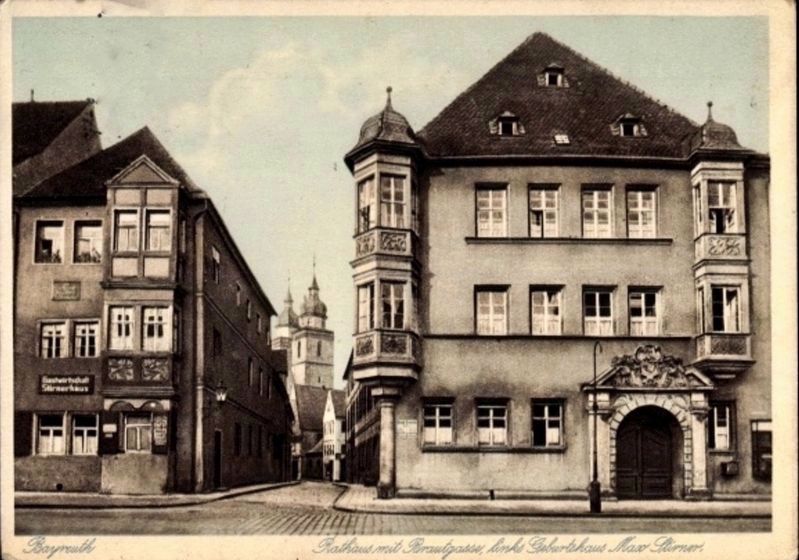
Additional keywords. Philosophy nihilism Gedenktafel
Credits. This page was last revised on January 28, 2022. It was originally submitted on December 14, 2017, by Andrew Ruppenstein of Lamorinda, California. This page has been viewed 750 times since then and 64 times this year. Photos: 1, 2, 3. submitted on December 14, 2017, by Andrew Ruppenstein of Lamorinda, California.
