St. Augustine in St. Johns County, Florida — The American South (South Atlantic)
Casa Horruytiner
Photographed by Cosmos Mariner, December 20, 2017
1. Casa Horruytiner Marker
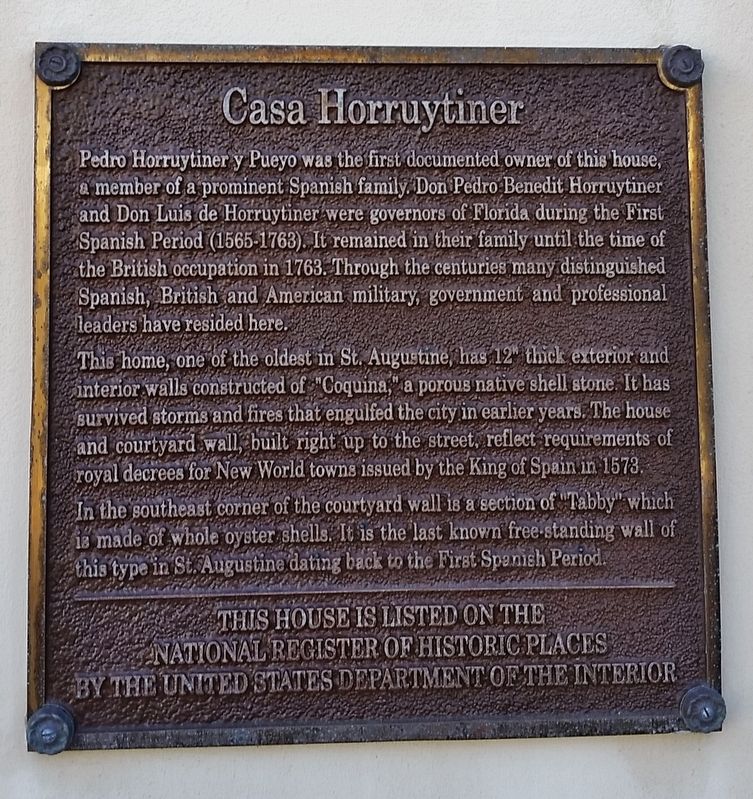
Pedro Horruytiner y Pueyo was the first documented owner of this house, a member of a prominent Spanish family. Don Pedro Benedit Horruytiner and Don Luis de Horruytiner were governors of Florida during the First Spanish Period (1565-1763). It remained in their family until the time of the British occupation in 1763. Through the centuries many distinguished Spanish, British and American military, government and professional leaders have resided here.
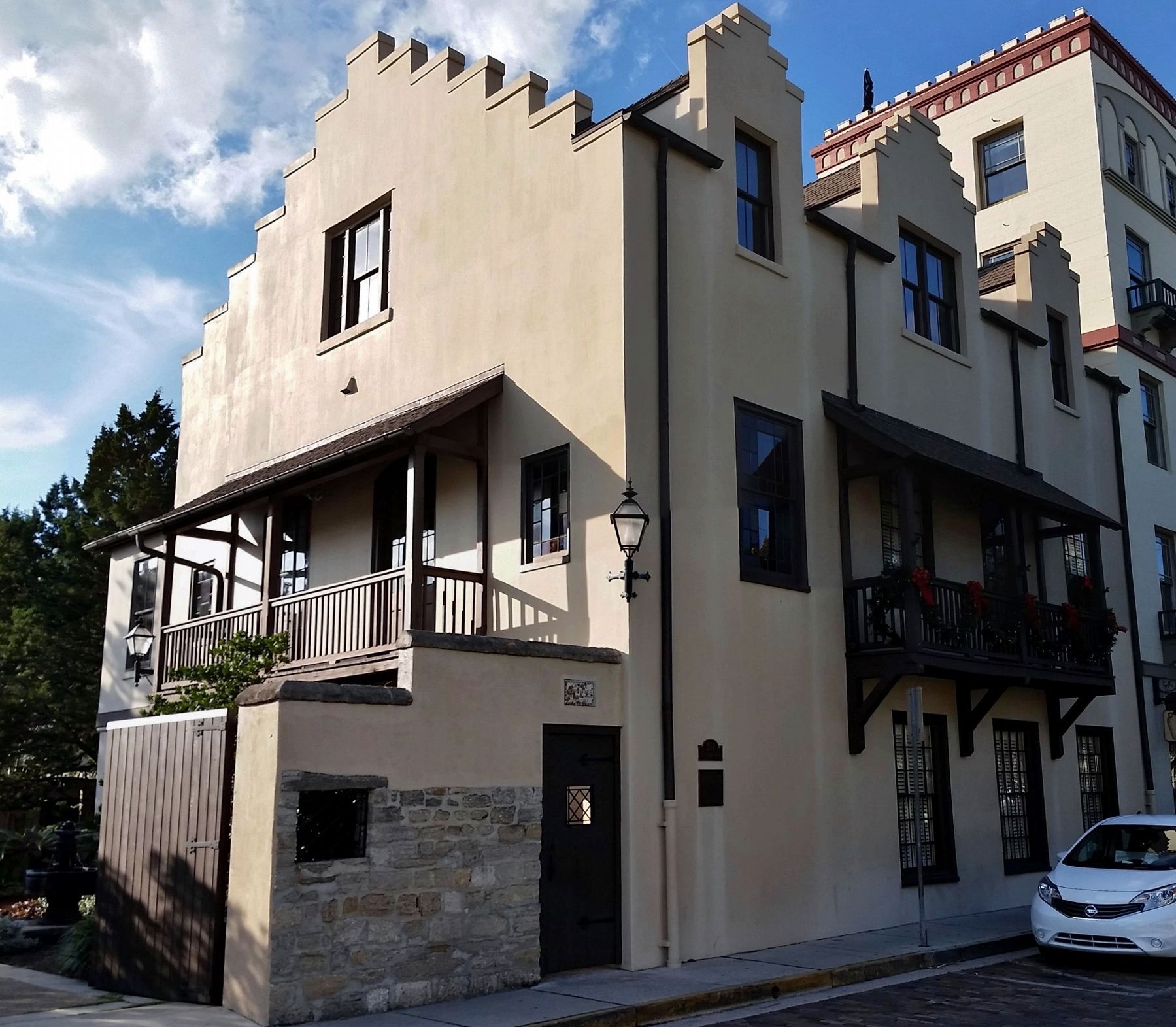
This home, one of the oldest in St. Augustine, has 12” thick exterior and interior walls constructed of “Coquina,” a porous native shell stone. It has survived storms and fires that engulfed the city in earlier years. The house and courtyard wall, built right up to the street, reflect requirements of royal decrees for New World towns issued by the King of Spain in 1573.
In the southeast corner of the courtyard wall is a section of “Tabby” which is made of whole oyster shells. It is the last known free-standing wall of this type in St. Augustine dating back to the First Spanish Period.
Topics.
this page online
Location. 29° 53.502′ N, 81° 18.763′ W. Marker is in St. Augustine, Florida, in St. Johns County. It is on Saint George Street south of King Street (Business U.S. 1), on the right when traveling south. Marker is mounted directly on subject building, near the southeast corner. Touch for map. Marker is at or near this postal address: 214 Saint George Street, Saint Augustine FL 32084, United States of America. Touch for directions.

Regionally, this marker is in First Coast and in Greater Jacksonville. It is also in the American South and on the Eastern Seaboard. Globally, it is in the North Atlantic Region, North America, a Gulf of Mexico state, the Western Hemisphere, the Western World, and the Anglosphere. Historically, it finds itself in what was once New Spain, the territory of the Mississippian Culture, one of the Confederate States of America, and the Antebellum South.
Other nearby markers. At least 8 other markers are within walking distance of this marker: Trinity Episcopal Church (within shouting
Photographed by Cosmos Mariner, December 20, 2017
2. Casa Horruytiner Marker (tall view)
Another marker is no longer nearby. Spanish Public Well (was within shouting distance of this marker but has been confirmed missing).
Also see . . .
1. Don Pedro Horruytiner House.
A house can be identified on the site with some degree of certainty at the time of the first Spanish evacuation in 1763. This is described as a "house of stone" belonging to Don Pedro Benedit Horruytiner y Pueyo. When Charles Howard bought the property from Robert Gatherwood in 1785, he described the house as "uninhabitable." When Howard sold the property to Juan Cavedo
Photographed by Cosmos Mariner, December 20, 2017
3. Casa Horruytiner Marker (wide view; marker visible at eye-level, just right of door)
2. Pedro Benedit Horruytiner.
Pedro Benedit Horruytiner was appointed acting co-governor of Florida on 11 April 1646. Horruytiner's term as interim governor of Florida ended on 8 January 1648; he was reappointed as governor on 19 October 1651. He retired on 18 June 1654, and was replaced by Diego de Rebolledo. Horruytiner died at the age of 71 on November 20, 1684, still in the service of the Spanish Crown. (Submitted on December 21, 2017, by Cosmos Mariner of Cape Canaveral, Florida.)
Photographed by Cosmos Mariner, December 20, 2017
4. Tabby Wall
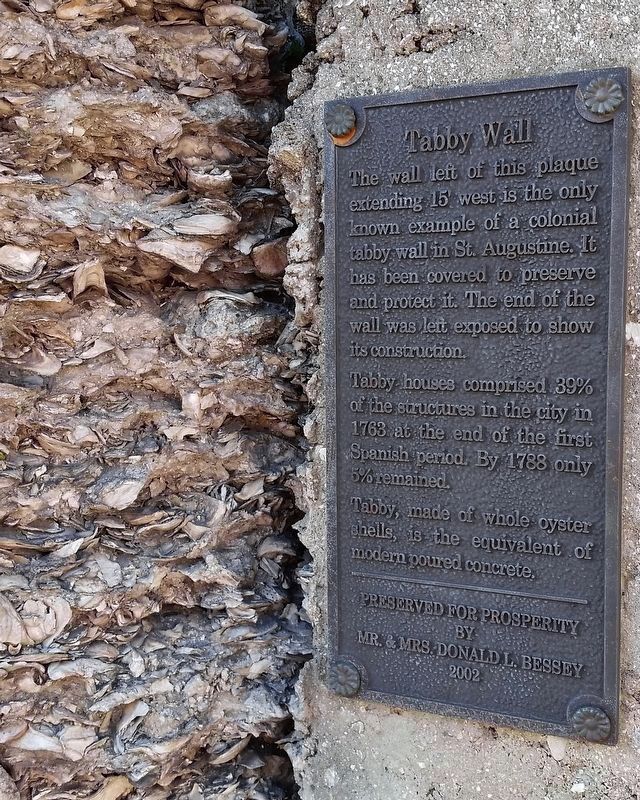
The wall left of this plaque extending 15’ west is the only known example of a colonial tabby wall in St. Augustine. It has been covered to preserve and protect it. The end of the wall was left exposed to show its construction.
Tabby houses comprised 39% of the structures in the city in 1763 at the end of the first Spanish period. By 1788 only 5% remained.
Tabby, made of whole oyster shells, is the equivalent of modern poured concrete.
by
Mr. & Mrs. Donald L. Bessey
2002
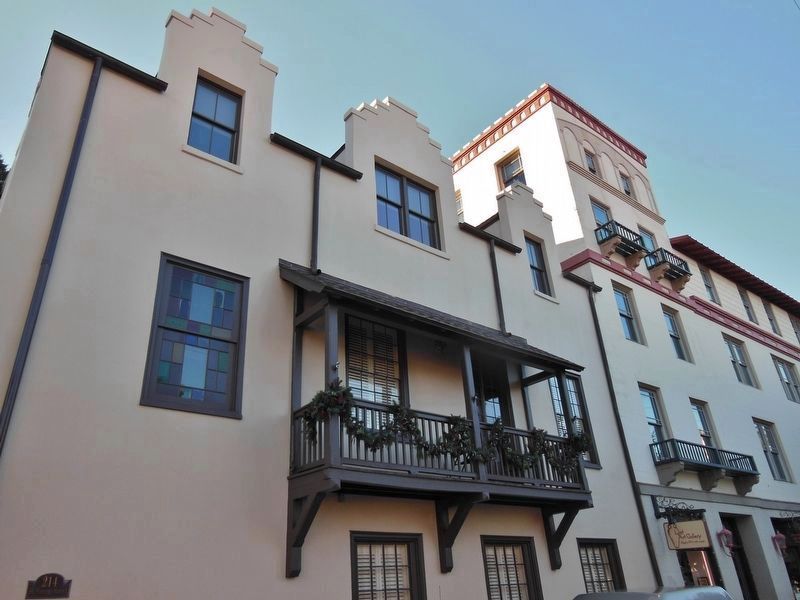
Photographed by Cosmos Mariner, December 18, 2013
5. Casa Horruytiner Balcony
Credits. This page was last revised on January 2, 2019. It was originally submitted on December 20, 2017, by Cosmos Mariner of Cape Canaveral, Florida. This page has been viewed 2,171 times since then and 138 times this year. Photos: 1, 2. submitted on December 20, 2017, by Cosmos Mariner of Cape Canaveral, Florida. 3, 4. submitted on December 21, 2017, by Cosmos Mariner of Cape Canaveral, Florida. 5. submitted on November 22, 2018, by Cosmos Mariner of Cape Canaveral, Florida. • Bernard Fisher was the editor who published this page.
