Fredericksburg, Virginia — The American South (Mid-Atlantic)
A Walking Tour of Fredericksburg’s Historic Old Mill District
Photographed by Dawn Bowen, June 2, 2007
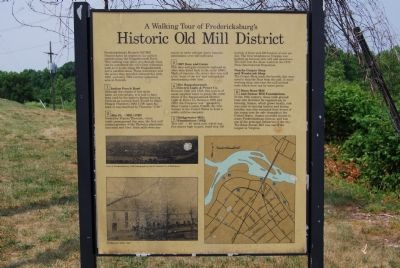
1. Historic Old Mill District Marker
Fredericksburg’s Historic Old Mill District dates its origins to the earliest settlers along the Rappahannock River. This walking tour takes you through what can be considered the city’s first industrial park as it winds along the Rappahannock and a parallel canal. These waterways and the power they provided allowed this 18th, 19th, and early 20th century industrial area to flourish.
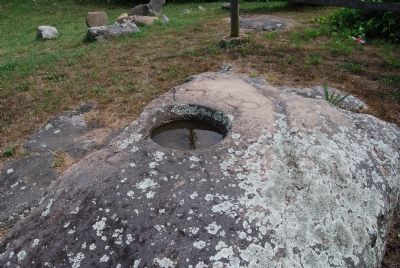
1. Indian Punch Bowl
Although the origins of this stone basin are not certain, it is said to have been used by the Indians during hunting festivals as a punch bowl. Found by Major Francis Thornton (1682-1758) upon his land, it was inscribed by Thornton “1720.”
2. Site First Mill (1720)
Owned by Francis Thornton, whose lands encompassed this area, the first mill ground produce of the the Thornton plantation into meal and flour . Such mills were necessary in early colonial times, because plantations were self-sufficient.
3. 1907 Dam and Gates
This dam and gate structure replaced an older dam dated back to the early 1800’s. Made of concrete, the newer dam was said to be “State of the art” and replaced the
this page online
4. Site Rappahannock Electric Light & Power Company
Between 1822 and 1922, this section of canal supplied water to power the water wheel of the Rappahannock Electric Light & Power Co. Between 1900 and 1923, the Company was managed by Ellen Caskie London Ficklin, the first woman in the United States to head a public utilities company.
5. Bridgewater Mills Foundations (1822)
This 150’ x 40’ brick mill, which was five stories high in part, could ship 150 barrels of flour and 400 bushels of corn per day. The first telephone in Virginia was hooked up between this mill and downtown. The mill won the silver medal at the 1878 Paris International Exposition. Nearby Cooper Chop and Woodwork Shop The Cooper Shop made barrels that were used to ship the flour from the mill. A wood-working shop, also near the mill, utilized tools which were run by water power.
6. Knox Bone Mill and Sumac Mill Foundations
In the 19th century, these mills ground bone into fertilizer for regional use in farming, Sumac, which grows locally, and was used in tanning leather and dyeing textiles, was also extracted from leaves of the
Photographed by Dawn Bowen, June 4, 2007
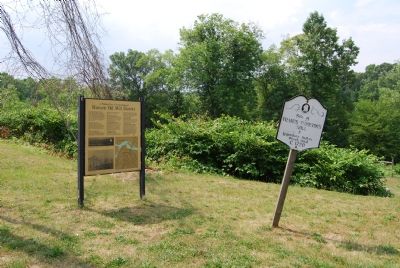
2. View of marker site along Rappahannock River
Topics. This historical marker is listed in this topic list: Industry & Commerce. A significant historical year for this entry is 1720.
Location. Marker is missing. It was located near 38° 19.18′ N, 77° 28.528′ W. Marker was in Fredericksburg, Virginia. It was at the intersection of Riverside Drive and Charles Street on Riverside Drive. Touch for map. Marker was in this post office area: Fredericksburg VA 22401, United States of America. Touch for directions.

Regionally, this marker was in the Washington Metropolitan Area and in Northern Virginia. It was also in the American South and specifically in the Upper South. Globally, it was in North America, the Western Hemisphere, the Western World, and the Anglosphere. Historically, it found itself in what was once the territory of the Mississippian Culture, one of the original Thirteen Colonies, one of the Confederate States of America, and the Antebellum South.
Photographed by Dawn Bowen, June 4, 2007
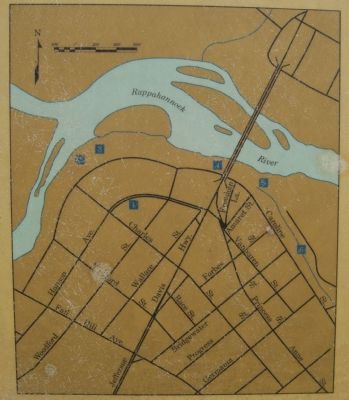
3. Map showiing mill sites
Other nearby markers. At least 10 other markers are within walking distance of this location: Contact: An Industrial Society Confronts A Native American Culture (a few steps from this marker); Harnessing The River's Power (within shouting distance of this marker); Amoroleck Encounters John Smith (about 500 feet away, measured in a direct line); Tobacco and Iron (about 600 feet away); The Falmouth Crossing (about 600 feet away); M 1897 M4 (approx. ¼ mile away); Veterans of Foreign Wars Eternal Flame (approx. ¼ mile away); Killed in Action Memorials (approx. ¼ mile away); Transportation and Settlement (approx. ¼ mile away); Capt. John Smith (approx. ¼ mile away). Touch for a list and map of all markers in Fredericksburg.
Related markers. Click here for a list of markers that are related to this marker. To better understand the relationship, study each marker in the order shown.
Photographed by Dawn Bowen, June 4, 2007
4. Indian Punch Bowl
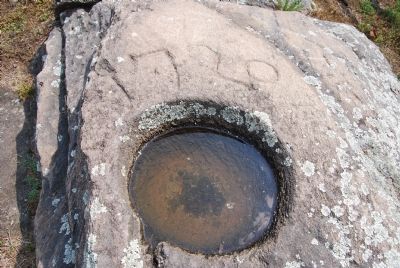
Photographed by Dawn Bowen, June 4, 2007
5. Indian Punch Bowl, note date of 1720 inscribed above
Credits. This page was last revised on December 13, 2024. It was originally submitted on June 2, 2007, by Dawn Bowen of Fredericksburg, Virginia. This page has been viewed 2,410 times since then and 70 times this year. Last updated on June 10, 2007, by Dawn Bowen of Fredericksburg, Virginia. Photos: 1. submitted on June 2, 2007, by Dawn Bowen of Fredericksburg, Virginia. 2, 3, 4, 5. submitted on June 4, 2007, by Dawn Bowen of Fredericksburg, Virginia. • J. J. Prats was the editor who published this page.
