Georgetown in Northwest Washington in Washington, District of Columbia — The American Northeast (Mid-Atlantic)
Early African American Georgetown
Photographed by Devry Becker Jones (CC0), February 2, 2018
1. Early African American Georgetown Marker
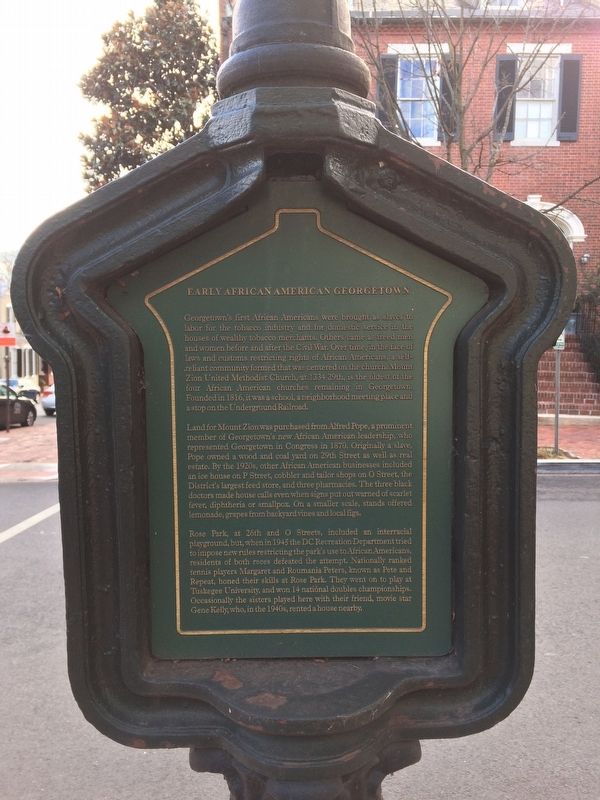
Georgetown's first African Americans were brought as slaves to labor for the tobacco industry and for domestic service in the houses of wealthy tobacco merchants. Others came as freed men and women before and after the Civil War. Over time, in the face of laws and customs restricting right of African Americans, a self-reliant community formed that was centered on the church. Mount Zion United Methodist Church, at 1334 29th, is the oldest of the four African American churches remaining in Georgetown. Founded in 1816, it was a school, neighborhood meeting place and a stop on the Underground Railroad.
Land for Mount Zion was purchased from Alfred Pope, a prominent member of Georgetown's new African American leadership, who represented Georgetown in Congress in 1870. Originally a slave, Pope owned a wood and coal yard on 29th Street as well as real estate. By the 1920s, other African American businesses included an ice house on P Street, cobbler and tailor shops on O Street, the Districts largest feed store, and three pharmacies. The three black doctors made house calls even when signs put out warned of scarlet fever,
this page online
Rose Park, at 26th and O Streets, included an interracial playground, but when in 1945 the DC Recreation Department tried to impose new rules restricting the park's use to African Americans, residents of both races defeated the attempt. Nationally ranked tennis players Margaret and Roumania Peters, known as Pete and Repeat, honed their skills at Rose Park. They went on to play at Tuskegee University, and won 14 national doubles championships. Occasionally the sisters played here with their friends, movie star Gene Kelly, who in the 1940s, rented a house nearby.
Erected by Cultural Tourism DC.
Topics and series. This historical marker is listed in these topic lists: African Americans • Industry & Commerce • Religion & Religious Structures • Sports. In addition, it is included in the DC, Art on Call, and the Historically Black Colleges and Universities series lists. A significant historical year for this entry is 1334.
Location. 38° 54.414′ N, 77° 3.494′ W. Marker is in Northwest Washington in Washington,
Photographed by Devry Becker Jones (CC0), February 2, 2018
2. Early African American Georgetown Marker

Regionally, this marker is in the Washington Metropolitan Area. It is also in the American Northeast, in the Upper South, in the Mid-Atlantic, in the Tidewater, and in the Chesapeake Bay Region. Globally, it is in North America, the Western Hemisphere, the Western World, and the Anglosphere.
Other nearby markers. At least 8 other markers are within walking distance of this marker: Stately Houses and Gardens (within shouting distance of this marker); The Colonial (about 300 feet away, measured in a direct line); Suter Home (about 300 feet away); Hyde House (about 300 feet away); Mount Zion United Methodist Church and Heritage Center, and the Female Union Band Cemetery (about 400 feet away); John Laird (about 400 feet away); Mt. Zion United Methodist Church (about 400 feet away); Mt. Zion United Methodist Church Parsonage
Photographed by Devry Becker Jones (CC0), February 2, 2018
3. Early African American Georgetown Marker
Another marker is no longer nearby. The Colonial (was about 300 feet away but has been replaced with another marker now near it).
Credits. This page was last revised on January 30, 2023. It was originally submitted on February 2, 2018, by Devry Becker Jones of Washington, District of Columbia. This page has been viewed 567 times since then and 40 times this year. Photos: 1, 2, 3. submitted on February 2, 2018, by Devry Becker Jones of Washington, District of Columbia. • Bill Pfingsten was the editor who published this page.
