
Haynie-Sirrine in Greenville in Greenville County, South Carolina — The American South (South Atlantic)
Furman University
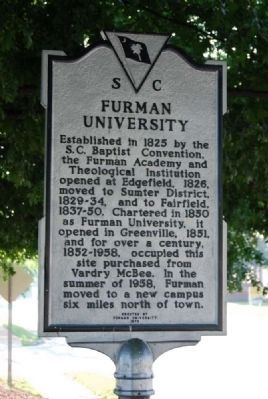
Photographed by Brian Scott, 2008
1. Furman University Marker
Erected 1975 by Furman University. (Marker Number 23-14.)
Topics. This historical marker is listed in these topic lists: Education • Religion & Religious Structures. A significant historical year for this entry is 1825.
Location. 34° 50.408′ N, 82° 24.202′ W. Marker is in Greenville, South Carolina, in Greenville County. It is in Haynie-Sirrine. It is at the intersection of University Ridge and Thurston Street on University Ridge. Touch for map. Marker is in this post office area: Greenville SC 29601, United States of America. Touch for directions.

Regionally, this marker is in Upstate. It is also in the American South, specifically in the Deep South, in Appalachia, and specifically in Southern Appalachia. Globally, it is in North America, the Western Hemisphere, the Western World, and the Anglosphere. Historically, it finds itself in what was once the original Cherokee Nation, the territory of the Mississippian Culture, one of the original Thirteen Colonies, one of the Confederate States of America, and the Antebellum South.
Other nearby markers. At least 10 other markers are within walking distance of this marker: Greenville County Veterans Memorial / Greenville County Medal of Honor (about 700 feet away, measured in a direct line); Claussen’s Bakery (approx. 0.2 miles away); Chancellor Waddy Thompson (approx. 0.2 miles away); Clay Buchholz (approx. ¼ mile away); Jim Rice
this page online
Another marker is no longer nearby. Reedy River Falls Historic Park (was approx. ¼ mile away but has been permanently removed).
More about this marker. The site is the current home of the Greenville County offices.
Regarding Furman University. Furman University is the oldest private higher education facility in South Carolina. It offers majors and courses in 42 subjects and is one of a few colleges that qualifies for a chapter of Phi Beta Kappa.
Also see . . .
1. Furman University. Furman University is a private, coeducational, non-sectarian university in Greenville, South Carolina, United States. (Submitted on March 21, 2009, by Brian Scott of Anderson, South Carolina.)
2. Furman University. Official website of Furman University. (Submitted on September 26, 2009, by Brian Scott of Anderson, South Carolina.)
3. "Look at Furman" (1950s Promotional Video).
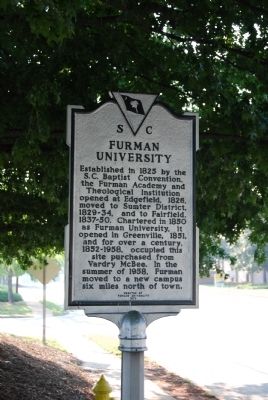
Photographed by Brian Scott, July 12, 2008
2. Furman University Marker
Additional commentary.
1. Post-antebellum Furman
At Furman, the faculty, rather than the trustees or the state Baptist Convention, took the initiative to reopen the institution in February 1866 with 140 students. The number declined, and the college closed in 1868. Nevertheless, President James C. Furman refused to give up. He told the Reedy River Baptist Association: "I have been urged to abandon the university and seek a field of labor more certain. But I have resolved, if the university should go down, to sink with it." Classes resumed in February 1869, and an endowment fund of two hundred thousand dollars was pledged to allow students free tuition. But by 1879 many of the bondholders defaulted on their payments, and most of the faculty resigned. In 1881 Dr. Charles Manly, former pastor of the First Baptist Church of Greenville, became president. The prospects of Furman began to improve, and by the time Manly resigned as president in 1898, the future of the institution was secure. Manly was
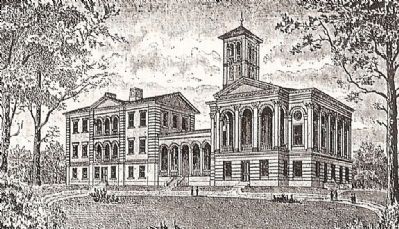
Special Collections, Greenville County Library, Greenville, 1901
3. Furman University Engraving
The music building to the left of the bell tower and the right building make up the entire Furman campus. This engraving comes from a 1901 Greenville city directory.
— Submitted September 26, 2009, by Brian Scott of Anderson, South Carolina.
2. About James Clement Furman
Born in Charleston, James Furman’s legacy is the service and devotion he gave to his namesake university, which is actually named for his father, Dr. Richard Furman, a Baptist minister and denominational leader. The junior Furman began his tenure as a member of the Furman University faculty while it was still located north of Columbia in Fairfield. He would, working with members of the school’s board of trustees, campaign over the next six years to persuade the state Baptist Convention to move the school to Greenville, where it eventually opened in 1851 in McBee Hall. He would
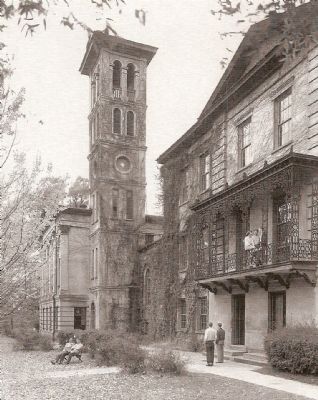
Special Collections, South Carolina Library, USC Columbia, April 13, 2009
4. Furman University (1854)
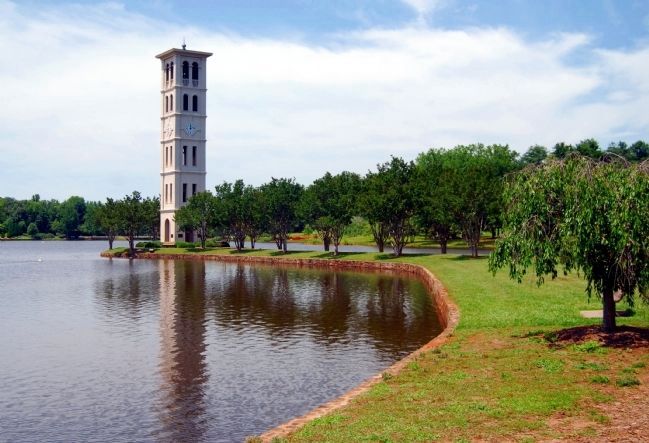
Furman Campus was designed by Edward C. Jones of Charleston. The Italian-style bell tower was rung each time there was a southern victory during the Civil War. The campus was demolished in 1961 but the bell tower was recreated on Furman's current campus. It now chimes each time there is a Furman athletic victory.
Furman, an ardent states’ rights supporter, was heavily involved in politics, as well. In 1860, he secured an appointment as one of the Greenville delegates to attend the Secession Convention, a meeting that would eventually lead South Carolina to become the first Southern state to secede from the Union. On December 20, 1860, Furman was one of the signers of the Ordinance of Secession. (Source: G: The Magazine of Greenville, Jan/Feb 09 pg 70.)
— Submitted March 21, 2009, by Brian Scott of Anderson, South Carolina.
3. James Clement Furman: History in Brief
At a Glance James Furman became an influential political figure in the community and a leader at Furman University, a school that his father, Dr. Richard Furman, worked to found.
Claim to Fame Furman is best known for his efforts to have Furman University moved from Fairfield, South Carolina, to Greenville in 1851, where it opened in McBee Hall on the corner of Main Street and McBee Avenue. He was chairman of the faculty before later becoming president.
Did You Know? Furman University
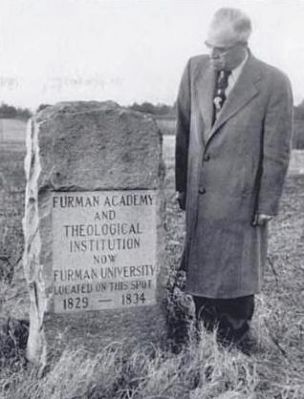
Photographed by College History Series: Furman University
5. Furman University Marker in the
High Hills of the Santee
High Hills of the Santee
An Impressive Eulogy At an 1870 commemoration of the death of Confederate General Robert E. Lee, Furman was a featured speaker. (Source: G: The Magazine of Greenville, Jan/Feb 09, pg 70.)
— Submitted March 21, 2009, by Brian Scott of Anderson, South Carolina.
4. About Vardry McBee
Vardry McBee was perhaps the most pivotal figure in the history of our city and Greenville County as a whole, thanks to his business acumen and impressive foresight for how the community could grow and prosper.
A product of the Carolina frontier, McBee was born in 1775 on the eve of the American Revolution, a conflict that would prove formative in his early years. Both his father and older brother fought with the Patriots, at King’s Mountain and the Battle of Cowpens. McBee himself never fought for American independence, but instead used his
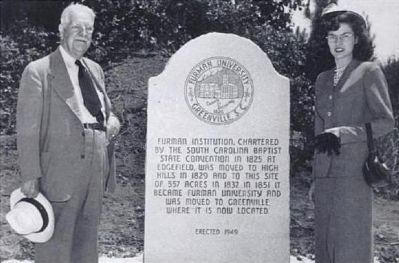
Photographed by College History Series: Furman University
6. Alester Garden Furman, Jr. and Wife, Janet -
At Furman Marker in Winnsboro, SC (Fairfield County)
At Furman Marker in Winnsboro, SC (Fairfield County)
McBee opened the first textile mill on the Reedy River, but he saw value in a diversified economy. In his private business life, that meant he owned two flour mills, a cotton factory, and wool and paper mills. Publicly, even as he approached his 80s, it led him to champion the construction of a railroad line that connected Columbia and Greenville. In 1853, this line became the first rail to serve the community, and it would become a turning point in the economy of the town. (Source: G: The Magazine of Greenville, Jan/Feb 09, pg 66.)
— Submitted March 21, 2009, by Brian Scott of Anderson, South Carolina.
5. Vardry McBee: History in Brief
At a glance An industrialist and philanthropist, McBee worked to diversify the Southern economy while also promoting education and religion. He donated land for the city’s first four churches (four different denominations), as well as the male and female academies. Those efforts influenced Furman University’s move to Greenville (from just north of
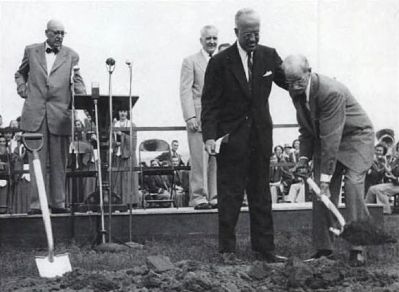
Photographed by College History Series: Furman University
7. Alester Garden Furman, Jr. -
Groundbreaking Ceremonies at New Campus
Groundbreaking Ceremonies at New Campus
Claim to fame In 1816, McBee bought the town of Greenville from landowner Lemuel Alston—all 11,028 acres of it.
Did You know? McBee was living in Lincolnton, North Carolina, when he purchased Greenville. Although he wouldn’t move to Greenville until 1836, McBee promoted Greenville as a summer resort and industrial center.
He said it “A man should be prudent and careful, (not a) bully of virtue, nor a bigot.” (Source: G: The Magazine of Greenville, Jan/Feb 09, pg 66.)
— Submitted September 26, 2009, by Brian Scott of Anderson, South Carolina.
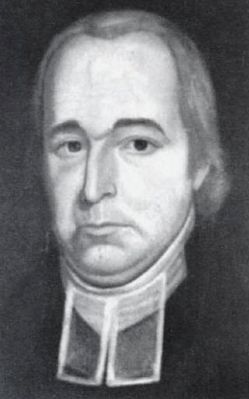
Photographed by College History Series: Furman University
8. Richard Furman
Colonial Baptist Minister
Namesake of Furman University
Colonial Baptist Minister
Namesake of Furman University
Furman University Library, Special Collections
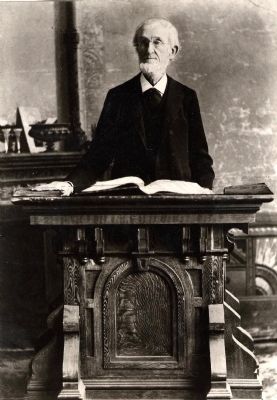
9. James Clement Furman
(1809-1981)
1st President of Furman University
(1809-1981)
1st President of Furman University
Photographed by Brian Scott, June 13, 2009
10. Furman University Bell Tower
Photographed by Brian Scott, April 25, 2009
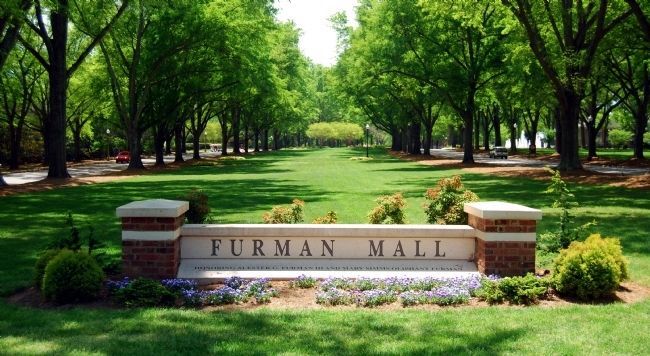
11. Furman University Mall
Photographed by Brian Scott, April 25, 2009
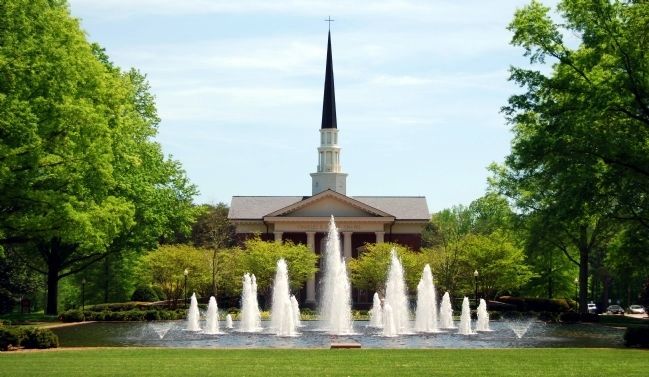
12. Daniel Chapel on Furman University Campus
Photographed by Brian Scott, May 9, 2009
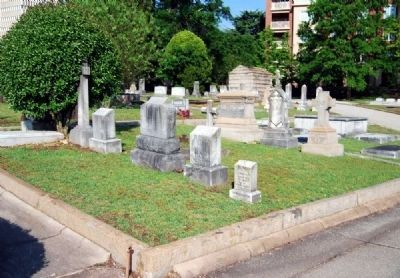
13. Furman University Plot -
Springwood Cemetery, Greenville SC
Springwood Cemetery, Greenville SC
Furman purchased 84 plots in 1868. Notables buried in the plot are Charles Judson (first professor hired by Furman University when the school moved to Greenville and the 12th President of the Greenville Female College), Mary Camilla Judson (the principal of the female college), James Clement Furman (first President of Furman University), James C. Furman II, M.D., and later Furman presidents Edwin Poteat and Dr. W.J. McGlothlin.
Photographed by Brian Scott, May 9, 2009
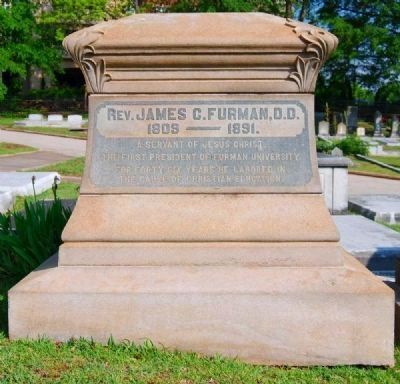
14. James Clement Furman Tombstone -
Springwood Cemetery, Greenville, SC
Springwood Cemetery, Greenville, SC
1809-1891
A servant of Jesus Christ
The First President of Furman University
For forty six years he labored in
the cause of Christian education.
Credits. This page was last revised on February 16, 2023. It was originally submitted on July 12, 2008, by Brian Scott of Anderson, South Carolina. This page has been viewed 4,999 times since then and 181 times this year. Last updated on September 12, 2008, by Kelly Jean Lopez of Greenville, South Carolina. Photos: 1. submitted on September 26, 2009, by Brian Scott of Anderson, South Carolina. 2. submitted on July 12, 2008, by Brian Scott of Anderson, South Carolina. 3, 4. submitted on April 13, 2009, by Brian Scott of Anderson, South Carolina. 5. submitted on September 26, 2009, by Brian Scott of Anderson, South Carolina. 6. submitted on September 10, 2009, by Brian Scott of Anderson, South Carolina. 7. submitted on September 11, 2009, by Brian Scott of Anderson, South Carolina. 8. submitted on September 26, 2009, by Brian Scott of Anderson, South Carolina. 9. submitted on March 21, 2009, by Brian Scott of Anderson, South Carolina. 10, 11, 12. submitted on September 26, 2009, by Brian Scott of Anderson, South Carolina. 13, 14. submitted on May 17, 2009, by Brian Scott of Anderson, South Carolina. • Kevin W. was the editor who published this page.
