Audubon Park History
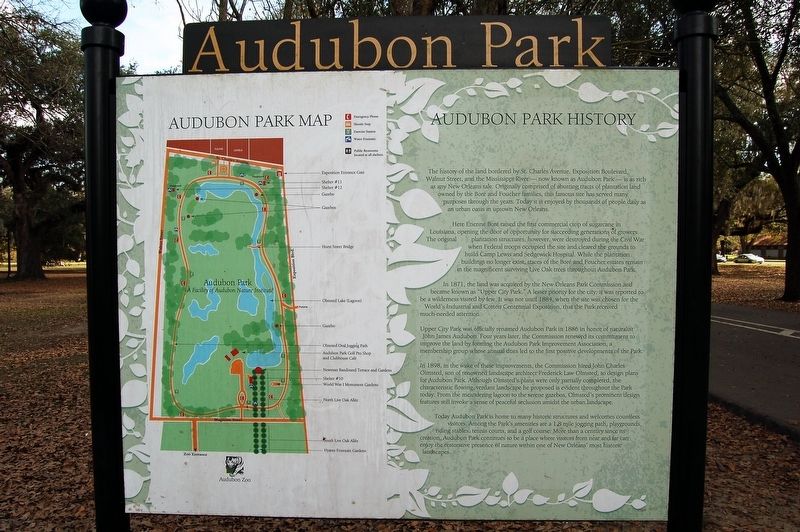
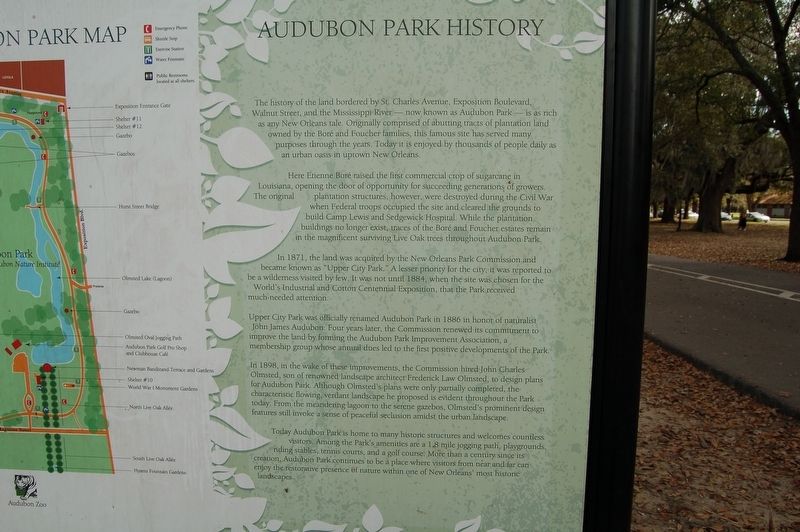
The history of the land bordered by St. Charles Avenue, Exposition Boulevard, Walnut Street and the Mississippi River - now known as Audubon Park - is as rich as any New Orleans tale. Originally comprised of abutting tracts of plantation land owned by the Boré and Foucher families, this famous site has served many purposes through the years. Today it is enjoyed by thousands of people daily as an urban oasis in uptown New Orleans.
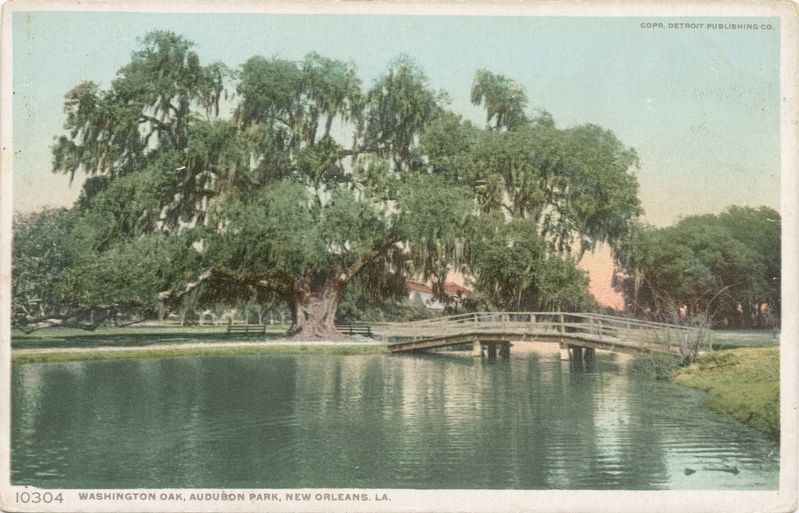
Here Etienne Boré raised the first commercial crop of sugarcane in Louisiana, opening the door of opportunity for succeeding generations of growers. The original plantation structures, however, were destroyed during the Civil War when Federal troops occupied the site and cleared the grounds to build Camp Lewis and Sedgewick Hospital. While the plantation buildings no longer exist, traces of the Boré and Foucher estates remain in the magnificent surviving Live Oak trees throughout Audubon Park.
In 1871, the land was acquired by the New Orleans Park Commission and became known as "Upper City Park.” A lesser priority for the city, it was reported to be a wilderness visited by few. It was not
this page online
Upper City Park was officially renamed Audubon Park in 1886 in honor of naturalist, John James Audubon. Four years later, the Commission renewed its commitment to improve the land by forming the Audubon Park Improvement Association, a membership group whose annual dues led to the first positive developments of the Park.
In 1898, in the wake of these improvements, the Commission hired John Charles Olmsted, son of renowned landscape architect Frederick Law Olmsted, to design plans for Audubon Park. Although Olmsted's plans were only partially completed, the characteristic flowing, verdant landscape he proposed is evident throughout the Park today. From the meandering lagoon to the serene gazebos, Olmsted's prominent design. features still invoke a sense of peaceful seclusion amidst the urban landscape.
Today Audubon Park is home to many historic structures and welcomes countless visitors. Among the Park's amenities are a 1.8 mile jogging path, playgrounds, riding stables, tennis courts, and a
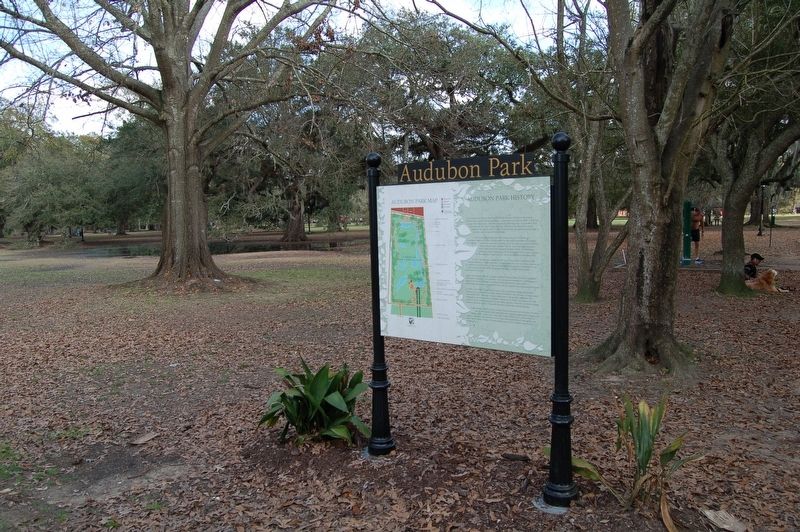
Erected by Audubon Park.
Topics. This historical marker is listed in this topic list: Parks & Recreational Areas.
Location. 29° 55.541′ N, 90° 7.704′ W. Marker is in New Orleans, Louisiana, in Orleans Parish. It is in Audubon. It is on Magazine Street south of Tea Room Drive. Touch for map. Marker is at or near this postal address: 6500 Magazine Street, New Orleans LA 70118, United States of America. Touch for directions.

Regionally, this marker is in one of Louisiana’s River Parishes. It is also in the American South, specifically in the Deep South, on the Gulf Coast, and in the Great River Road Region. Globally, it is in North America, a Gulf of Mexico state, the Western Hemisphere, the Western World, and the Anglosphere. Historically, it finds itself in what was once New Spain, the Viceroyalty of New France, the territory of the Mississippian
Other nearby markers. At least 8 other markers are within walking distance of this marker: Classic Designs (within shouting distance of this marker); Louisiana Roll Of Honor World War 1917-1919 (about 500 feet away, measured in a direct line); The Joseph Gumbel International Drive (about 700 feet away); Audubon Zoo (approx. 0.2 miles away); Audubon Zoo's Whooping Crane Legacy (approx. ¼ mile away); Grand Beginnings (approx. ¼ mile away); Boré Plantation - Audubon Park (approx. 0.3 miles away); DeDroit Residence (approx. 0.3 miles away). Touch for a list and map of all markers in New Orleans.
More about this marker. Located along the Audubon Park Trail path inside park at parking lot.
Credits. This page was last revised on August 18, 2023. It was originally submitted on February 22, 2018, by Cajun Scrambler of Assumption, Louisiana. This page has been viewed 2,151 times since then and 161 times this year. Photos: 1, 2, 3. submitted on February 22, 2018. 4. submitted on May 7, 2018.
