Natchez in Adams County, Mississippi — The American South (East South Central)
Three Archaeological Excavations
Photographed by Cajun Scrambler, May 27, 2017
1. Three Archaeological Excavations Marker
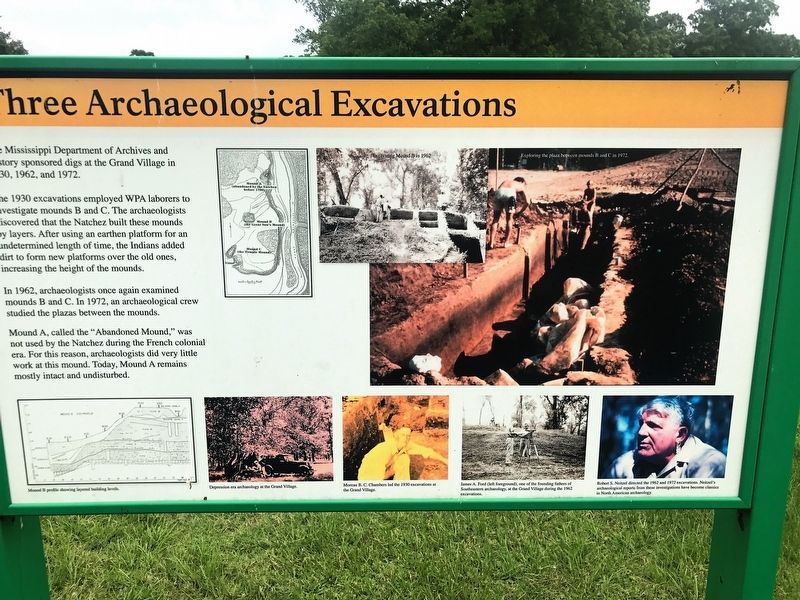
The Mississippi Department of Archives and History sponsored digs at the Grand Village in 1930, 1960 and 1972.
The 1930 excavations employed WPA laborers to investigate mounds B and C. The archaeologists discovered that the Natchez built these mounds by layers. After using an earthen platform for an undetermined length of time, the Indians added dirt to form new platforms over the old ones, increasing the height of the mounds.
In 1962, archaeologists once again examined mounds B and C. In 1972, an archaeological crew studied the plazas between the mounds.
Mound A, called the “Abandoned Mound,” was not used by the Natchez during the French colonial era. For this reason, archaeologists did very little work at this mound. Today, Mound A remains mostly intact and undisturbed.
Captions:
Excavating Mound B in 1962.
Exploring the plaza between mounds B and C in 1972.
Mound B profile showing layered building levels.
Depression era archaeology at the Grand Village.
Moreau B.C. Chambers led the 1930 excavations at the Grand Village.
James A. Ford (left foreground), one of the founding fathers of Southeastern archaeology,
this page online
Robert S. Neitzel directed the 1962 and 1972 excavations. Neitzel's archaeological reports from these investigations have become classics in North American archaeology.
Topics. This historical marker is listed in this topic list: Indigenous Peoples and Communities.
Location. 31° 31.409′ N, 91° 22.803′ W. Marker is in Natchez, Mississippi, in Adams County. It can be reached from Jeff Davis Boulevard near South Temple Road, on the right. Touch for map. Marker is at or near this postal address: 400 Jeff Davis Boulevard, Natchez MS 39120, United States of America. Touch for directions.

Regionally, this marker is in Southwest Mississippi and in Natchez Trace Corridor. It is also in the American South, specifically in the Deep South, and in the Great River Road Region. Globally, it is in North America, a Gulf of Mexico state, the Western Hemisphere, the Western World, and the Anglosphere. Historically, it finds itself in what was once New Spain, the Viceroyalty of New France, the territory of the Mississippian Culture, one
Photographed by Cajun Scrambler, May 27, 2017
2. Three Archaeological Excavations Marker
Other nearby markers. At least 8 other markers are within walking distance of this marker: Historical Archaeology - the Chief's House and Temple (here, next to this marker); Road to Fort Rosalie (within shouting distance of this marker); Historic Use of Ceremonial Mounds (within shouting distance of this marker); Conflict with the French (within shouting distance of this marker); Historic Plaza (about 300 feet away, measured in a direct line); Native Structures (about 300 feet away); Ceremonial Center (about 500 feet away); Abandoned Mound (about 600 feet away). Touch for a list and map of all markers in Natchez.
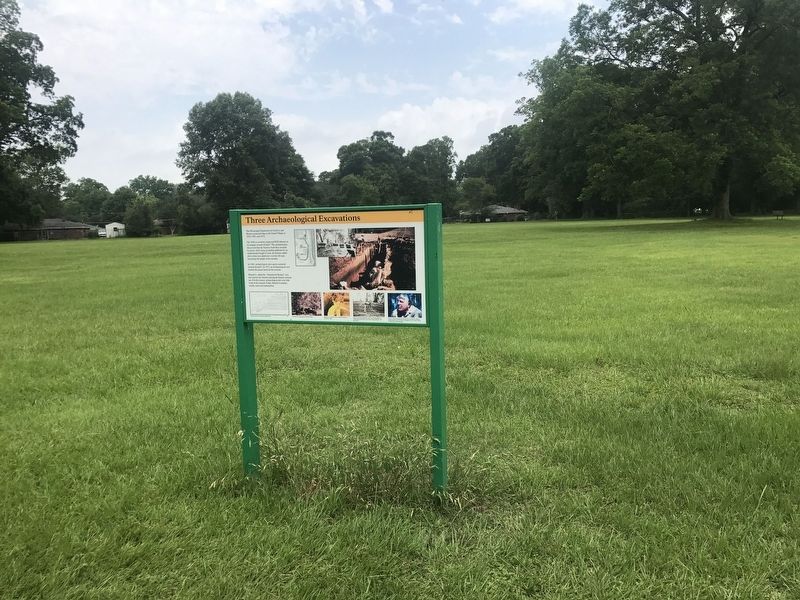
More about this marker. Located on the grounds of the Grand Village of the Natchez National Historic site.
Credits. This page was last revised on June 24, 2024. It was originally submitted on March 1, 2018, by Cajun Scrambler of Assumption, Louisiana. This page has been viewed 530 times since then and 37 times this year. Photos: 1, 2. submitted on March 1, 2018.
