
Salamanca, Guanajuato, Mexico — The Central Highlands (North America)
The Lord of the Hospital
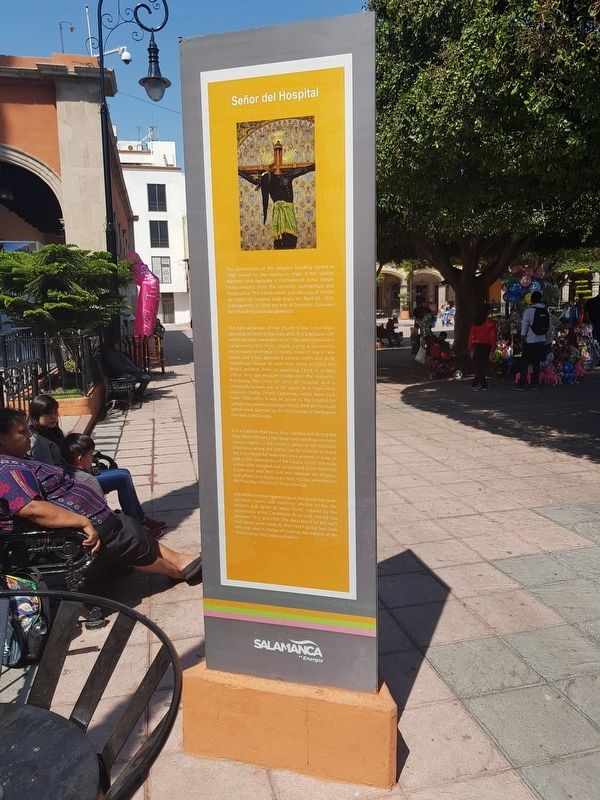
Photographed by J. Makali Bruton, March 3, 2018
1. The Lord of the Hospital Marker

El atractivo principal del templo es el Cristo Negro ubicado en su nicho principal del altar mayor, imagen religiosa que se venera desde el año de 1560 a su llegada a lo que hoy es la ciudad de Salamanca. Esta figura es de las originales durante la conquista espiritual, hecha de una técnica purépecha michoacana cuyo principal material es la pasta de caña de maíz, ha generado una versión milagrosa en cuanto a su misterioso cambio de color blanco a negro, la posición de su cuerpo, de un Cristo agonizante a un Cristo muerto y a los milagros que ha realizado a través de los siglos. Antes, el Cristo del Señor
this page online
Es ya una tradición que cada Martes Santo y durante la Semana Santa distintas peregrinaciones y danzas autóctonas provenientes de diferentes regiones del país se congregan en el Santuario Diocesano en el que los fieles piden milagros o dan las gracias por algún favor recibido del Cristo Negro. En el mes de junio, dentro del marco de las celebraciones del Corpus Christi, los gremios de oficios de trabajo ofrecen como ofrenda la cera escamada con motivos religiosos al Santísimo Sacramento y de paso se visita y se venera la imagen del Cristo de pasta de maíz. También se honra y venera esta sagrada imagen durante los festejos del Jueves de la Ascensión del Señor.
Además de esta enigmática figura, el interior del templo cuenta con siete excelentes pinturas murales clásicas con temas referentes a la vida, pasión y muerte de Jesucristo,
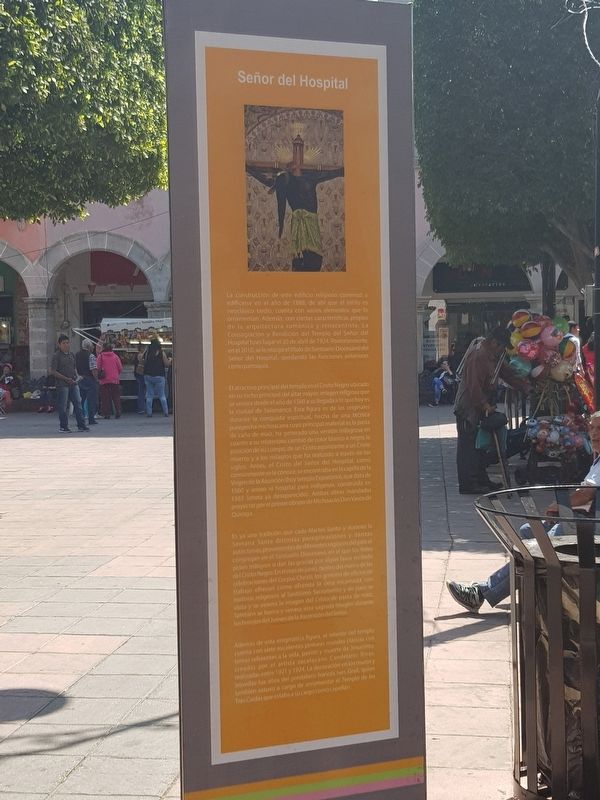
Photographed by J. Makali Bruton, March 3, 2018
2. The Lord of the Hospital Marker English side
(Señor del Hospital)
The best attraction of the church is the Cristo Negro placed at its niche in the main altar. It is a religious icon which has been venerated since 1560 when it arrived in Salamanca. The icon, made using a purepecha michoacana technique, is mostly made of maize cane paste, and it had generated various myths due to its mysterious change of color from white to black, the body’s position from an agonizing Christ
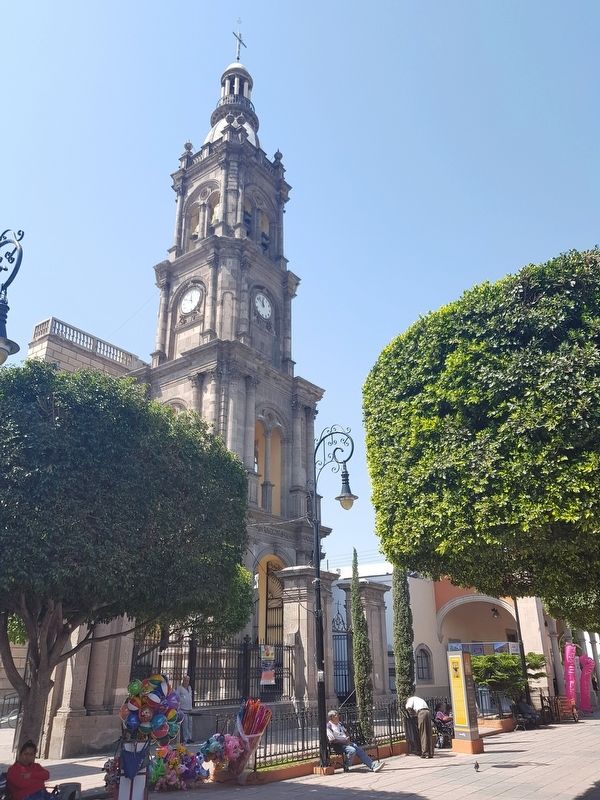
Photographed by J. Makali Bruton, March 3, 2018
3. The Lord of the Hospital Marker
It is a tradition that every Holy Tuesday and during the Holy Week different pilgrimages and native dances from various regions in the country gather at the Santuario Diocesano, where the faithful ask for miracles or thank the Cristo Negro for favor they were granted. In June, as part of the celebrations of the Corpus Christi, the trade unions offer shingled wax consecrated to the Santísimo Sacramento and then visit and venerate the religious icon of the Cristo de pasta del maíz. lt is also venerated on the Thursday of the Lord's Ascension Day.
In addition to this enigmatic figure, the church has seven excellent classic wall paintings allusive to the life, passion and death of Jesus Christ, created by the zacatenano artist Candelario
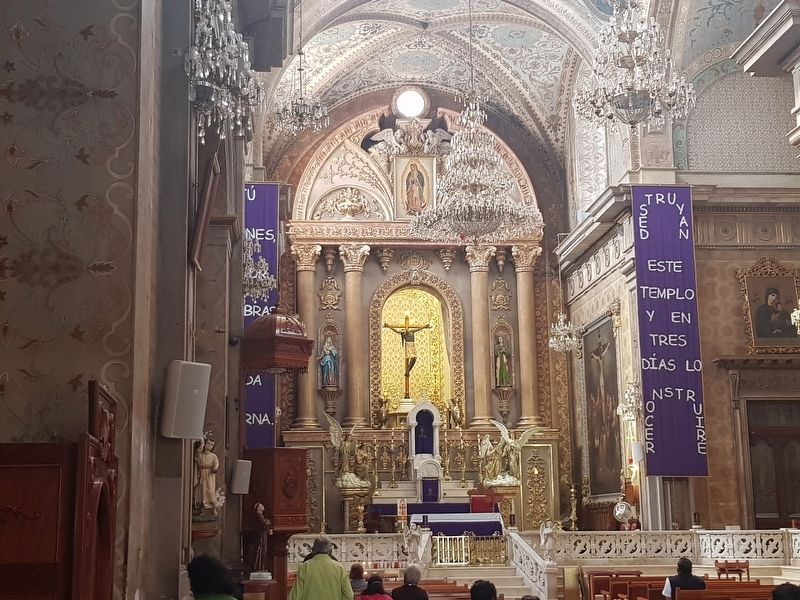
Photographed by J. Makali Bruton, March 3, 2018
4. The interior of the Lord of the Hospital Church, with the Black Christ seen in the distance
Topics. This historical marker is listed in these topic lists: Indigenous Peoples and Communities • Religion & Religious Structures. A significant historical date for this entry is April 30, 1924.
Location. 20° 34.116′ N, 101° 11.975′ W. Marker is in Salamanca, Guanajuato. It is on Calle Río Lerma just north of Calle Revolución, on the left when traveling north. The marker is just north of the Catholic Church of the Lord of the Hospital. Touch for map. Marker is in this post office area: Salamanca GTO 36700, Mexico. Touch for directions.

Regionally, this marker is in Central Mexico and in the Bajío. Globally, it is in North America, on the Ring of Fire, and in the Western Hemisphere. Historically, it finds itself in what was once New Spain, a Spanish colony, and the Aztec Empire.
Other nearby markers. At least 8 other markers are within walking distance of this marker: The Founders of Salamanca (within shouting
Photographed by J. Makali Bruton, March 3, 2018
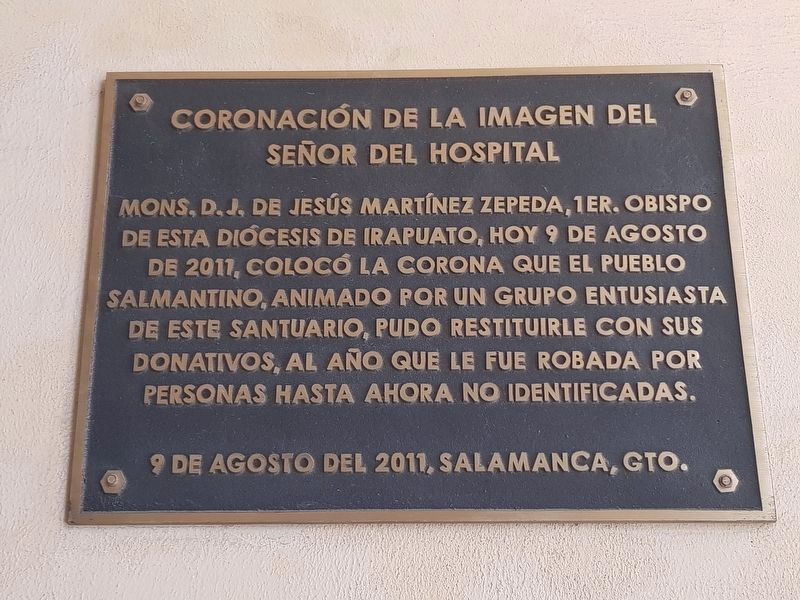
5. An additional, nearby marker on the restoration of the Black Christ's crown in 2011
This marker describes how the crown of the Black Christ at this church was stolen and then replaced by the congregants' donations in 2011. It reads:
Coronación de la Imagen del Señor del Hospital
Mons. D.J. de Jesús Martínez Zepeda, 1er. Obispo de esta Diócesis de Irapuato, hoy 9 de Agosto de 2011, colocó la corona que el pueblo salmantino, animado por un grupo entusiasta de este santuario, pudo restituirle con sus donativos, al año que le fue robada por personas hasta ahora no identificadas.
9 de Agosto del 2011, Salamanca, Gto.
Mons. D.J. de Jesús Martínez Zepeda, 1er. Obispo de esta Diócesis de Irapuato, hoy 9 de Agosto de 2011, colocó la corona que el pueblo salmantino, animado por un grupo entusiasta de este santuario, pudo restituirle con sus donativos, al año que le fue robada por personas hasta ahora no identificadas.
9 de Agosto del 2011, Salamanca, Gto.
Photographed by J. Makali Bruton, March 3, 2018
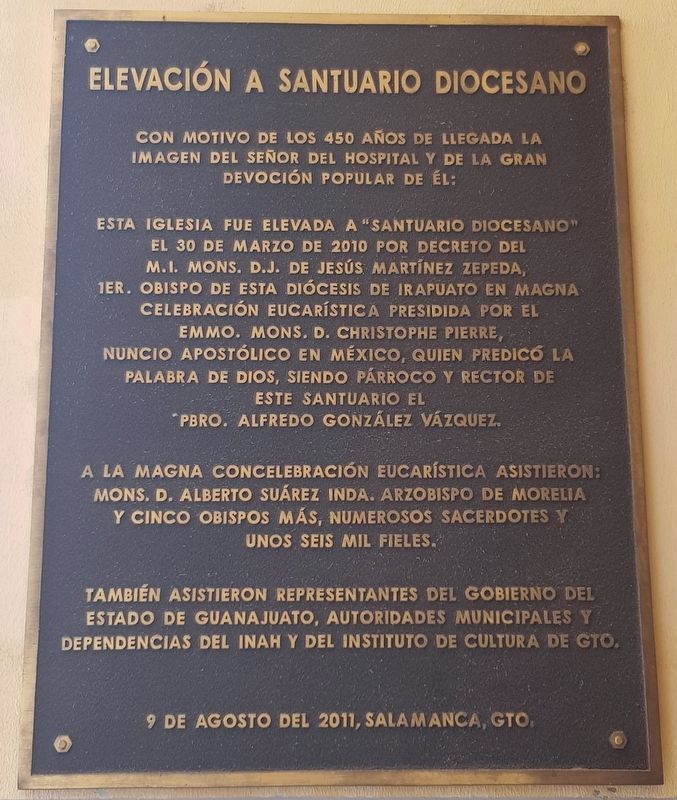
6. An additional marker on the elevation of the church to Diocesan Sanctuary in 2010
This marker celebrates the church's elevation to a Diocesan Sanctuary in 2010 on the 450th anniversary of the arrival of the Black Christ here. It reads:
Elevación a Santuario Diocesano
Con motivo de los 450 años de llegada la imagen del Señor del Hospital y de la gran devoción popular de él:
Esta iglesia fue elevada a “Santuario Diocesano” el 30 de marzo de 2010 por decreto del M.I. Mons. D.J. de Jesús Martínez Zepeda, 1er. Obispo de esta diócesis de Irapuato en magna celebración eucarística presidida por el Emmo. Mons. D. Christophe Pierre, Nuncio Apostólico en México, quien predicó la palabra de dios, siendo párroco y rector de este santuario el Pbro. Alfredo González Vázquez.
A la magna concelebración eucarística asistieron: Mons. D. Alberto Suárez Inda. Arzobispo de Morelia y cinco obispos más, numerosos sacerdotes y unos seis mil fieles.
Con motivo de los 450 años de llegada la imagen del Señor del Hospital y de la gran devoción popular de él:
Esta iglesia fue elevada a “Santuario Diocesano” el 30 de marzo de 2010 por decreto del M.I. Mons. D.J. de Jesús Martínez Zepeda, 1er. Obispo de esta diócesis de Irapuato en magna celebración eucarística presidida por el Emmo. Mons. D. Christophe Pierre, Nuncio Apostólico en México, quien predicó la palabra de dios, siendo párroco y rector de este santuario el Pbro. Alfredo González Vázquez.
A la magna concelebración eucarística asistieron: Mons. D. Alberto Suárez Inda. Arzobispo de Morelia y cinco obispos más, numerosos sacerdotes y unos seis mil fieles.
Credits. This page was last revised on March 15, 2018. It was originally submitted on March 13, 2018, by J. Makali Bruton of Washington, District of Columbia. This page has been viewed 931 times since then and 87 times this year. Photos: 1, 2, 3, 4, 5. submitted on March 13, 2018, by J. Makali Bruton of Washington, District of Columbia. 6. submitted on March 14, 2018, by J. Makali Bruton of Washington, District of Columbia.
