Memphis in Shelby County, Tennessee — The American South (East South Central)
Waterproof, Louisiana/Ashland Landing, Mississippi
Mississippi River Walk

Photographed by Jason Voigt, August 2, 2024
1. Waterproof, Louisiana/Ashland Landing, Mississippi Marker
Marker was replaced with one put up by Mud Island Park
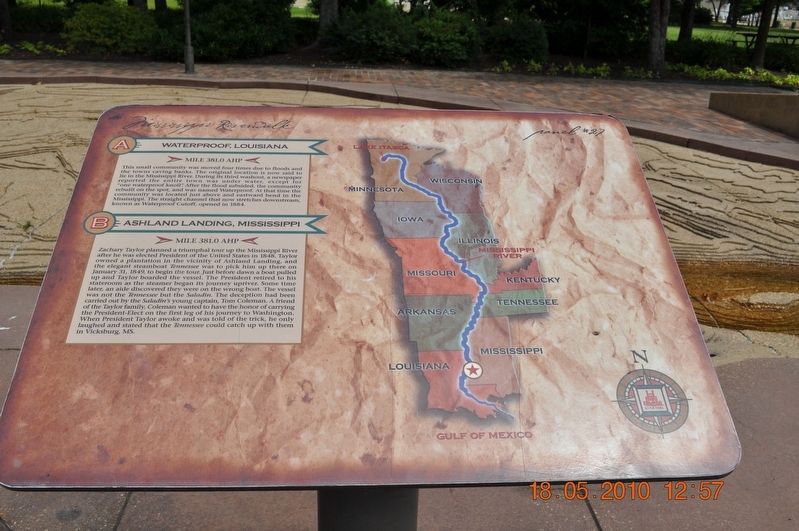
A. Waterproof, Louisiana
Mile 381.0 AHP
This small community was moved four times due to floods and the towns caving banks. The original location is now said to lie in the Mississippi River. During its third washout, a newspaper reported the entire town was under water, except for “one waterproof knoll.” After the flood subsided, the community rebuilt on the spot and was named Waterproof. At that time the community was located just above and eastward bend in the Mississippi. The straight channel that now stretches downstream, known as Waterproof Cutoff, opened in 1884.
B. Ashland Landing, Mississippi
Mile 381.0 AHP
Zachary Taylor planned a triumphal tour up the Mississippi River after he was elected President of the United States in 1848. Taylor owned a plantation in the vicinity of Ashland Landing, and the elegant steamboat Tennessee was to pick him up there on January 31, 1849, to begin the tour. Just before dawn, a boat pulled up and Taylor boarded the vessel. The President retired to his stateroom as the steamer began its journey upriver. Sometime later, an aide discovered they were on the wrong boat. The vessel
this page online
Erected by Mud Island Park. (Marker Number 27.)
Topics and series. This historical marker is listed in these topic lists: Disasters • Settlements & Settlers • Waterways & Vessels. In addition, it is included in the Former U.S. Presidents: #12 Zachary Taylor series list. A significant historical year for this entry is 1848.
Location. 35° 8.839′ N, 90° 3.574′ W. Marker is in Memphis, Tennessee, in Shelby County. It can be reached from Island Drive. Located at Mud Island Park. Touch for map. Marker is at or near this postal address: 125 N Front St, Memphis TN 38103, United States of America. Touch for directions.

Regionally, this marker is in West Tennessee. It is also in the American South, specifically in the Deep South, in the
Photographed by Sandra Hughes, May 18, 2010
2. Waterproof, Louisiana/Ashland Landing, Mississippi Marker
Other nearby markers. At least 8 other markers are within walking distance of this marker: Rodney Cutoff/Bayou Pierre (a few steps from this marker); Natchez, Mississippi (a few steps from this marker); Natchez Island / Vidalia, Louisiana / Giles Cutoff (a few steps from this marker); Grand Gulf, Mississippi / Yucatan Cutoff / Big Black River (a few steps from this marker); Gauges and Navigation Lights (within shouting distance of this marker); Palmetto Bend/Jackson Point/St. Catherine’s Creek/Ellis Cliffs (within shouting distance of this marker); Davis Island, Mississippi/Kents Island (within shouting distance of this marker); Fort Adams, Mississippi/Old River Control Structure/Homochitto Cutoff (within shouting distance of this marker). Touch for a list and map of all markers in Memphis.
Also see . . .
1. Waterproof, Louisiana.

Photographed by Jason Voigt, August 2, 2024
3. Waterproof, Louisiana/Ashland Landing, Mississippi Marker
Marker is on the right (by the pole)
2. Ashland, Jefferson County, Mississippi. Ashland was located near Cypress Grove Plantation, purchased in 1840 by future United States president Zachary Taylor.[2] After being elected president in 1849, the large and elegant steamer Tennessee was sent to pick Taylor up at Ashland Landing and transport him to Vicksburg to attend several receptions. It went unnoticed in the pre-dawn hours that the steamer Saladin had arrived in Ashland Landing before the Tennessee. Tom Coleman, Saladin's 24-year-old captain, was a Taylor family friend who wanted the honor of transporting the president-elect to Vicksburg. When aides discovered the deception, they woke Taylor, who had been sleeping in Saladin's stateroom. Taylor laughed and stated that the Tennessee would catch up at Vicksburg and he could transfer there.[3] (Submitted on March 18, 2018, by Sandra Hughes Tidwell of Killen, Alabama, USA.)
3. Zachary Taylor. He also bought a plantation in Louisville for $95,000, as well as the Cypress Grove Plantation near Rodney, Jefferson County, Mississippi. These acquisitions included slaves, rising in number to over 200.[20][21] In July 1811 he was called to the Indiana Territory, where he assumed control of Fort Knox after the commandant fled. In only a few weeks, he was able to restore order in the garrison, for which he was lauded by Governor William Henry Harrison.[22] Taylor was temporarily called to Washington to testify for Wilkinson as a witness in a court-martial, and so he did not take part in the November 1811 Battle of Tippecanoe against the forces of Tecumseh, a Shawnee chief.[23] (Submitted on March 18, 2018, by Sandra Hughes Tidwell of Killen, Alabama, USA.)
Credits. This page was last revised on August 24, 2024. It was originally submitted on March 18, 2018, by Sandra Hughes Tidwell of Killen, Alabama, USA. This page has been viewed 1,125 times since then and 80 times this year. Photos: 1. submitted on August 24, 2024, by Jason Voigt of Glen Carbon, Illinois. 2. submitted on March 18, 2018, by Sandra Hughes Tidwell of Killen, Alabama, USA. 3. submitted on August 24, 2024, by Jason Voigt of Glen Carbon, Illinois. • Bill Pfingsten was the editor who published this page.
