Portsmouth in Rockingham County, New Hampshire — The American Northeast (New England)
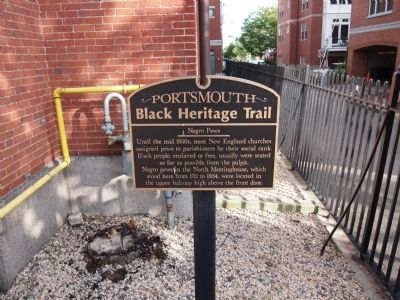
Negro Pews
Portsmouth Black Heritage Trail
Photographed by Bryan Simmons, July 2012
1. Negro Pews Marker
Topics and series. This historical marker is listed in these topic lists: African Americans • Religion & Religious Structures. In addition, it is included in the New Hampshire, The Black Heritage Trail of series list. A significant historical year for this entry is 1711.
Location. 43° 4.603′ N, 70° 45.479′ W. Marker is in Portsmouth, New Hampshire, in Rockingham County. It is on Congress St (U.S. 1) close to Church Street, on the left when traveling west. Located in small fenced in area next to church. Touch for map. Marker is in this post office area: Portsmouth NH 03801, United States of America. Touch for directions.

Regionally, this marker is on the Seacoast. It is also in the American Northeast, in New England, and on the Eastern Seaboard. Globally, it is in the North Atlantic Region, North
this page online
Other nearby markers. At least 8 other markers are within walking distance of this marker: The Original New Hampshire State House (within shouting distance of this marker); 18 Congress (within shouting distance of this marker); Nation's Oldest Bank (within shouting distance of this marker); Treaty of Portsmouth 1905 (within shouting distance of this marker); The South Church (about 400 feet away, measured in a direct line); Ceilia Layton Thaxter (about 400 feet away); Joseph & Nancy (Cotton) and their children, Eleazor & James (about 400 feet away); Temple Israel (about 600 feet away). Touch for a list and map of all markers in Portsmouth.
Related markers. Click here for a list of markers that are related to this marker. Portsmouth Black Heritage Trail
Also see . . . Portsmouth Black Heritage Trail.
In the colonial era some white people objected to the Christianization of enslaved Africans and didn’t take their slaves to church. Pious whites catechized
Photographed by Bryan Simmons, July 2012
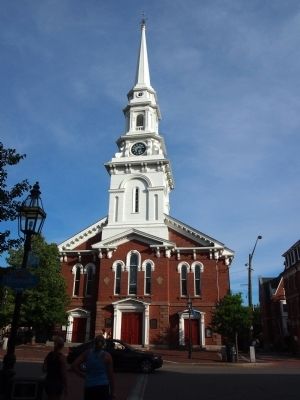
2. North Meetinghouse
Credits. This page was last revised on September 7, 2025. It was originally submitted on July 28, 2012, by Bryan Simmons of Attleboro, Massachusetts. This page has been viewed 1,291 times since then and 57 times this year. Last updated on April 7, 2018, by Cosmos Mariner of Cape Canaveral, Florida. Photos: 1, 2. submitted on July 28, 2012, by Bryan Simmons of Attleboro, Massachusetts. • Andrew Ruppenstein was the editor who published this page.
