Downtown Memphis in Shelby County, Tennessee — The American South (East South Central)
Shelby County Archives and Hall of Records ⎯⎯⎯ Former Criminal Courts Building
Photographed by Mark Hilton, April 8, 2018
1. Shelby County Archives And Hall Of Records Marker
Inscription.
Shelby County Archives and Hall of Records, also, Former Criminal Courts Building. . ,
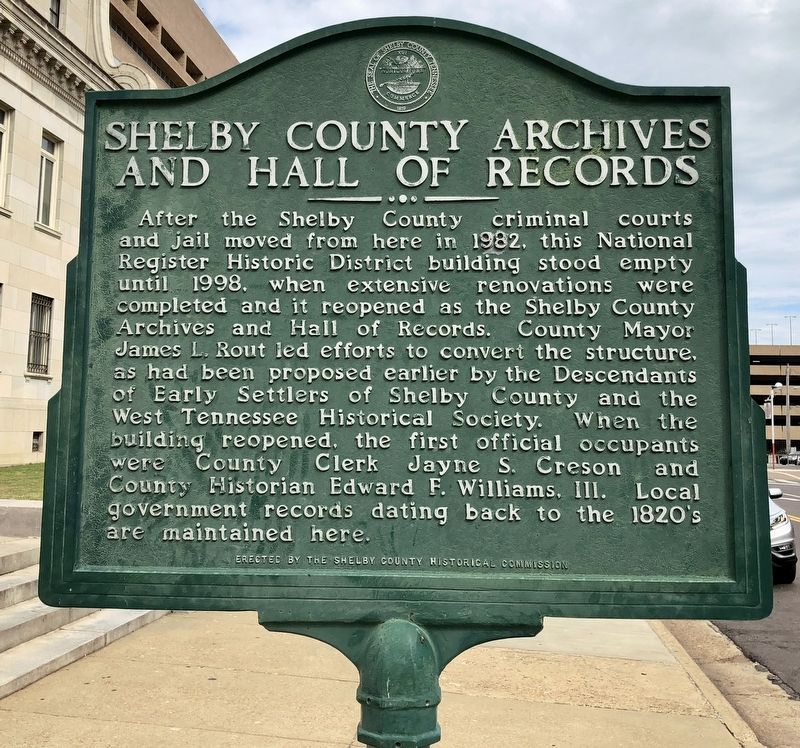
Shelby County Archives and Hall of Records. After the Shelby County criminal courts and jail moved from here in 1982, this National Register Historic District building stood empty until 1998, when extensive renovations were completed and it reopened as the Shelby County Archives and Hall of Records. County Mayor James L. Rout led efforts to convert the structure, as had been proposed earlier by the Descendants of Early Settlers of Shelby County and the West Tennessee Historical Society. When the building reopened, the first official occupants were County Clerk Jayne S. Creson and County Historian Edward F. Williams, III. Local government records dating back to the 1820's are maintained here. ,
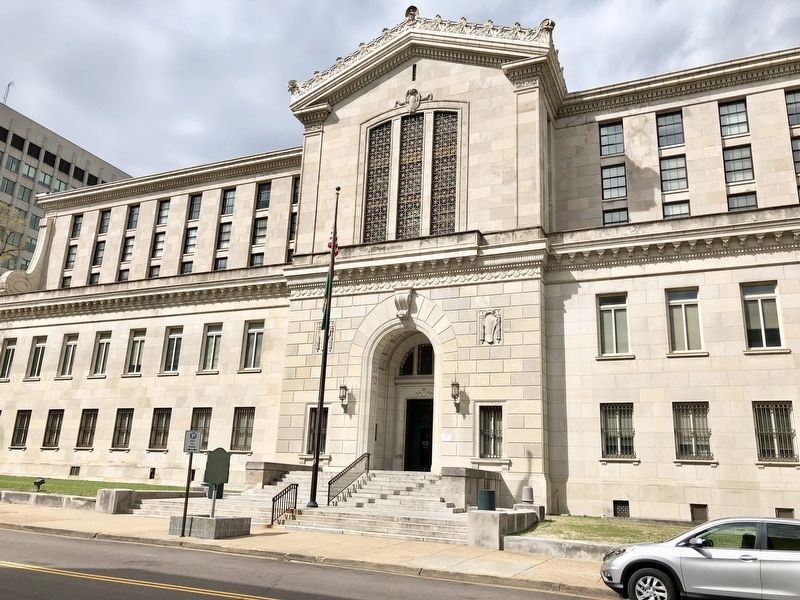
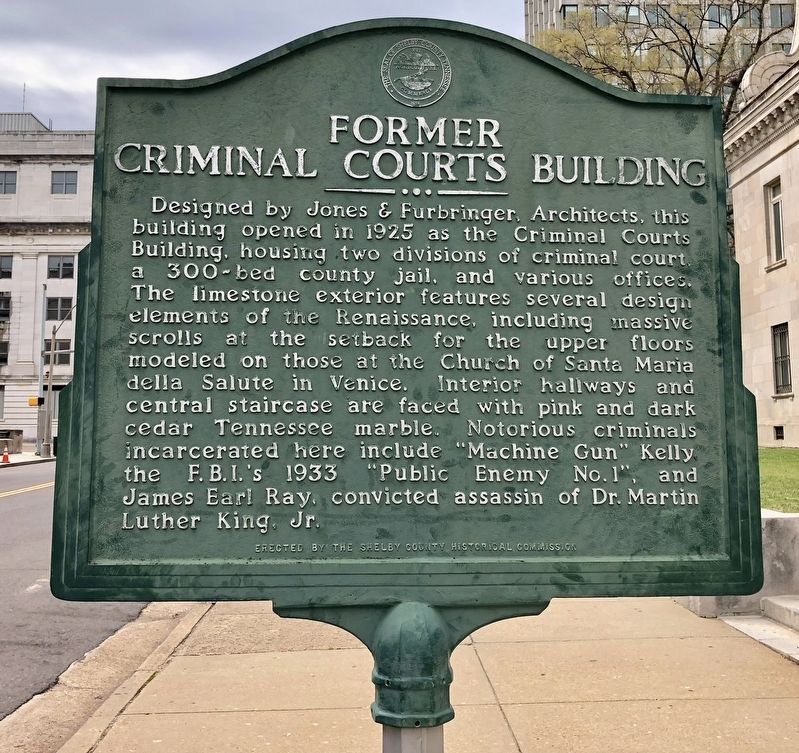
Former Criminal Courts Building . Designed by Jones and Furbringer, Architects, this building opened in 1925 as the Criminal Courts Building, housing two divisions of criminal court, a 300-bed county jail, and various offices. The limestone exterior features several design elements of the Renaissance, including massive scrolls at the setback for the upper floors modeled on those at the Church of Santa Maria Della Salute in Venice. Interior hallways and central staircase are faced with pink and dark cedar Tennessee Marble. Notorious criminals incarcerated here include "Machine Gun" Kelly, the F.B.I.'s 1933 "Public Enemy No. l" and James Earl Ray, convicted assassin of Dr. Martin Luther King, Jr.
Shelby County Archives and Hall of Records
After the Shelby County criminal courts and jail moved from here in 1982, this National Register Historic District building stood empty until 1998, when extensive renovations were completed and it reopened as the Shelby County Archives and Hall of Records. County Mayor James L. Rout led efforts to convert the structure, as had been proposed earlier by the Descendants of Early Settlers of Shelby County and the West Tennessee Historical Society. When the building reopened, the first official occupants were County Clerk Jayne S. Creson and County Historian Edward F. Williams, III. Local government records dating back to the 1820's are maintained here.
Former Criminal Courts Building
Designed by Jones & Furbringer, Architects, this building opened in 1925 as the Criminal Courts Building, housing two divisions of criminal court, a 300-bed county jail, and various offices. The limestone exterior features several design elements of the Renaissance, including massive scrolls at the setback for the upper floors modeled on those at the Church of Santa Maria Della Salute in Venice.
Click or scan to see this page online
Interior hallways and central staircase are faced with pink and dark cedar Tennessee Marble. Notorious criminals incarcerated here include "Machine Gun" Kelly, the F.B.I.'s 1933 "Public Enemy No. l" and James Earl Ray, convicted assassin of Dr. Martin Luther King, Jr.
Erected by Shelby County Historical Commission.
Topics. This historical marker is listed in these topic lists: Architecture • Notable Buildings. A significant historical year for this entry is 1982.
Location. 35° 8.925′ N, 90° 2.958′ W. Marker is in Memphis, Tennessee, in Shelby County. It is in Downtown Memphis. It is on Washington Avenue west of North B.B. King Boulevard, on the right when traveling west. Touch for map. Marker is at or near this postal address: 150 Washington Avenue, Memphis TN 38103, United States of America. Touch for directions.

Regionally, this marker is in West Tennessee. It is also in the American South, specifically in the Deep South, in the Upper South, in the Mississippi Delta, and in the Great River Road Region. Globally, it is in North America, the Western Hemisphere, the Western World, and the Anglosphere. Historically,
Photographed by Mark Hilton, April 8, 2018
2. Former Criminal Courts Building Marker
it finds itself in what was once the territory of the Mississippian Culture, one of the Confederate States of America, and the Antebellum South.
Credits. This page was last revised on February 7, 2023. It was originally submitted on April 14, 2018, by Mark Hilton of Montgomery, Alabama. This page has been viewed 1,150 times since then and 66 times this year. Photos:1, 2, 3. submitted on April 14, 2018, by Mark Hilton of Montgomery, Alabama.