Antioch Missionary Baptist Church
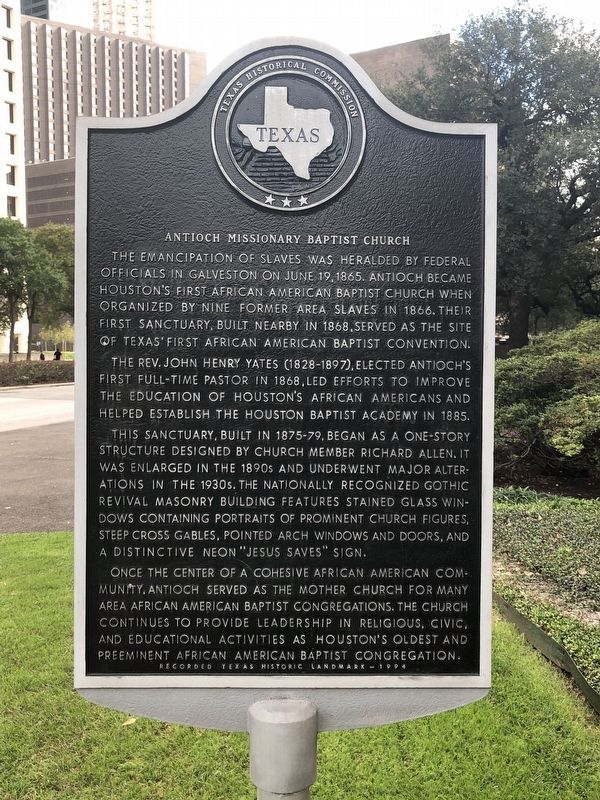
The emancipation of slaves was heralded by federal officials in Galveston on June 19, 1865. Antioch became Houston's first African American Baptist Church when organized by nine former area slaves in 1866. Their first sanctuary, built nearby in 1868,served as the site of Texas' first African American Baptist Convention.
The Rev. John Henry Yates (1828-1897), elected Antioch's first full-time pastor in 1868, led efforts to improve the education of Houston's African Americans and helped establish the Houston Baptist Academy in 1885.
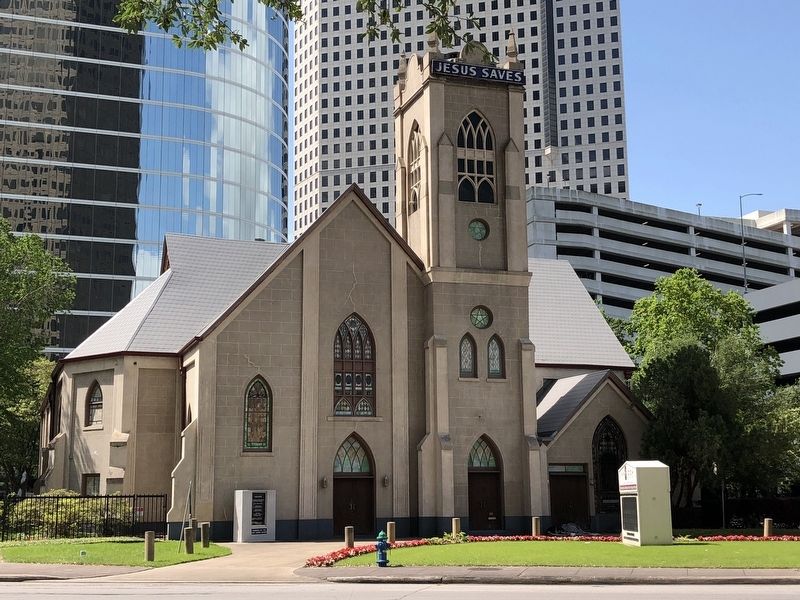
This sanctuary, built in 1875-79, began as a one-story structure designed by church member Richard Allen. It was enlarged in the 1890s and underwent major alterations in the 1930s. The nationally recognized Gothic Revival masonry building features stained glass windows containing portraits of prominent church figures, steep cross gables, pointed arch windows and doors, and a distinctive neon "Jesus Saves" sign.
Once the center of a cohesive African American community, Antioch served as the mother church for many area African American Baptist congregations. The church continues to
this page online
Recorded Texas Historic Landmark - 1994
Erected 1994 by Texas Historical Commission. (Marker Number 10597.)
Topics. This historical marker is listed in these topic lists: African Americans • Religion & Religious Structures.
Location. 29° 45.384′ N, 95° 22.318′ W. Marker is in Houston, Texas, in Harris County. It is in the Central Business District. It is on Clay Street, on the right when traveling south. Touch for map. Marker is at or near this postal address: 500 Clay Street, Houston TX 77002, United States of America. Touch for directions.
Regionally, this marker is in the American South and on the Gulf Coast. Globally, it is in North America, a Gulf of Mexico state, the Western Hemisphere, the Western World, and the Anglosphere. Historically, it finds itself in what was once New Spain, the Republic of Texas, one of the Confederate States of America, and the Antebellum South.
Other nearby markers. At least 8 other
Credits. This page was last revised on February 1, 2023. It was originally submitted on April 18, 2018, by Brian Anderson of New Albany, Ohio. This page has been viewed 879 times since then and 58 times this year. Photos: 1, 2. submitted on April 18, 2018, by Brian Anderson of New Albany, Ohio. • Andrew Ruppenstein was the editor who published this page.
