Cumberland Township near Gettysburg in Adams County, Pennsylvania — The American Northeast (Mid-Atlantic)
Pettigrew's Brigade
Heth's Division - Hill's Corps
| — | Army of Northern Virginia | — |
Photographed by Craig Swain, June 28, 2008
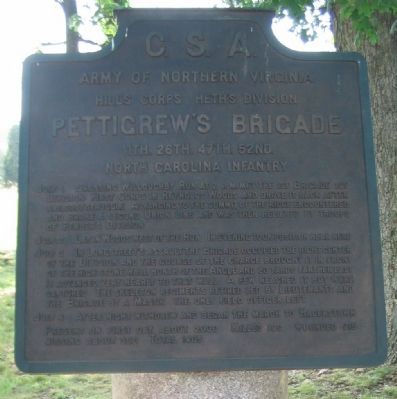
1. Pettigrew's Brigade Tablet
Army of Northern Virginia
Hill's Corps Heth's Division
Pettigrew's Brigade
11th. 26th. 47th. 52nd.
North Carolina Infantry
July 1 Crossing Willoughby Run at 2 p.m. met the 1st Brigade 1st Division First Corps in Reynolds Woods and drove it back after a bloody struggle. Advancing to the summit of the ridge encountered and broke a second Union line and was then relieved by troops of Pender's Division
July 2 Lay in Woods west of the Run. In evening took position near here.
July 3 In Longstreet's assault the Brigade occupied the right center of the Division and the course of the charge brought it in front of the high stone wall north of the Angle and 80 yards further east. It advanced very nearly to that wall. A few reached it but were captured. The skeleton regiments retired led by Lieutenants and the Brigade by a Major the only field officer left.
July 4 After night withdrew and began the march to Hagerstown.
Present on first day about 2000. Killed 190, wounded 915, missing about 300. Total 1405.
Erected 1910 by Gettysburg National Military Park Commission.
Topics and series. This historical marker is listed in this
this page online
Location. 39° 49.064′ N, 77° 14.897′ W. Marker is near Gettysburg, Pennsylvania, in Adams County. It is in Cumberland Township. It is on West Confederate Avenue, on the left when traveling south. Located on Seminary Ridge in Gettysburg National Military Park, near the North Carolina and Tennessee State Memorials. Touch for map. Marker is in this post office area: Gettysburg PA 17325, United States of America. Touch for directions.

Regionally, this marker is in South-Central Pennsylvania. It is also in the American Northeast, in the Mid-Atlantic, in Appalachia, and specifically in Northern Appalachia. Globally, it is in North America, the Western Hemisphere, the Western World, and the Anglosphere. Historically, it finds itself in what was once the Haudenosaunee (Iroquois) Confederacy and also one of the original Thirteen Colonies.
Other nearby markers. At least 8 other markers are within walking distance of this marker: Lieut. General Ambrose P. Hill (within shouting
Photographed by Craig Swain, June 28, 2008
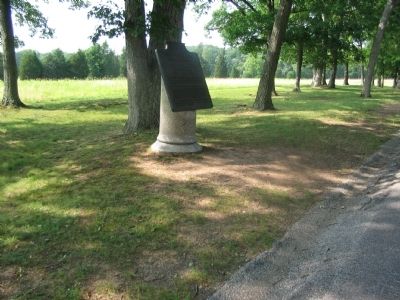
2. Pettigrew's Brigade Tablet
Another marker is no longer nearby. Confederate Line of Battle (was about 300 feet away but has been replaced with another marker now near it).
Also see . . . Report of Maj J. Jones, Twenty-sixth North Carolina Infantry. Ohio State University eLibrary entry:
Major Jones, who commanded the Brigade after the assault, wrote this:
n moving off, there was some confusion in the line, owing to the fact that it had been ordered to close in on the right on Pickett's division, while that command gave way to the left. This was soon corrected, and the advance was made in perfect order. When about half across the intervening space, the enemy opened on us a most destructive fire of grape and canister. When within about 250 or 300 yards of the stone wall behind which the enemy was posted, we were met with a perfect hail-storm of lead from their small-arms. The brigade dashed on, and many had reached the wall, when we received a deadly volley from the left. The whole line on the left had given way, and we were being rapidly flanked. With our thinned ranks and in such a position, it would have been folly to stand, and against such odds. We therefore fell back to our original position in rear of the batteries. After this day's fight, but one field officer was left in the brigade. Regiments that went in with colonels came out commanded by lieutenants.
Photographed by Craig Swain, June 28, 2008
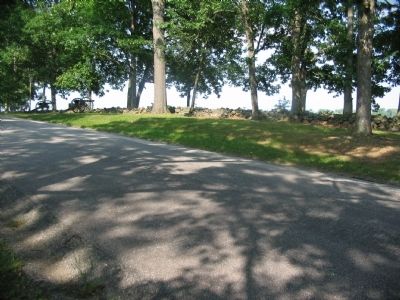
3. Stepping Off Point for Pettigrew's Brigade
The Brigade stepped out of the wood line in this area and proceeded across the open fields in front of Cemetery Ridge on July 3, 1863.
Photographed by Craig Swain, September 17, 2008
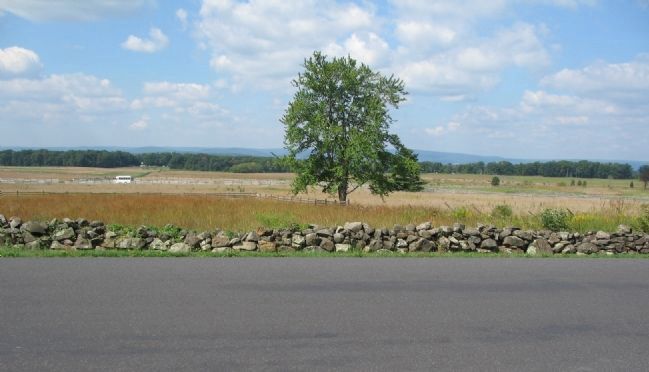
4. High Water Mark for Pettigrew's Brigade
Looking west from Cemetery Ridge. The rock wall mentioned in the text is in the foreground. Pettigrew's Brigade fought their way through artillery and infantry fire from the Federals on the ridge and reached a point just in front of the wall before forced to retire.
Credits. This page was last revised on February 7, 2023. It was originally submitted on September 21, 2008, by Craig Swain of Leesburg, Virginia. This page has been viewed 1,079 times since then and 45 times this year. Photos: 1, 2, 3, 4. submitted on September 21, 2008, by Craig Swain of Leesburg, Virginia.
