City of Westminster in Greater London, England, United Kingdom — Northwestern Europe (the British Isles)
Edmund Burke
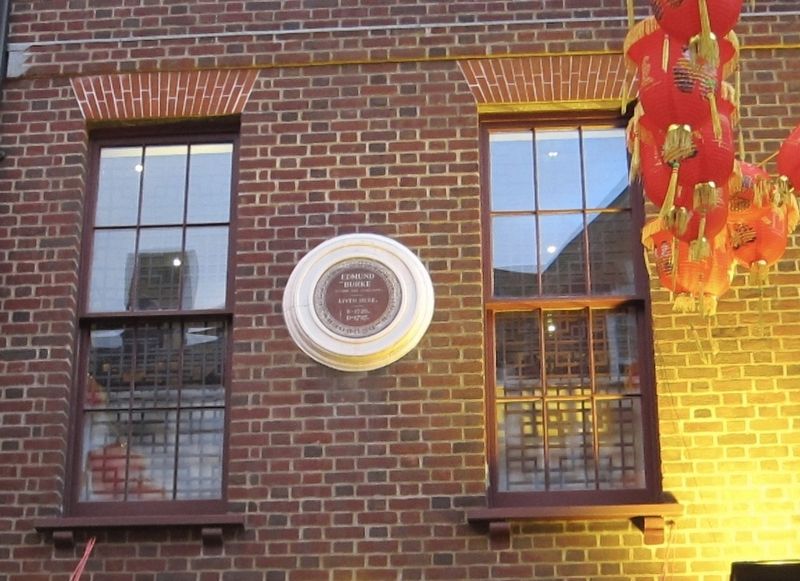
Photographed by Andrew Ruppenstein, March 16, 2018
1. Edmund Burke Marker
————————
lived here.
————————
B • 1729.
D • 1797.
Erected 1876 by Royal Society of the Arts.
Topics. This historical marker is listed in these topic lists: Arts, Letters, Music • Government & Politics. A significant historical year for this entry is 1729.
Location. 51° 30.703′ N, 0° 7.858′ W. Marker is in City of Westminster, England, in Greater London. It is at the intersection of Gerrard Street and Macclesfield Street, on the right when traveling east on Gerrard Street. Touch for map. Marker is at or near this postal address: 37 Gerrard Street, City of Westminster, England W1D 5QB, United Kingdom. Touch for directions.

Regionally, this marker is in London and in the Greater South East. Globally, it is on the Atlantic Ocean, in the North Atlantic Region, in Europe, in Atlantic Europe, on one of the British Isles, in the Western World, and in the Anglosphere. Historically, it finds itself in what was once the Roman Empire.
Other nearby markers. At least 8 other markers are within walking distance of this marker: Penny Post (within shouting distance of this marker);
this page online
Also see . . . Edmund Burke (Wikipedia). "Edmund Burke (12 January [NS] 1730 – 9 July 1797) was an Irish statesman born in Dublin, as well as an author, orator, political theorist and philosopher, who after moving to London in 1750 served as a member of parliament (MP) between 1766 and 1794 in the House of Commons with the Whig Party....Burke was a proponent of underpinning virtues with manners in society and of the importance of religion in moral life. These views were expressed in his A Vindication of Natural Society. Burke criticized British treatment of the American colonies, including through its taxation policies. He also supported the
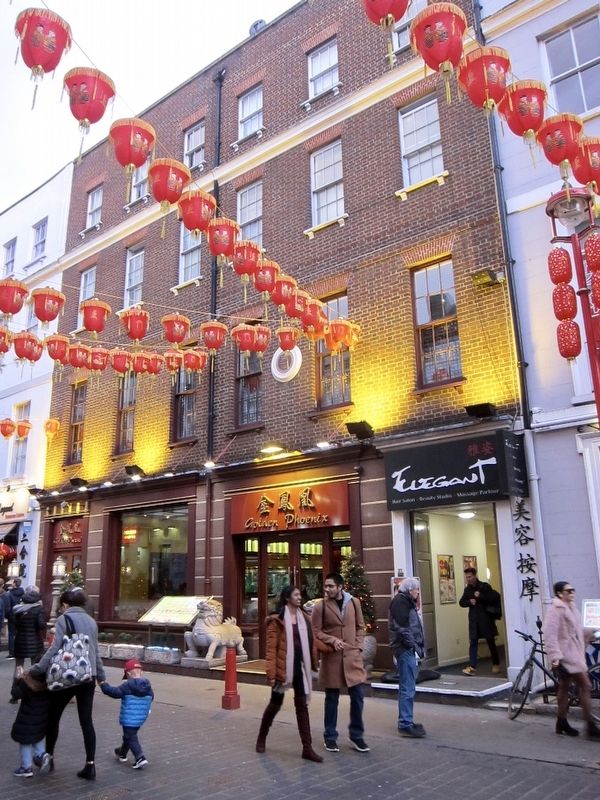
Photographed by Andrew Ruppenstein, March 16, 2018
2. Edmund Burke Marker - Wide View
Additional keywords. Leicester Square
Credits. This page was last revised on March 15, 2026. It was originally submitted on April 24, 2018, by Andrew Ruppenstein of Lamorinda, California. This page has been viewed 366 times since then and 20 times this year. Photos: 1, 2. submitted on April 24, 2018, by Andrew Ruppenstein of Lamorinda, California.
Editor’s want-list for this marker. Better photo of the plaque • Can you help?
