The London Wall Walk - 21
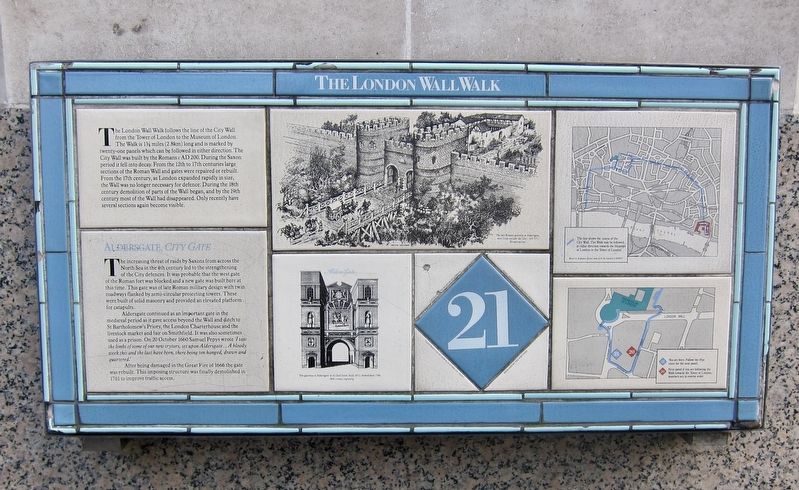
Aldersgate, City Gate
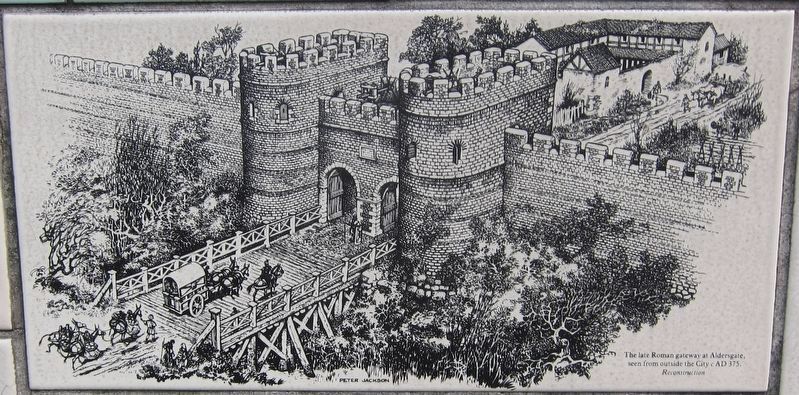
The increasing threat of raids by Saxons from across the North Sea in the 4th century led to the strengthening of the City defences. It was probable that the west gate of the Roman fort was blocked and a new gate was built here at this time. This gate was of late Roman military design with twin roadways flanked by semi-circular projecting towers. These were built of solid masonry and provided an elevated platform
this page online
Aldersgate continued as an important gate in the medieval period as it gave access beyond the Wall and ditch to St Bartholomew's Priory, the London Charterhouse and the livestock market and fair on Smithfield. It was also sometimes used as a prison. On 20 October 1660 Samuel Pepys wrote 'I saw the limbs of some of our new trytors, set upon Aldersgate .. A bloody week this and the last have been, there being ten hanged, drawn and quartered.'
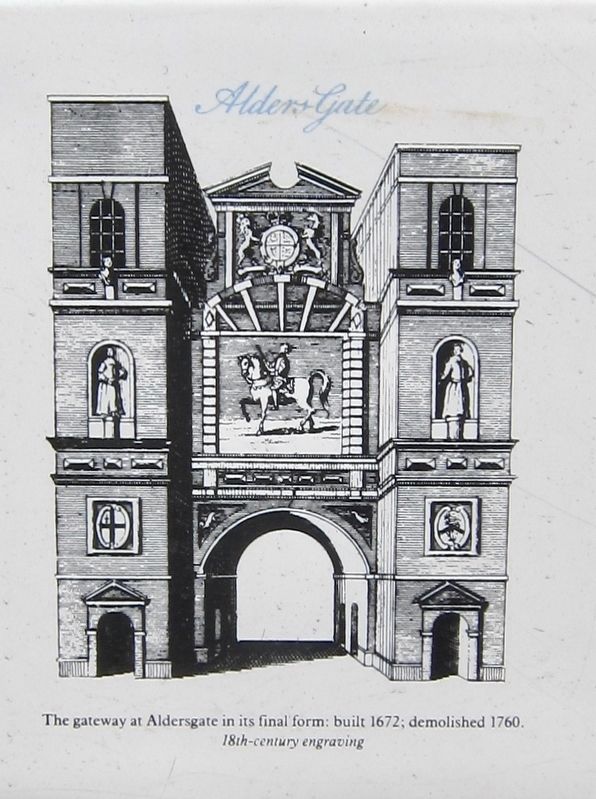
After being damaged in the Great Fire of 1666 the gate was rebuilt. This imposing structure was finally demolished in 1761 to improve traffic access.
Erected 1984 by The Museum of London. (Marker Number 21.)
Topics. This historical marker is listed in this topic list: Forts and Castles. A significant historical date for this entry is October 20, 1660.
Location. 51° 31.008′ N, 0° 5.805′ W. Marker is in City of London, England, in Greater London. It is on Aldersgate Street just north of Gresham Street, on the right when traveling north. Touch for map. Marker is at or near this postal address: 10 Aldersgate Street, City of London, England EC1A 4HJ, United Kingdom. Touch for directions.
Regionally,
Other nearby markers. At least 8 other markers are within walking distance of this marker: The Conversions of the Revs. John and Charles Wesley (a few steps from this marker); Cooks Hall (a few steps from this marker); Aldersgate (a few steps from this marker); French Protestant Church (within shouting distance of this marker); a different marker also named Cooks Hall (within shouting distance of this marker); St Mark's Hospital (within shouting distance of this marker); Northumberland House (within shouting distance of this marker); The Bull and Mouth Inn (within shouting distance of this marker). Touch for a list and map of all markers in City of London.
Also see . . .
1. London’s Roman City Wall (Historic UK). "From around 200 AD, the shape of London was defined by one single structure; it’s massive city wall. From Tower Hill in
2. London Wall (Wikipedia). "The London Wall was the defensive wall first built by the Romans around Londinium, their strategically important port town on the River Thames in what is now London, England, and subsequently maintained until the 18th century....Until the later Middle Ages, the wall defined the boundaries of the City of London....Although the exact reason for the wall's construction is unknown, the wall appears to have been built in the late 2nd or early 3rd century.[1] This was around 80 years after the construction in 120 AD of the city's fort, whose north and west walls were thickened and doubled in height to form part of the new city wall. It continued to be developed until at least the end of the 4th century, making it among the last major building projects undertaken by the Romans before the Roman departure from Britain in 410....The wall's gateways coincided with their alignment
Credits. This page was last revised on January 27, 2022. It was originally submitted on May 8, 2018, by Andrew Ruppenstein of Lamorinda, California. This page has been viewed 681 times since then and 70 times this year. Photos: 1, 2, 3, 4. submitted on May 8, 2018, by Andrew Ruppenstein of Lamorinda, California.
