City of London in Greater London, England, United Kingdom — Northwestern Europe (the British Isles)
St. Botolph-without-Bishopsgate
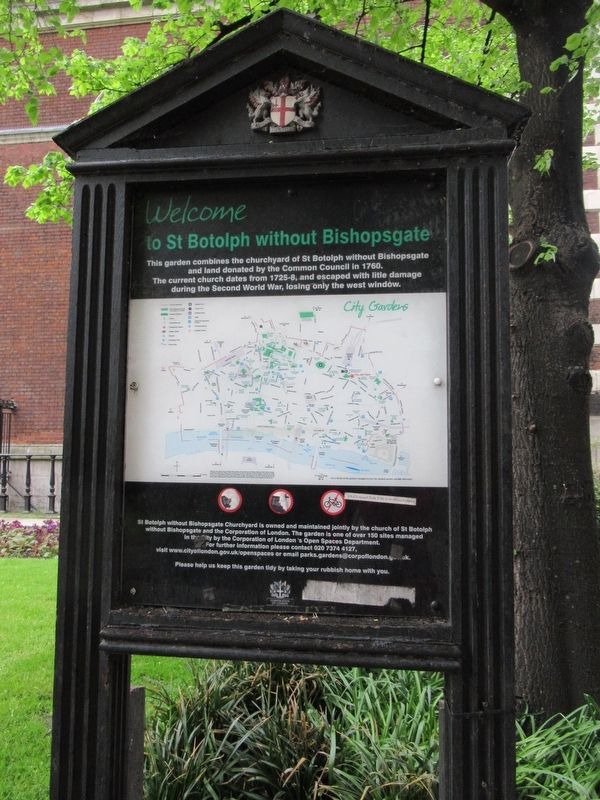
Photographed by Michael Herrick, April 27, 2018
1. St. Botolph-without-Bishopsgate Marker
Over the centuries, many famous Londoners have been associated with St. Botolph's, including Sir William Allen, Lord Mayor 1571-2, who repaired the church at his own expense; Edward Alleyn, founder of Dulwich College, who was baptised here
this page online
The church contains the regimental memorial chapel of the Honourable Artillery Company and the Book of Remembrance of the London Rifle Brigade. The memorial cross in the churchyard is believed to be the first memorial of the Great War (1914-1918) to be set up in London, erected in 1916 after the Battle of Jutland.
A brochure with a more detailed history of the church is available inside. St Botolph's is a City church and continues to minister to those who work or live in, or visit, the City. You are warmly welcome to join us in worship and prayer.
Topics. This historical marker is listed in this topic list: Religion & Religious Structures.
Location. 51° 30.995′ N, 0° 4.885′ W. Marker is in City of London, England, in Greater London. It is on England Route A10 close to Aldermans Walk, on the left when traveling north. Touch for map. Marker is in this post office area: City of London, England EC2M 3TL, United Kingdom. Touch for directions.

Regionally, this marker is in London
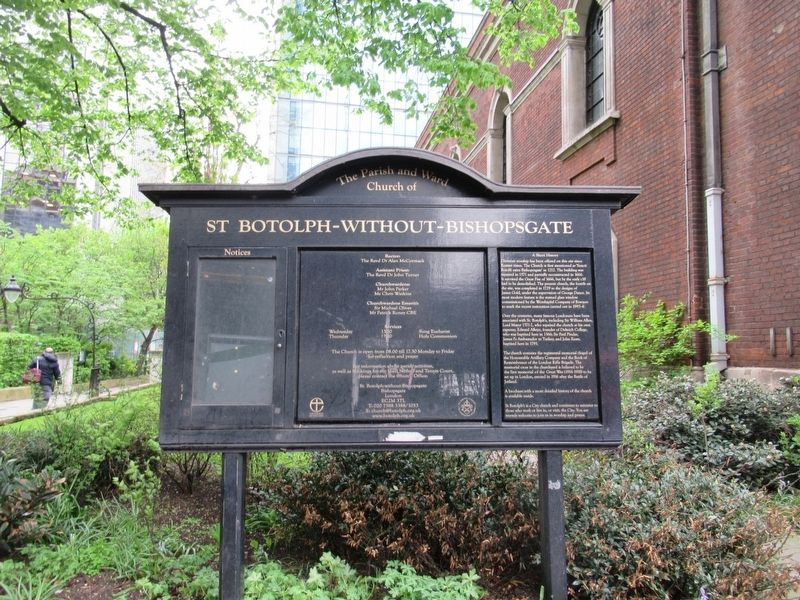
Photographed by Michael Herrick, April 27, 2018
2. St. Botolph-without-Bishopsgate Marker
Other nearby markers. At least 8 other markers are within walking distance of this marker: First Bethlehem Hospital (about 90 meters away, measured in a direct line); Children of the Kindertransport (about 150 meters away); Hope Square (about 150 meters away); Houndsditch Murders (about 210 meters away); The London Wall Walk - 07 (approx. 0.3 kilometers away); Site of First Synagogue (approx. 0.4 kilometers away); The Great Synagogue Dukes Place (approx. 0.4 kilometers away); Holy Trinity Priory (approx. 0.4 kilometers away). Touch for a list and map of all markers in City of London.
Also see . . .
1. St Botolph-without-Bishopsgate. Wikipedia entry (Submitted on May 10, 2018, by Michael Herrick of Southbury, Connecticut.)
2. Who Was St Botolph And Why Are So Many London Churches Named After Him?. Londonist website entry (Submitted on September 9, 2024, by Larry Gertner of New York, New York.)
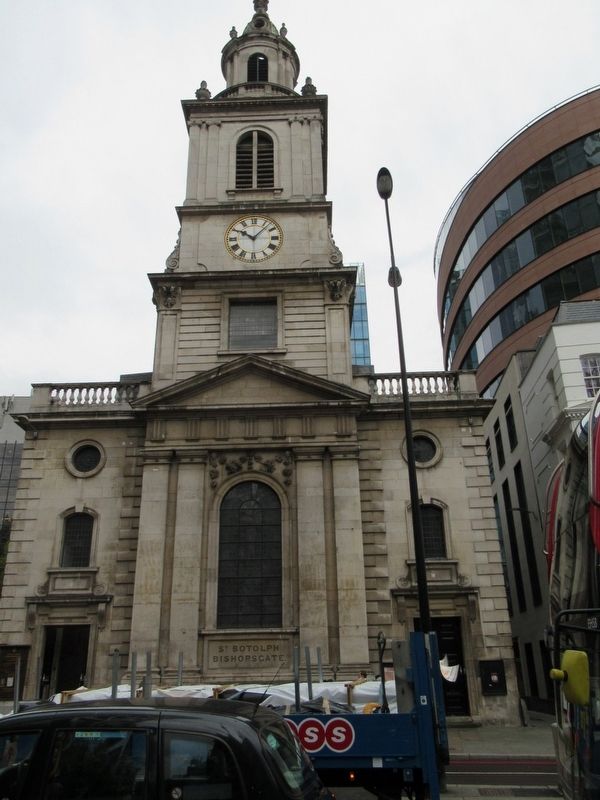
Photographed by Michael Herrick, April 27, 2018
3. St. Botolph-without-Bishopsgate
Credits. This page was last revised on September 9, 2024. It was originally submitted on May 10, 2018, by Michael Herrick of Southbury, Connecticut. This page has been viewed 376 times since then and 24 times this year. Photos: 1, 2, 3. submitted on May 10, 2018, by Michael Herrick of Southbury, Connecticut.
