Ophir in Placer County, California — The American West (Pacific Coastal)
Town of Ophir
Photographed by Syd Whittle, December 6, 2005
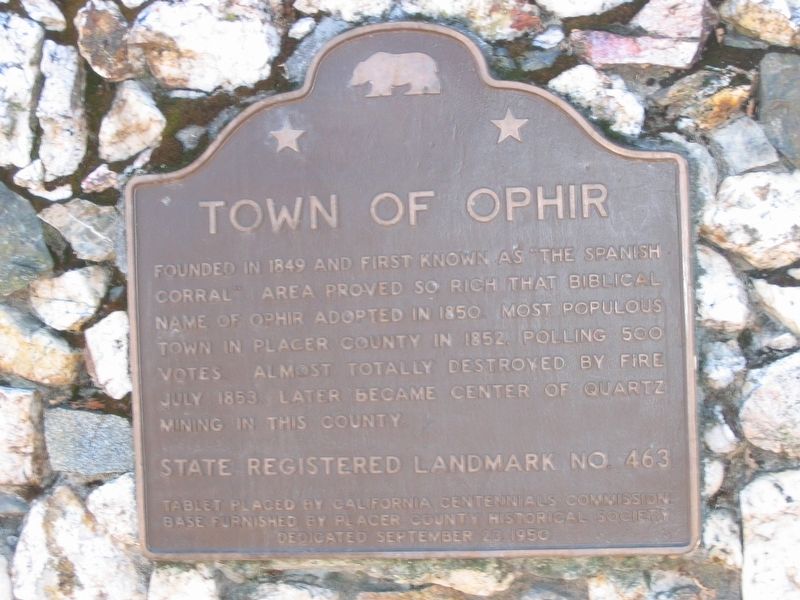
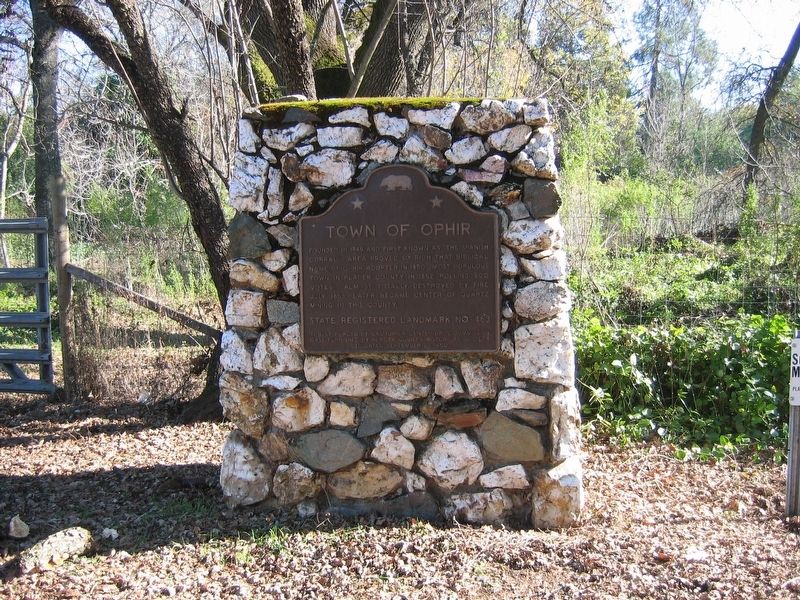
1. Town of Ophir Marker
(Original marker, which was stolen in 2012. See Photo #1)
Founded in 1849 as 'The Spanish Corral,' Area proved so rich that Biblical name of Ophir adopted in 1850. Most populous town in Placer County in 1852, polling 500 votes. Almost totally destroyed by fire in July 1853. Later became the center of quartz mining in this county.
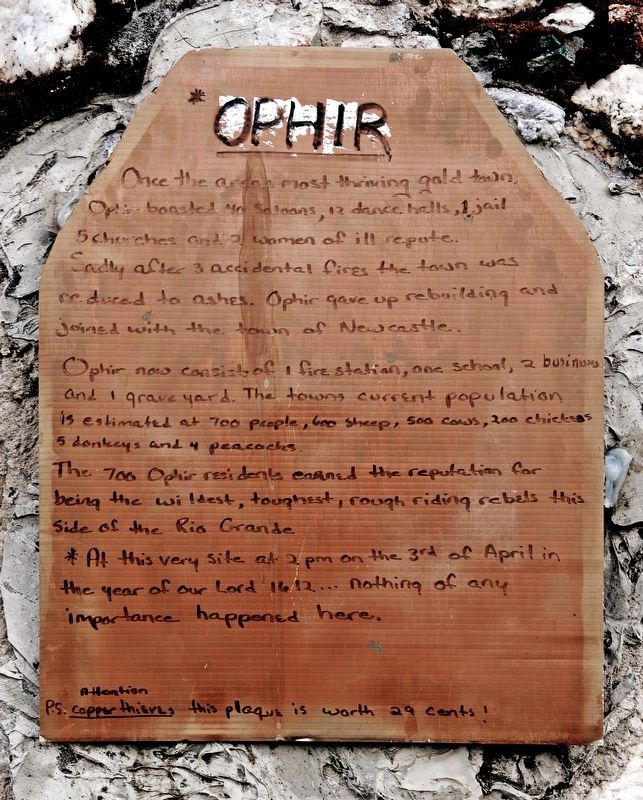
Second - Temporary Marker - Placed by the residents of Ophir. See Photo #2
Once the areas most thriving gold town, Ophir boasted 40 saloons, 12 dance halls, 1 jail, 5 churches and 2 women of ill repute. Sadly after 3 accidental fires the town was reduced to ashes. Ophir gave up rebuilding and joined with the town of Newcastle. Ophir now consists of 1 fire station, one school, 2 businesses and 1 grave yard. The towns current population is estimated at 700 people, 600 sheep, 500 cows, 200 chickens, 5 donkeys and 4 peacocks. The 700 Ophir residents earned the reputation for being the wildest, toughest, rough riding rebels this side of the Rio Grande * At this very site at 2PM on the 3rd of April in the year of our Lord 1612... nothing of any importance happened here.
Attention
P. S.: Copper thieves this plaque is worth 29 cents!
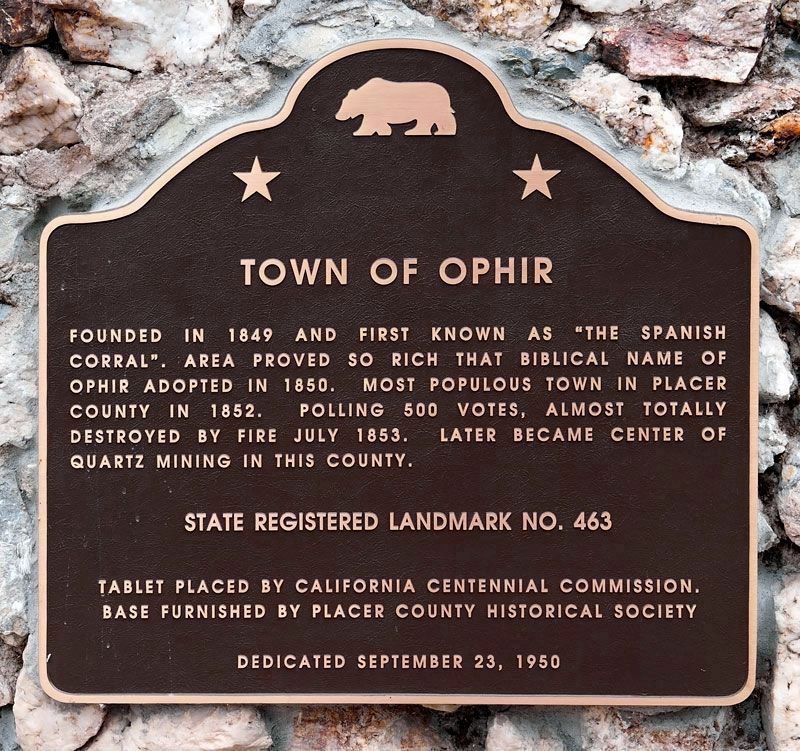
Replacement Marker - Dedicated April 14, 2012. See Photo #3.
Founded in 1849 as 'The Spanish Corral,' Area proved so rich that Biblical name of Ophir adopted in 1850. Most populous town in Placer County in 1852, polling 500 votes. Almost totally destroyed by fire in July 1853. Later became the center of quartz mining in this county.
Erected 1950
this page online
Topics and series. This historical marker is listed in these topic lists: Industry & Commerce • Landmarks • Natural Resources • Notable Places • Settlements & Settlers. In addition, it is included in the California Historical Landmarks, and the E Clampus Vitus series lists. A significant historical month for this entry is July 1853.
Location. 38° 53.477′ N, 121° 7.474′ W. Marker is in Ophir, California, in Placer County. It is at the intersection of Lozanos Road and Bald Hill Road, on the right when traveling north on Lozanos Road. Touch for map. Marker is in this post office area: Auburn CA 95603, United States of America. Touch for directions.

Regionally, this marker is in Sacramento Metro and in the Sierra Nevada. It is also in the American Mountain West. Globally, it is in North America, on the Ring of Fire, on the Pacific Rim, in the Western Hemisphere, in the Western World, and in the Anglosphere. Historically, it finds itself in what was once New Spain and also Mexico’s Alta California.
Other nearby markers. At least 8 other markers are within 3 miles of this marker, measured as the crow flies: Lincoln Highway (approx. 1.2 miles away); Wise Power Plant (approx. 1.2 miles away); First Transcontinental Railroad (approx. 1.2 miles away); Newcastle Portuguese Hall (approx. 1½ miles away); Bloomers Cut (approx. 2.4 miles away); Jean Baptiste Charbonneau
Photographed by Alvis Hendley, December 10, 2013
2. TemporaryTown of Ophir Marker
Placed by the residents of Ophir.
More about this marker. This site has been designated as California Registered Historical Landmark No.463.
Regarding Town of Ophir. Ophir is an unincorporated community of Placer County, California. Postal mailing addresses in portions of the area use Newcastle or Auburn.
Also see . . .
1. Beach California: Ophir, California. (Submitted on September 29, 2008, by Syd Whittle of Mesa, Arizona.)
2. Ophir’s landmark plaque back in place after theft. (Submitted on April 30, 2014, by Lester J Letson of Fresno, California.)
Additional commentary.
1. Ophir is layered, changed, overgrown, rebuilt, remembered — and still here.
Ophir is an unincorporated historic community in Placer County, California, in the western foothills of the Sierra Nevada. Its history predates the Gold Rush by millions of years. The community occupies a landscape formed by ancient geology, erosion, changing river systems, climate shifts, wildlife habitat and watersheds long before the first modern settlement was established. Before the Native Nations made it home, before the town had two books released on its own history locally. And before me!
Long before modern property lines, roads or mines, First Nation peoples lived within, moved through, cared for, and understood this landscape. Their history belongs before the Gold Rush, not as a footnote after it.
Ophir’s chronology therefore reaches through the prehistoric landscape,
Photographed by Alvis Hendley, August 29, 2014
3. Town of Ophir Marker (Replacement)
Before every rich era came another era. Before every government came another people. Before every map came another landscape.
Ophir survived the prehistoric world, First Nation history, trappers, rancheros, campers, settlers, repeated waves of miners, changing counties and governments, fire, flood, extraction, economic collapse, shrinking population, lost buildings, changed roads, changed boundaries, and administrative relabeling.
It is still alive.
Small does not mean gone. Changed does not mean erased. Burned does not mean abandoned.
Ophir is still here.
Geologic origins and the ancient Sierra Nevada. The rocks and landforms underlying the Ophir area are far older than the community itself. The western Sierra Nevada contains ancient metamorphic rocks, later intrusive igneous rocks and gold-bearing mineral systems formed through tectonic, volcanic and hydrothermal processes over immense spans of geologic time.
The modern Sierra Nevada did not suddenly appear during the Ice Age. Geological research indicates that the range had already developed much of its major modern topographic character millions of years ago; one USGS-linked study found evidence for a Sierra Nevada rain shadow of approximately modern magnitude
Photographed by Syd Whittle, December 6, 2005
4. Town of Ophir Marker (Original)
Erosion then repeatedly cut streams and river channels across the western slope. Weathering released gold from mineralized quartz veins and other lode deposits, after which moving water transported and concentrated the heavy gold particles in stream gravels. USGS research describes this weathering, transport and stream concentration as the basic process that created California's placer deposits.
Thus, the gold that later attracted miners to Spanish Corral and Ophir was itself the product of a natural process vastly older than the Gold Rush.
The Ice Age. During the Pleistocene Epoch, commonly called the Ice Age, the Sierra Nevada experienced repeated episodes of extensive glaciation. Major documented glacial stages include the Sherwin, Tahoe and Tioga glaciations. Large glaciers occupied the higher Sierra and flowed through major mountain valleys.
The lower Ophir foothills should not be described as having been covered by glaciers without local evidence. The 1983 Ophir General Plan places the Ophir Plan Area at roughly 600 to 1,300 feet in elevation, far below the high Sierra glacial accumulation zones.
A more accurate description is that Ophir inherited a watershed downstream from an Ice Age Sierra.
Snow, ice, rainfall, erosion and long-term river incision in the Sierra helped shape the larger drainage systems flowing westward toward the foothills and Central Valley. The present ravines around Ophir are part of this much older landscape of moving water, sediment and eroded rock.
Ice Age animals.
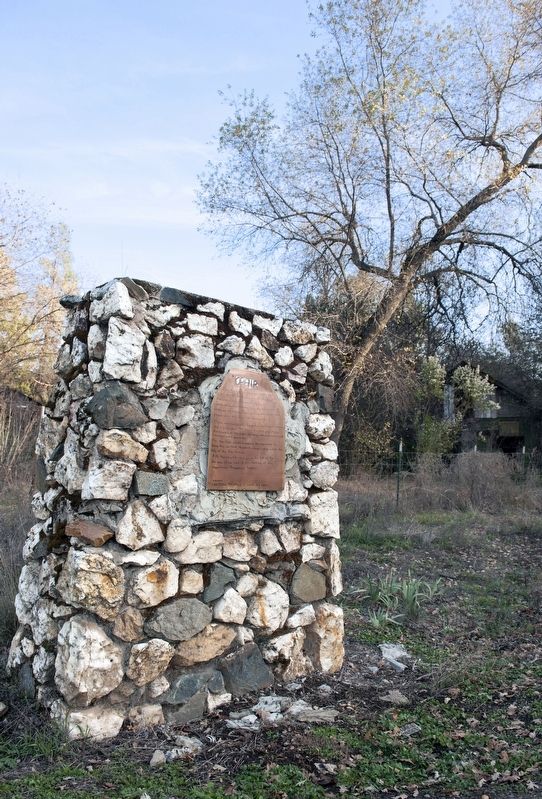
Photographed by Alvis Hendley, December 10, 2013
5. Town of Ophir Marker (Temporary Marker Placed by Ophir Residents)
For a period of time, the stolen metal plaque was replaced by a spunky cardboard plaque. Huzzah to the good people of Ophir and their illustrious forebears!
The saber-toothed cat Smilodon californicus is California's official state fossil. Saber-toothed cats survived in North America until approximately the end of the Pleistocene.
However, an important distinction should be maintained: the presence of Smilodon and other megafauna in Pleistocene California does not by itself establish that fossils of those species have been recovered from the exact Ophir townsite. Unless a local paleontological record is located, these animals are best described as part of the broader Ice Age fauna of California and western North America rather than as confirmed Ophir fossil discoveries.
This distinction is important because Ophir's early history is already remarkable without adding unsupported claims.
From megafauna to the modern foothill ecosystem. At the end of the Pleistocene, many of North America's largest mammals disappeared. Mammoths, mastodons, saber-toothed cats, dire wolves and many other large-bodied species became extinct during the terminal Pleistocene, while other animals and plant communities persisted or shifted their ranges as climate changed.
Over time, the western Sierra foothills developed the oak woodland, grassland, riparian and seasonal-stream environments historically associated with
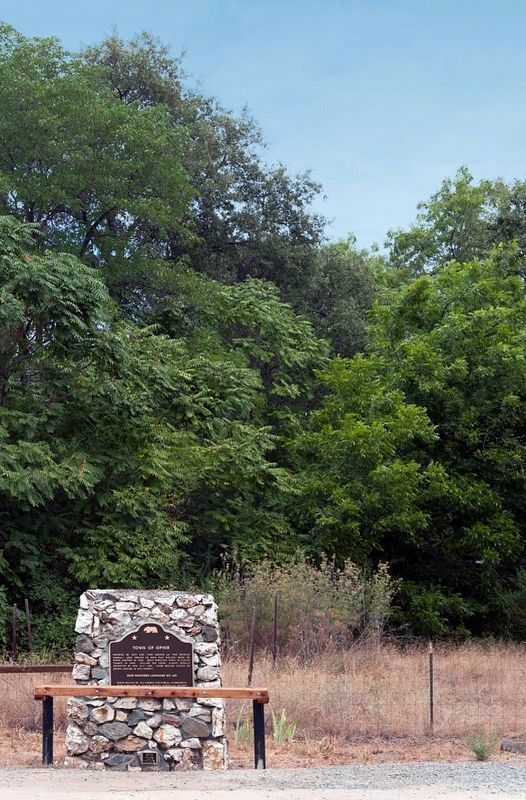
Photographed by Alvis Hendley, August 29, 2014
6. Town of Ophir Marker
A replacement plaque was installed and dedicated
on 11 April 2014. The rededication is
commemorated by a small marker at the bottom
of the stone base.
Placer County's 1983 environmental study mapped Ophir vegetation including grasslands, oak-grassland, riparian areas, oak woodland, oak-pine vegetation, pasture and orchards. It described riparian areas containing sedges, rushes, blackberry and willow and noted that many were seasonally wet or flooded.
The same document recorded deer and a large variety of other mammals, birds, fish and reptiles within the Ophir Plan Area and warned that future development could substantially reduce wildlife populations.
The watershed before the town. Water is one of the oldest continuous themes in Ophir's history.
The 1983 Ophir General Plan identifies Doty Ravine and Auburn Ravine as major streams within the Plan Area. It warned that changing the characteristics of these waterways could create drainage and flood-control problems and directed that natural vegetation be protected, floodplains avoided, impervious surfaces limited and natural watercourses maintained.
Auburn Ravine remains a living ecological corridor today. Following modification of a major downstream fish barrier, recent surveys have documented Chinook salmon, steelhead and Pacific lamprey again reaching formerly obstructed portions of Auburn Ravine. Doty Ravine is also part of a connected migratory watershed. Placer County describes salmon and steelhead traveling from the Pacific Ocean through San Francisco Bay and the Sacramento River system into Raccoon Creek and ultimately Doty Ravine. Secret Ravine is another important drainage in the broader Ophir-area
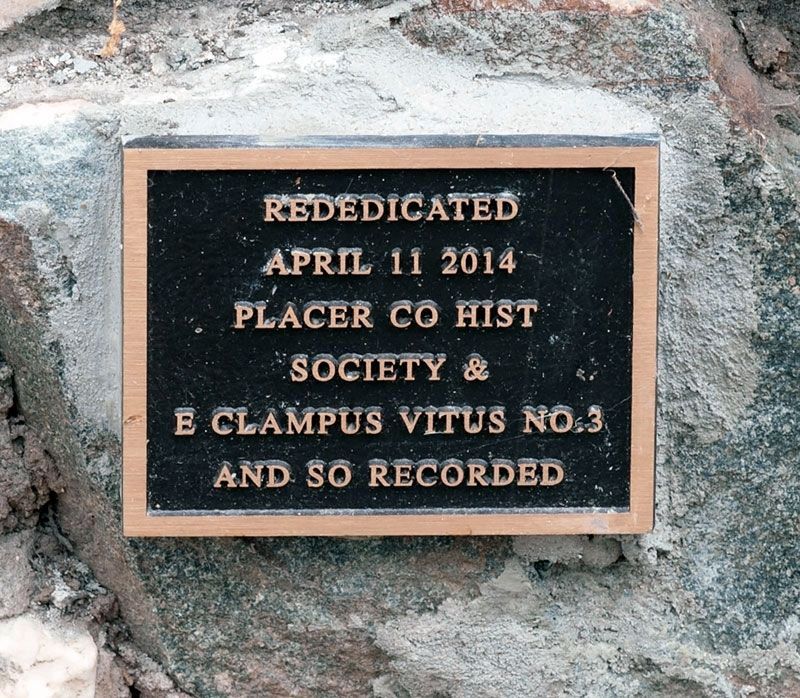
Photographed by Alvis Hendley, August 29, 2014
7. Town of Ophir Rededication Marker
These ravines are therefore more than modern drainage channels. They are surviving pieces of a much older ecological network connecting the Sierra foothills to the Sacramento Valley and, through the river system, ultimately the Pacific Ocean.
The land before property lines. Before there were roads, mines, parcels, railroads, canals or towns, the Ophir landscape consisted of ridges, ravines, seasonal drainage, rock outcrops, soil, grassland, oak woodland and riparian corridors.
- Wildlife moved through a landscape without property boundaries.
- Water followed terrain rather than culverts.
- Streams flooded and shifted.
- Vegetation slowed runoff and stabilized soil.
- Animals used riparian corridors for water, food, shelter and movement.
- Gold remained locked in quartz veins or concentrated naturally in ancient and modern stream gravels.
Ancient rivers and the gold beneath Ophir. Gold in the western Sierra Nevada existed long before humans knew it was there.
USGS research shows that much of California's placer gold originated in mineralized quartz-vein systems of the western Sierra. Weathering released the gold, streams transported it, and flowing water concentrated the dense particles in gravel deposits. Some ancient river gravels were later buried, preserving what geologists call fossil or Tertiary placer deposits.
The northern Sierra is famous for these ancient gold-bearing river systems. USGS mapping shows both lode deposits and gold-bearing ancient river channels distributed across the western slope.
This creates an important continuity in Ophir's story: The miners did not create the gold landscape. They discovered and industrialized a landscape that water and geology had already been building for millions of years.
Before the Gold Rush. Long before the name Spanish Corral or Ophir existed, people also lived within and understood the Sierra foothill landscape.
That human history should follow the geological and ecological sections rather than replace them. Tribal affiliation, archaeological sites and culturally sensitive locations should be described from appropriate tribal, archaeological and governmental sources and should not be inferred solely from modern geographic boundaries.
The important chronological point is that the Gold Rush was not the beginning of Ophir's landscape and not the beginning of human history there. Before every rich era after. It survived Prehistoric, Trappers, Rancheros, First Nations, Campers, Settlers, Waves of Miners, The county of sutter, the county of placer, and its still alive and going even on fire, even flooded, even small, even against erasure.
It was the beginning of an exceptionally disruptive new chapter.
From living landscape to extraction landscape. When large-scale mining began in the nineteenth century, newcomers encountered a landscape already organized by geology and water.
- The quartz veins determined where hard-rock mines could develop.
- Ancient and modern stream gravels determined where placer miners searched for gold.
- Ravines supplied and transported water.
- Terrain determined roads.
- Water systems determined ditches and canals.
Mining therefore did not occur on an empty surface. It was superimposed upon an existing geological, hydrological and ecological system.
That distinction becomes essential when telling what happened next.
From Spanish Corral to Ophir. The settlement later known as Ophir emerged during the California Gold Rush. It was founded in 1849 as The Spanish Corral and adopted the name Ophir in 1850 after the richness of the area's placer deposits became apparent.
By 1852, Ophir was the most populous town in Placer County, polling approximately 500 votes.
A catastrophic fire in July 1853 nearly destroyed the early town, but Ophir did not disappear. It later became an important center of quartz mining and continued through subsequent periods of mining, agriculture, orchards, ranching, rural settlement and community development.
And from there we continue with the sections we already built:
- Gold Rush Ophir
- Quartz Mining
- Fires and Rebuilding
- Agriculture and Rural Transition
- Ophir Cemetery
- Historic Sites and Mines
- Virginiatown, Gold Hill and the Wider Mining Landscape
- Schools, Fire Protection and Community Institutions
- The 1983 Ophir General Plan
- Community Identity and Newcastle
- California Historical Landmark No. 463
- Modern Ophir
Ancient Sierra geology → gold-bearing mineral systems → ancient rivers and erosion → Ice Age climate and regional glaciation → Pleistocene megafauna → oak woodland, grassland and riparian ecosystems → Indigenous human landscape → Spanish Corral → Gold Rush Ophir → placer mining → fires → quartz mining → agriculture and orchards → rural settlement → cemetery, school, roads and community institutions → 1983 Ophir General Plan → present-day unincorporated Ophir.That changes the meaning of the page completely.
Instead of: “Here was a mining town. It burned. The end.”
the page becomes: “Here is a landscape millions of years old. Water shaped it. Animals inhabited it. People lived with it. Mining transformed it. Fire devastated it. Agriculture reused it. Residents eventually chose to protect its rural form. And it is still here.” Note To Editor only visible by Contributor and editor
— Submitted August 14, 2026, by Lexanna Marie Tucker of Ophir, California.
Credits. This page was last revised on August 20, 2026. It was originally submitted on September 29, 2008, by Syd Whittle of Mesa, Arizona. This page has been viewed 2,602 times since then and 131 times this year. Photos: 1. submitted on September 29, 2008, by Syd Whittle of Mesa, Arizona. 2. submitted on August 16, 2014, by Alvis Hendley of San Francisco, California. 3. submitted on July 11, 2016, by Alvis Hendley of San Francisco, California. 4. submitted on September 29, 2008, by Syd Whittle of Mesa, Arizona. 5. submitted on August 16, 2014, by Alvis Hendley of San Francisco, California. 6, 7. submitted on July 11, 2016, by Alvis Hendley of San Francisco, California.
