South Haven in Van Buren County, Michigan — The American Midwest (Great Lakes)
Algonquin Legends of South Haven

Photographed by J. J. Prats, May 6, 2024
1. Algonquin Legends of South Haven Marker
"Our traditional account of South Haven given us by ki-os-ag (our forefathers) was held as sacred by them as Holy Writ by the white man. Long, long bi-bong (years) ago Ki-ji Man-i-to (the Great Spirit) who held dominion of Mi-shi-gan (Lake Michigan) and the surrounding country, selected Haw-was-naw a place at the o-don (mouth) of Maw-kaw-te (Black River) as his seat of government. His royal throne (Ki-tehi-wik) was located on the highest point of that neck of land lying between Maw-kaw-te River and Lake Michigan. This high point of land was called Ish-pem-inz, meaning a high place.
The tradition above given was handed down to us by a tribe of Au-nish-naw-be-og (Indians) that lived in Michigan before my people, the Pottawattomies. They were called Mash-ko-de (Prairie tribe), on account of their clearing up large tracts of woodland and living somewhat as farmers. They were said to be very peaceful, seldom going on the warpath. We had great reverence for their traditions, as we occupied the land of their principal odena (village) about Black River. We named it Nik-onong, which was derived from two
this page online
Nik-a-nong, in its day, was quite a manufacturing town. Large quantities of white birch bark were brought there by canoe loads and, as it never decays, was buried in the earth for use or trade when called for. Out of this wonderful manifold bark our fathers made canoes, hats, caps, wigwams and dishes for domestic use, and our maidens tied with it the knot that sealed the marriage vow. Sis-si-ba-kwat (maple sugar) was also made and kept in large quantities near this place and sold to southern and western tribes for wampum or in exchange for pi-jis-ki-we-win (buffalo robes)."
Erected by John L. Marple & Michigan Maritime Museum.
Topics. This historical marker is listed in this topic list: Indigenous Peoples and Communities.
Location. 42° 24.337′ N, 86° 16.614′ W. Marker is in South Haven, Michigan, in Van Buren County. It is on Black River Street 0.1 miles south of Dyckman Avenue, on the right when traveling south. Marker is located on the Harbor Walk, beside the sidewalk, at the All Seasons

Photographed by J. J. Prats, May 6, 2024
2. Algonquin Legends of South Haven Marker

Regionally, this marker is in Southwest Michigan and specifically in one of the Lake Michigan Shore counties. It is also in the American Midwest. Globally, it is in North America, on the Great Lakes, in the Western Hemisphere, in the Western World, and in the Anglosphere. Historically, it finds itself in what was once the Northwest Territory.
Other nearby markers. At least 8 other markers are within walking distance of this marker: A Peach of a Man (within shouting distance of this marker); A Farming Heritage (within shouting distance of this marker); Strike Up the Band! (about 300 feet away, measured in a direct line); Captains of Industry (about 300 feet away); Shipbuilding (about 400 feet away); Catskills of the Midwest (about 400 feet away); Evelyn S (about 500 feet away); A Historic Harbor (about 500 feet away). Touch for a list and map of all markers in South Haven.
More about this marker. Marker is a large composite plaque,
via Kal-Haven Heritage Trail Site List, Unknown
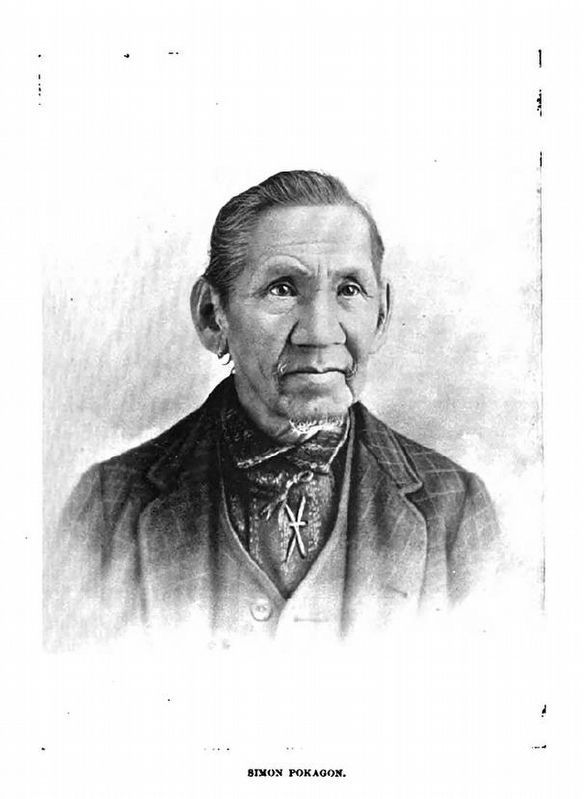
3. Simon Pokagon.
Image Credit: Benjamin Flowers, The Arena . Vol. XVI, 1896
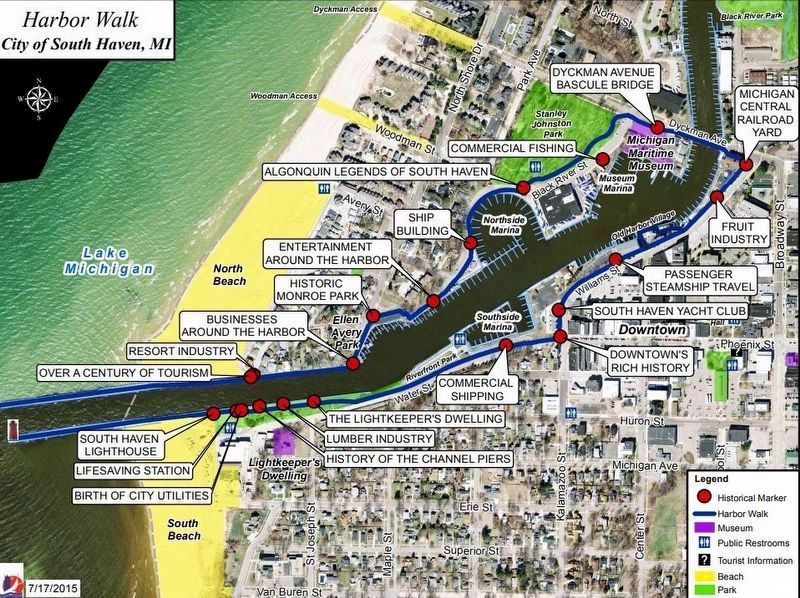
Related markers. Click here for a list of markers that are related to this marker. South Haven Harbor Walk
Also see . . .
1. From Nik-o-nog to South Haven. Kal-Haven Heritage Trail Site List entry (Submitted on January 2, 2021, by Larry Gertner of New York, New York.)
2. Chief Simon Pokagon. In the later part of the Nineteenth Century when the spiritual vibrations for human rights were beginning to encircle the planet, there arose in the Potawatomi Nation a literary genius named Simon Pokagon. He was the Chief of the Potawatomis of southwestern Michigan. During his lifetime he became known as the best-educated full-blooded Indian in North America and was called “the Redskin Bard,” “the Longfellow of his Race.” He visited President Lincoln on two occasions and smoked a pipe-of-peace with President Grant. (Submitted on June 26, 2018, by Cosmos Mariner of Cape Canaveral, Florida.)
via City of South Haven, Unknown
4. South Haven Harbor Walk

Photographed by Cosmos Mariner, July 24, 2017
5. Previous Version of this Marker
Credits. This page was last revised on May 14, 2024. It was originally submitted on June 25, 2018, by Cosmos Mariner of Cape Canaveral, Florida. This page has been viewed 1,071 times since then and 107 times this year. Photos: 1, 2. submitted on May 14, 2024, by J. J. Prats of Powell, Ohio. 3, 4. submitted on January 2, 2021, by Larry Gertner of New York, New York. 5. submitted on June 26, 2018, by Cosmos Mariner of Cape Canaveral, Florida. • Andrew Ruppenstein was the editor who published this page.
