
Angeles National Forest in Los Angeles County, California — The American West (Pacific Coastal)
Harvard’s Mount Wilson Station
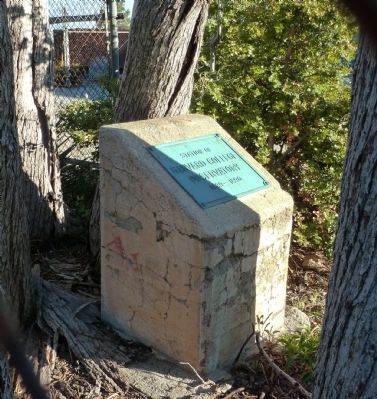
Photographed by Roger W. Sinnott, June 5, 2012
1. Harvard’s Mount Wilson Station Marker
Station of Harvard College Observatory,
1889–1890.
Erected 1910 by Edward C. Pickering, Harvard College Observatory.
Topics. This historical marker is listed in this topic list: Science & Medicine. A significant historical year for this entry is 1889.
Location. 34° 13.447′ N, 118° 3.781′ W. Marker is in Angeles National Forest, California, in Los Angeles County. It is on Mt. Wilson Road, on the right when traveling south. Marker is just inside a fenced-off area of television and radio antennas, before you get to the main parking lot on Mount Wilson. Touch for map. Marker is in this post office area: Pasadena CA 91107, United States of America. Touch for directions.

Regionally, this marker is in Greater Los Angeles and in the Transverse Ranges. It is also on the American Pacific Coast. Globally, it is in North America, on the Ring of Fire, in the Pacific Rim, in the Western Hemisphere, in the Western World, and in the Anglosphere. Historically, it finds itself in what was once New Spain and also Mexico’s Alta California.
Other nearby markers. At least 8 other markers are within 3 miles of this marker,
this page online
Regarding Harvard’s Mount Wilson Station. During the late 19th century, barely a trail existed up Wilson’s Peak, the 5,700-foot mountain overlooking Pasadena and Los Angeles, California. Getting up or down was a five-hour trek for hikers and mules. Nevertheless, Edward Pickering, director of Harvard College Observatory, decided to see if the mountain would make a good site for an astronomical observatory. He sent his brother William (who was also an astronomer) and Alvan G. Clark, of the noted telescope-making firm Alvan Clark & Sons, to spend the night of January 23, 1889, at the summit. Following their favorable report,
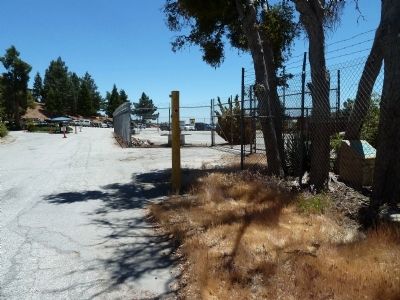
Photographed by Roger W. Sinnott, June 5, 2012
2. Wider View Looking Southeast
The plaque can be seen just inside the chain-link fence at extreme right. On the road ahead is the main parking lot serving the summit of Mount Wilson.
Although Pickering failed in his efforts to secure permanent title to the land for Harvard, the short-lived station proved that Wilson’s Peak had the frequent clear skies and air quality needed for serious astronomical work. In commemoration, Pickering erected this brass plaque in 1910. In a sense, the pioneering station had paved the way for George Ellery Hale, with funding from Andrew Carnegie, to establish the far more famous Mount Wilson Observatory that is still in operation at the summit.
Much of the above information is adapted from the histories of Harvard Observatory by S. I. Bailey (1931) and by B. Z. Jones and L. G. Boyd (1971).
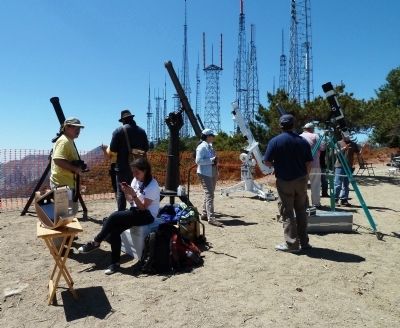
Photographed by Roger W. Sinnott, June 5, 2012
3. Site of Harvard Station Today
Giant radio and TV towers mark the location of the old Harvard astronomical station on Mount Wilson today. In the foreground, members of the Antique Telescope Society gathered to observe the transit of Venus across the disk of the Sun on June 5, 2012. This is the only transit of Venus ever observed from Mount Wilson, because the one in 2004 was best seen from Europe, Africa, or Asia, and in 1882 (the next Venus transit before that) Mount Wilson was wilderness.
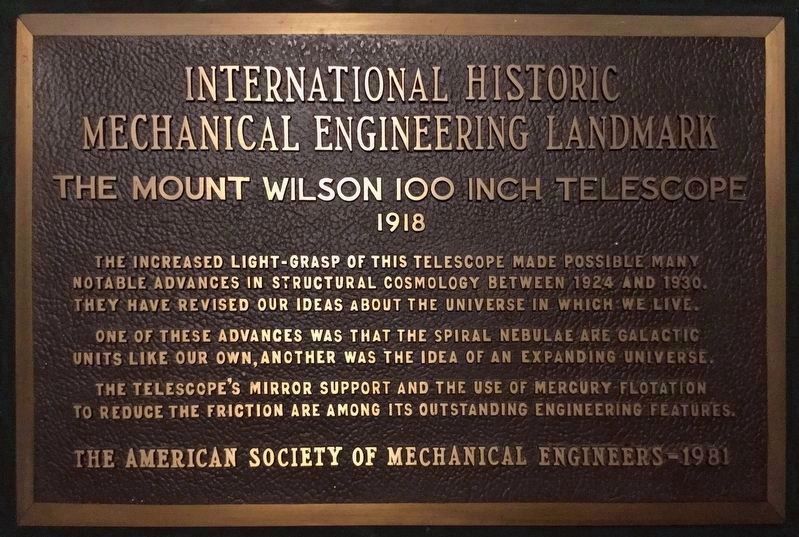
Photographed by Craig Baker, July 1, 2018
4. Nearby Marker, 100 Inch Telescope
Located inside the dome of the 100 inch telescope.
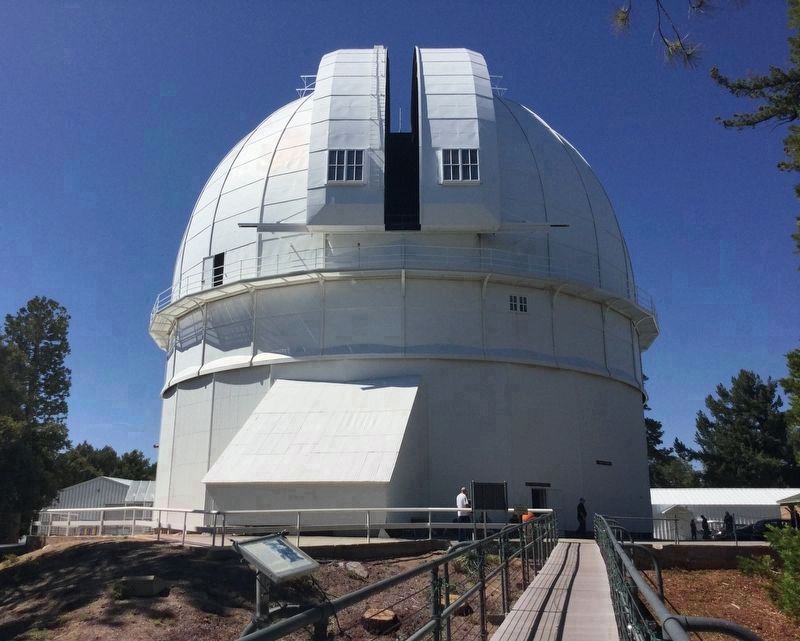
Photographed by Craig Baker, June 30, 2018
5. 100 Inch Telescope Dome
This is where Edwin Hubble proved the universe extends beyond the Milky Way galaxy, and the universe is expanding.
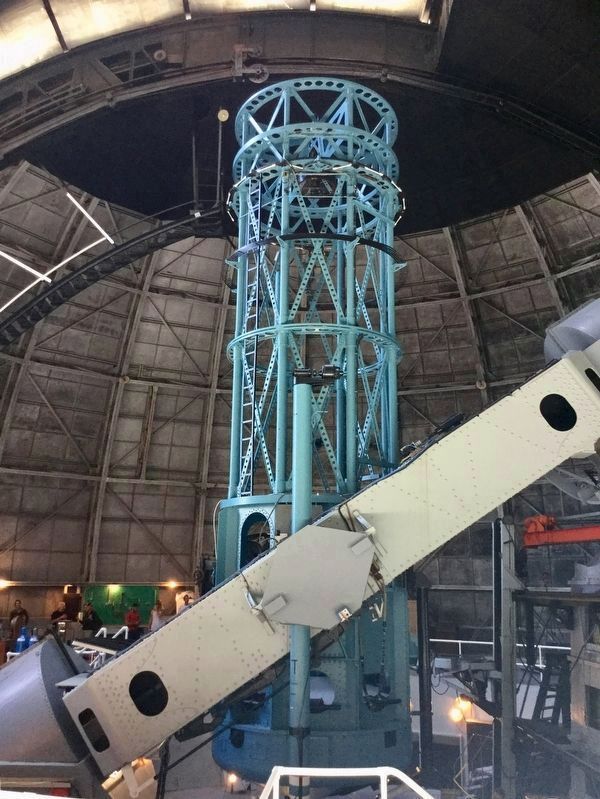
Photographed by Craig Baker, June 30, 2018
6. 100 Inch Telescope
The largest telescope in the world from 1918 to 1949.
Credits. This page was last revised on June 3, 2023. It was originally submitted on July 8, 2012, by Roger W. Sinnott of Norwell, Massachusetts. This page has been viewed 1,418 times since then and 38 times this year. Last updated on July 4, 2018, by Craig Baker of Sylmar, California. Photos: 1, 2, 3. submitted on July 8, 2012, by Roger W. Sinnott of Norwell, Massachusetts. 4, 5, 6. submitted on July 4, 2018, by Craig Baker of Sylmar, California. • Syd Whittle was the editor who published this page.
