Colorado City in Mitchell County, Texas — The American South (West South Central)
Texas & Pacific Railway
Arrival in Colorado River Valley of the
Photographed by Bill Kirchner, November 12, 2017
1. Texas & Pacific Railway Marker
Inscription.
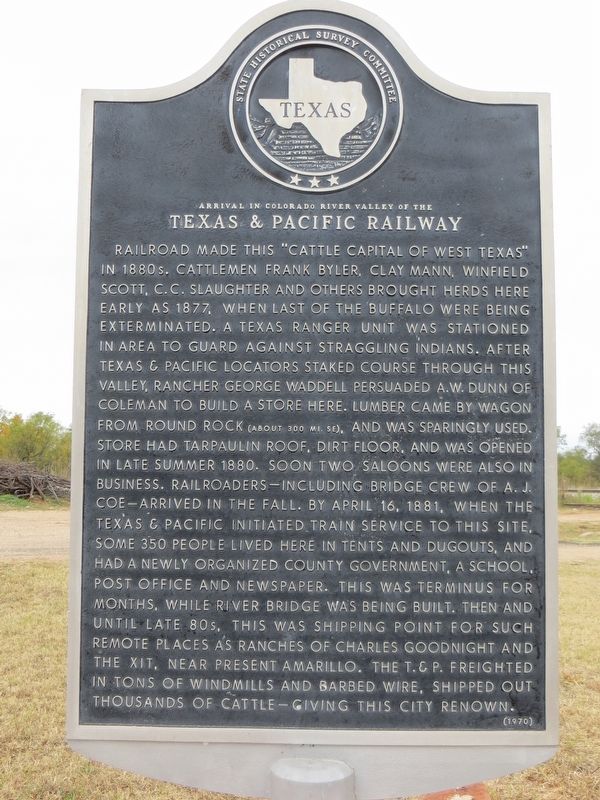
Railroad made this "Cattle Capital of West Texas" in 1880s. Cattlemen Frank Byler, Clay Mann, Winfield Scott, C.C. Slaughter and others brought herds here early as 1877, when last of the buffalo were being exterminated. A Texas Ranger unit was stationed in area to guard against straggling Indians. After Texas & Pacific locators staked course through this valley, rancher George Waddell persuaded A.W. Dunn of Coleman to build a store here. Lumber came by wagon from Round Rock (about 300 mi. SE), and was sparingly used. Store had tarpaulin roof, dirt floor, and was opened in late summer 1880. Soon two saloons were also in business. Railroaders--including bridge crew of A.J. Coe--arrived in the fall. By April 16, 1881, when the Texas & Pacific initiated train service to this site, some 350 people lived here in tents and dugouts, and had a newly organized county government, a school, post office and newspaper. This was terminus for months, while river bridge was being built. Then and until late 80s, this was shipping point for such remote places as ranches of Charles Goodnight and the XIT, near present Amarillo. The T. & P.
Click or scan to see this page online
freighted in tons of windmills and barbed wire, shipped out thousands of cattle--giving this city renown.
Erected 1970 by State Historical Survey Committee. (Marker Number 210.)
Topics and series. This historical marker is listed in this topic list: Railroads & Streetcars. In addition, it is included in the Windmills series list. A significant historical date for this entry is April 16, 1881.
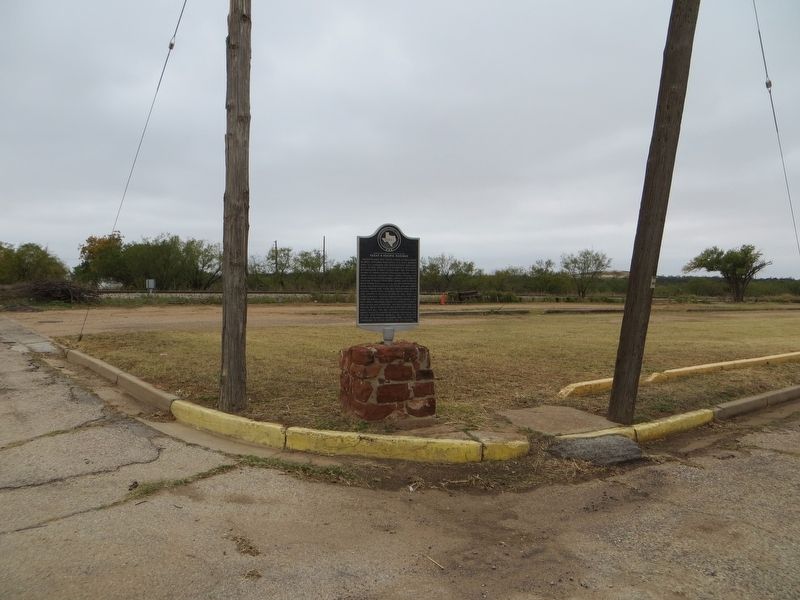
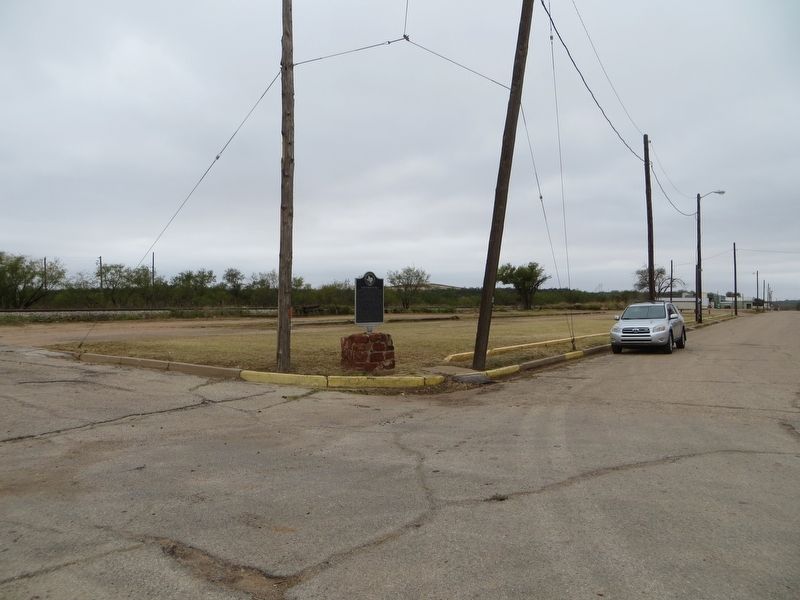
Location. 32° 23.248′ N, 100° 51.967′ W. Marker is in Colorado City, Texas, in Mitchell County. It is at the intersection of West Main Street and Elm Street, on the right when traveling east on West Main Street. Touch for map. Marker is in this post office area: Colorado City TX 79512, United States of America. Touch for directions.
Regionally, this marker is in Big Country. Globally, it is in North America, a Gulf of Mexico state, the Western Hemisphere, the Western World, and the Anglosphere. Historically, it finds itself in what was once New Spain, the Comanchería, the Republic of Texas, and one of the Confederate States of America.
Other nearby markers. At least 8 other markers are within walking distance of this marker: Baker Hotel
Credits. This page was last revised on July 19, 2018. It was originally submitted on July 19, 2018, by Bill Kirchner of Tucson, Arizona. This page has been viewed 503 times since then and 54 times this year. Photos:1, 2, 3. submitted on July 19, 2018, by Bill Kirchner of Tucson, Arizona.