Deadwood in Lawrence County, South Dakota — The American Midwest (Upper Plains)
Chicago Burlington & Quincy Railroad Yard
Photographed by Cosmos Mariner, July 12, 2018
1. Chicago Burlington & Quincy Railroad Yard Marker
(Panel 1)
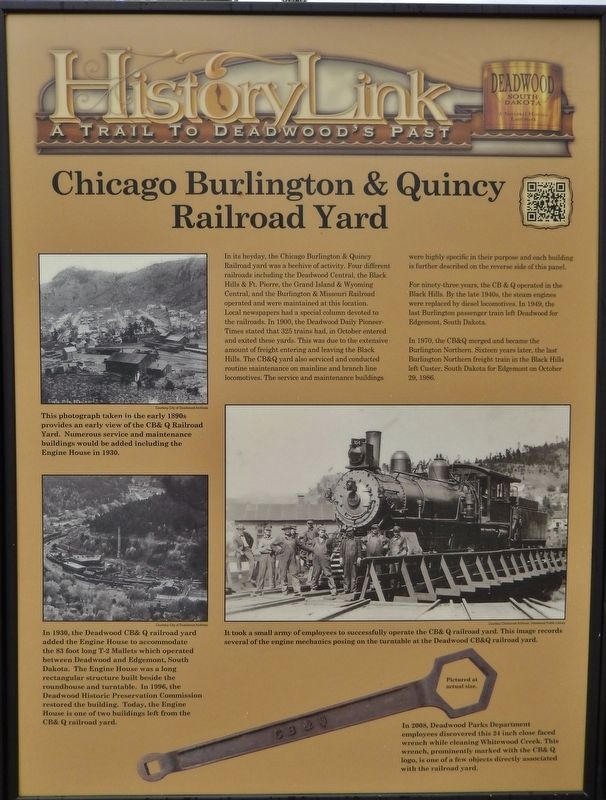
In its heyday, the Chicago Burlington & Quincy Railroad yard was a beehive of activity. Four different railroads including the Deadwood Central, the Black Hills & Ft. Pierre, the Grand Island & Wyoming Central, and the Burlington & Missouri Railroad operated and were maintained at this location. Local newspapers had a special column devoted to the railroads. In 1900, the Deadwood Daily Pioneer-Times stated that 325 trains had, in October entered and exited these yards. This was due to the extensive amount of freight entering and leaving the Black Hills. The CB&Q yard also serviced and conducted routine maintenance on mainline and branch line locomotives. The service and maintenance buildings were highly specific in their purpose and each building is further described on the reverse side of this panel.
For ninety-three years, the CB&Q operated in the Black Hills. By the late 1940s, the steam engines were replaced by diesel locomotives. In 1949, the last Burlington passenger train left Deadwood for Edgemont, South Dakota.
In 1970, the CB&Q merged and became the Burlington Northern. Sixteen years later, the
this page online
In 2008, Deadwood Parks Department employees discovered this 21 inch close faced wrench while cleaning Whitewood Creek. This wrench, prominently marked with the CB&Q logo, is one of a few objects directly associated with the railroad yard.
(Panel 2)
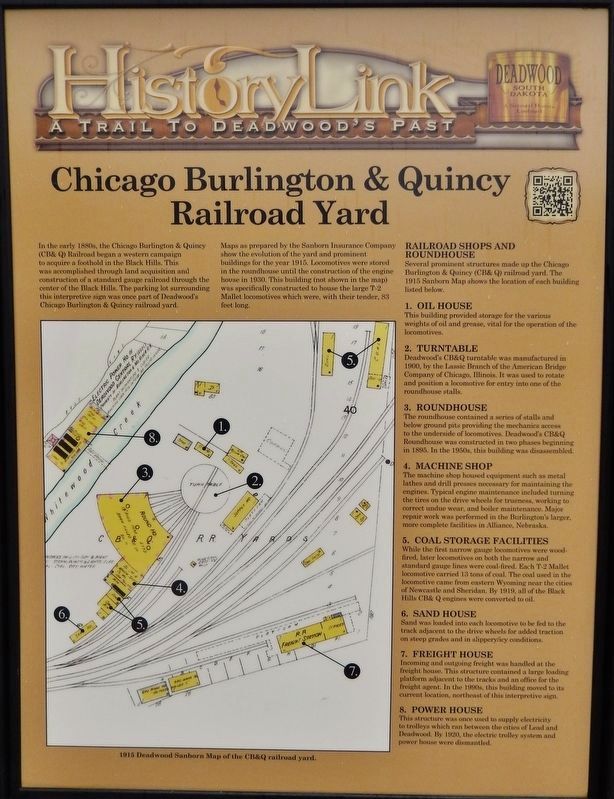
In the early 1880s, the Chicago Burlington & Quincy (CB&Q) Railroad began a western campaign to acquire a foothold in the Black Hills. This was accomplished through land acquisition and construction of a standard gauge railroad through the center of the Black Hills. The parking lot surrounding this interpretive sign was once part of Deadwood's Chicago Burlington & Quincy railroad yard.
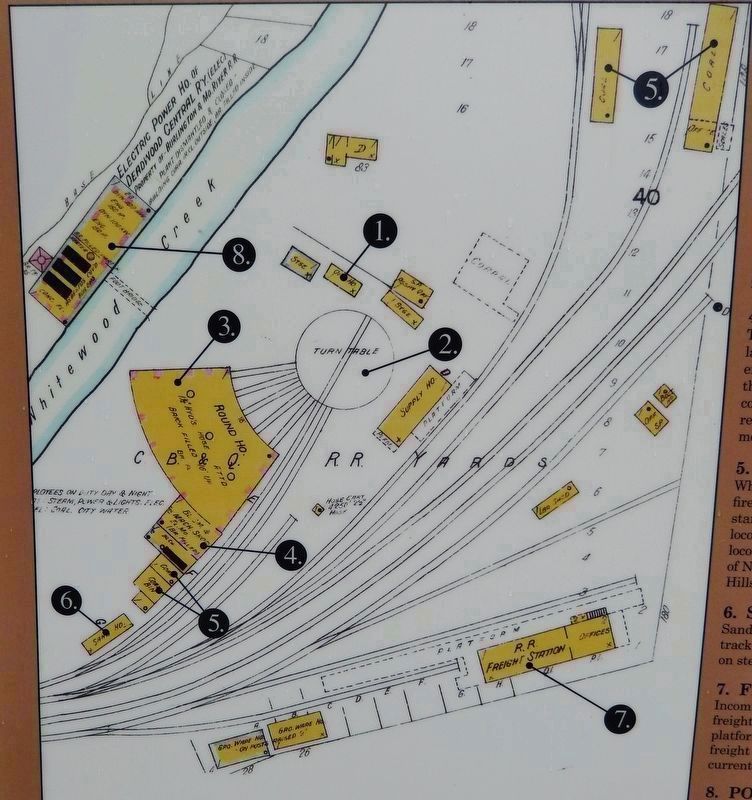
Maps as prepared by the Sanborn Insurance Company show the evolution of the yard and prominent buildings for the year 1915. Locomotives were stored in the roundhouse until the construction of the engine house in 1930. This building (not shown in the map) was specifically constructed to house the large T-2 Mallet locomotives which were, with their tender, 83 feet long.
RAILROAD SHOPS AND ROUNDHOUSE
Several
Photographed by Cosmos Mariner, July 12, 2018
2. Chicago Burlington & Quincy Railroad Yard Marker (panel 2)
1. OIL HOUSE
This building provided storage for the various weights of oil and grease, vital for the operation of the locomotives.
2. TURNTABLE
Deadwood's CB&Q turntable was manufactured in 1900, by the Lassie Branch of the American Bridge Company of Chicago, Illinois. It was used to rotate and position a locomotive for entry into one of the roundhouse stalls.
3. ROUNDHOUSE
The roundhouse contained a series of stalls and below ground pits providing the mechanics access to the underside of locomotives. Deadwood's CB&Q Roundhouse was constructed in two phases beginning in 1895. In the 1950s, this building was disassembled.
4. MACHINE SHOP
The machine shop housed equipment such as metal lathes and drill presses necessary for maintaining the engines. Typical engine maintenance included turning the tires on the drive wheels for trueness, working to correct undue wear, and boiler maintenance. Major repair work was performed in the Burlington's larger, more complete facilities in Alliance,
3. Marker (Panel 2) detail: 1915 Deadwood Sanborn Map of the CB&Q railroad yard
5. COAL STORAGE FACILITIES
While the first narrow gauge locomotives were wood-fired, later locomotives on both the narrow and standard gauge lines were coal-tired. Each T-2 Mallet locomotive carried 13 tons of coal. The coal used in the locomotive came from eastern Wyoming near the cities of Newcastle and Sheridan. By 1919, all of the Black Hills CB&Q engines were converted to oil.
6. SAND HOUSE
Sand was loaded into each locomotive to be fed to the track adjacent to the drive wheels for added traction on steep grades and in slippery/icy conditions.
7. FREIGHT HOUSE
Incoming and outgoing freight was handled at the freight house. This structure contained a large loading platform adjacent to the tracks and an office for the freight agent. In the 1990s, this building moved to its current location, northeast of this interpretive sign.
8. POWER HOUSE
This structure was once used to supply electricity to trolleys which ran between the cities of Lead and Deadwood. By I920, the electric trolley system and power house were dismantled.
Erected by The Deadwood Historic Preservation Commission.
Topics. This historical marker
Photographed by Cosmos Mariner, July 12, 2018
4. Chicago Burlington & Quincy Railroad Yard Marker (wide view)
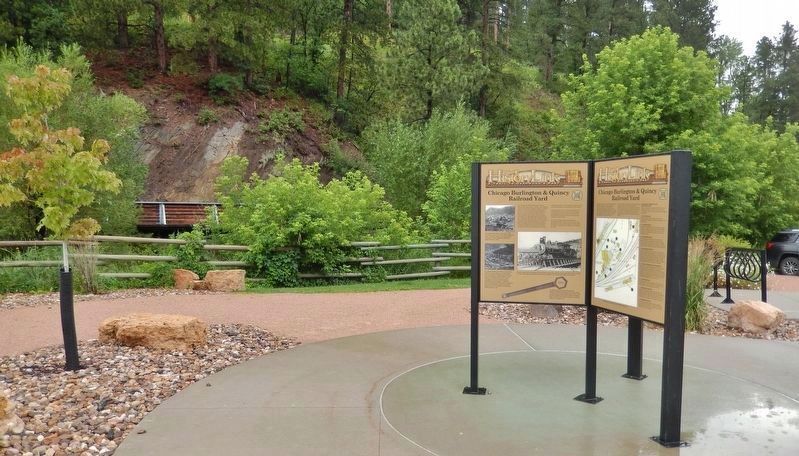
Location. 44° 22.235′ N, 103° 43.722′ W. Marker is in Deadwood, South Dakota, in Lawrence County. It can be reached from the intersection of Charles Street (CanAm Highway) (U.S. 85) and Cedar Lane, on the right when traveling south. Marker is located at the Deadwood Trailhead of the George S. Mickelson Trail, at the south end of the parking lot. Touch for map. Marker is at or near this postal address: 32 Charles Street, Deadwood SD 57732, United States of America. Touch for directions.

Regionally, this marker is in West River. It is also in the American Black Hills, in the Lewis & Clark Corridor, on the prairies, and on the Northern Plains. Globally, it is in North America, the Western Hemisphere, the Western World, and the Anglosphere. Historically, it finds itself in what was once Rupert’s Land and also the Louisiana Purchase.
Other nearby markers. At least 8 other markers are within walking distance of this marker: George S. Mickelson Trail (here, next to this marker);
Courtesy Centennial Archives, Deadwood Public Library
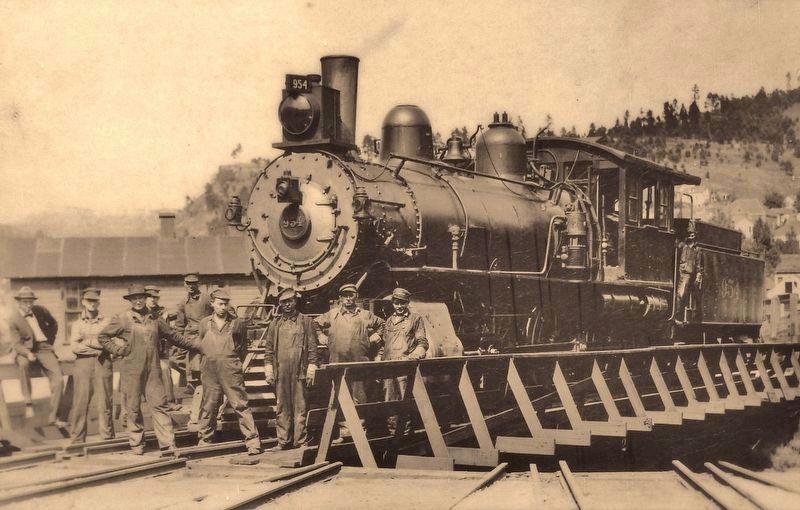
5. Marker (Panel 1) detail: mechanics & locomotive on turntable
It took a small army of employees to successfully operate the CB&Q railroad yard. This image records several of the engine mechanics posing on the turntable at the Deadwood CB&Q railroad yard.
Another marker is no longer nearby. Track or Trail: Sweat Equity Played a Role (was within shouting distance of this marker but has been confirmed missing).
More about this marker. This is a large, multi-panel, "kiosk-style" marker.
Also see . . . Rough & Tumble Deadwood, South Dakota. Legends of America website entry (Submitted on October 4, 2025, by Larry Gertner of New York, New York.)
Courtesy City of Deadwood Archives
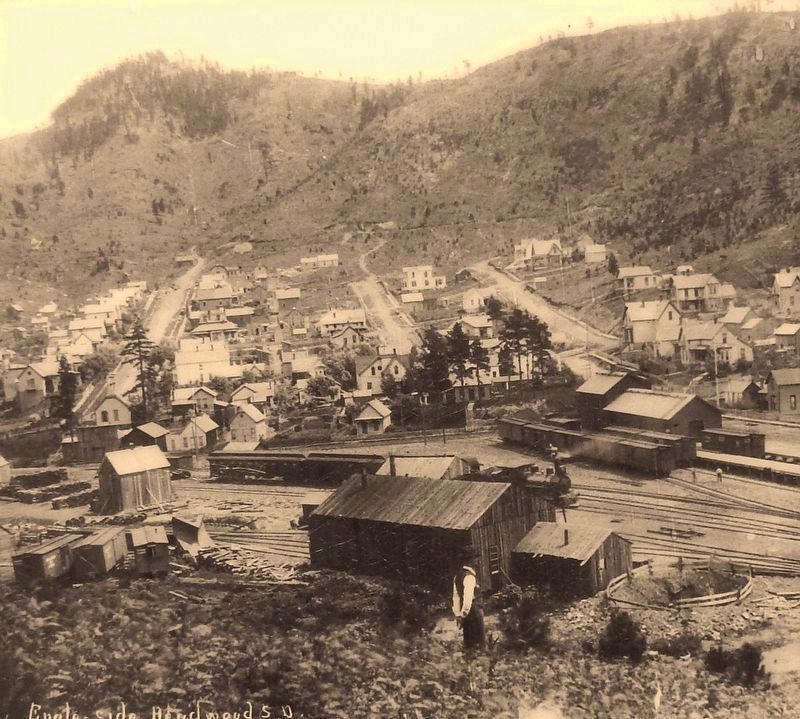
6. Marker (Panel 1) detail: CB&Q Railroad Yard, circa 1890s
This photograph taken in the early 1890s provides an early view of the CB&Q Railroad Yard. Numerous service and maintenance buildings would be added including the Engine House in 1930.
Courtesy City of Deadwood Archives
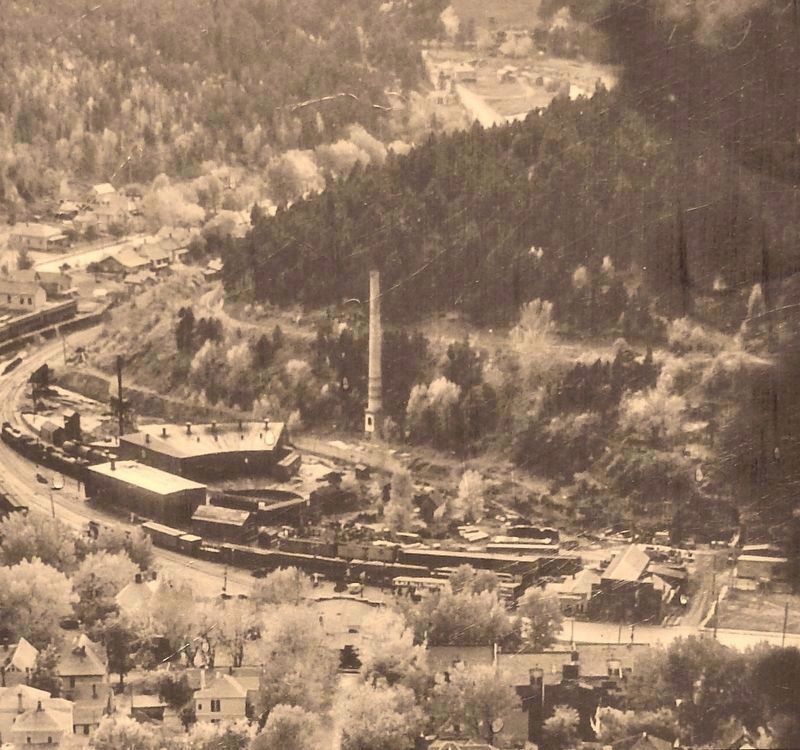
7. Marker (Panel 1) detail: CB&Q Railroad Yard, circa 1930
In 1930, the Deadwood CB&Q railroad yard added the Engine House to accommodate the 83 foot long T-2 Mallets which operated between Deadwood and Edgemont, South Dakota. The Engine House was a long rectangular structure built beside the roundhouse and turntable. In 1996, the Deadwood Historic Preservation Commission restored the building. Today, the Engine House is one of two buildings left from the CB&Q railroad yard.
Photographed by Cosmos Mariner, July 12, 2018
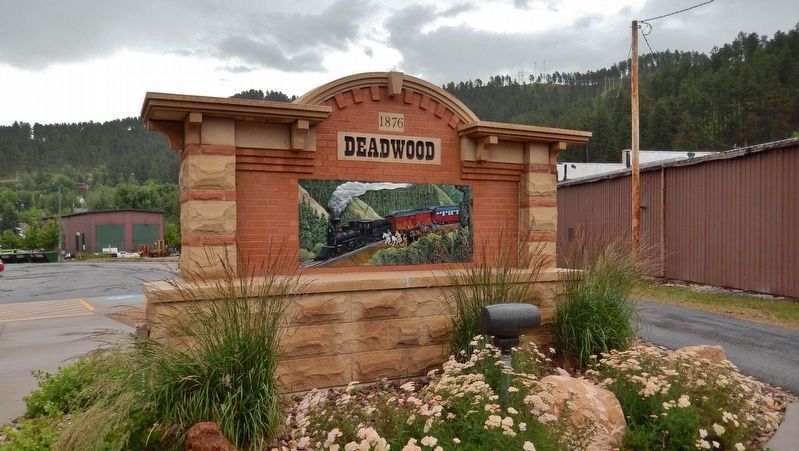
8. Deadwood Trailhead Sign (near marker)
Credits. This page was last revised on October 4, 2025. It was originally submitted on August 3, 2018, by Cosmos Mariner of Cape Canaveral, Florida. This page has been viewed 2,303 times since then and 117 times this year. Photos: 1. submitted on August 3, 2018, by Cosmos Mariner of Cape Canaveral, Florida. 2, 3. submitted on August 4, 2018, by Cosmos Mariner of Cape Canaveral, Florida. 4. submitted on August 14, 2018, by Cosmos Mariner of Cape Canaveral, Florida. 5, 6, 7. submitted on August 4, 2018, by Cosmos Mariner of Cape Canaveral, Florida. 8. submitted on August 14, 2018, by Cosmos Mariner of Cape Canaveral, Florida. • Bill Pfingsten was the editor who published this page.
