Norman in Cleveland County, Oklahoma — The American South (West South Central)
Cleveland County Courthouse
Photographed by Brian Anderson, August 11, 2018
1. Cleveland County Courthouse Marker
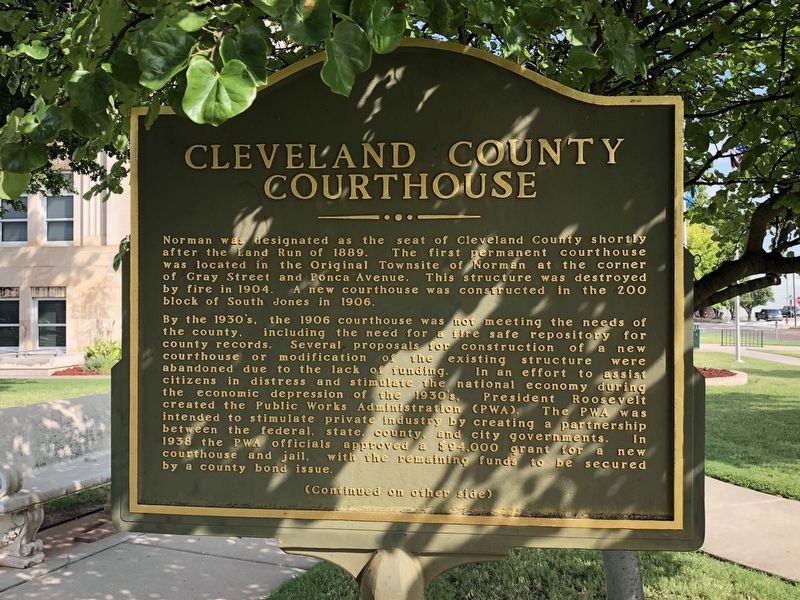
Norman was designated as the seat of Cleveland County shortly after the Land Run of 1889. The first permanent courthouse was located in the Original Townsite of Norman at the corner of Gray Street and Ponca Avenue. This structure was destroyed by fire in 1904. A new courthouse was constructed in the 200 block of South Jones in 1906.
By the 1930's, the 1906 courthouse was not meeting the needs of the county, including the need for a fire safe repository for county records. Several proposals for construction of a new courthouse or modification of the existing structure were abandoned due to the lack of funding. In an effort to assist citizens in distress and stimulate the national economy during the economic depression of the 1930's, President Roosevelt created the Public Works Adininistration (PWA). The PWA was intended to stimulate private industry by creating a partnership between the federal, state, county, and city governments. In 1938 the PWA officials approved a $94,000 grant for a new courthouse and jail, with the remaining funds to be secured by a county bond issue.
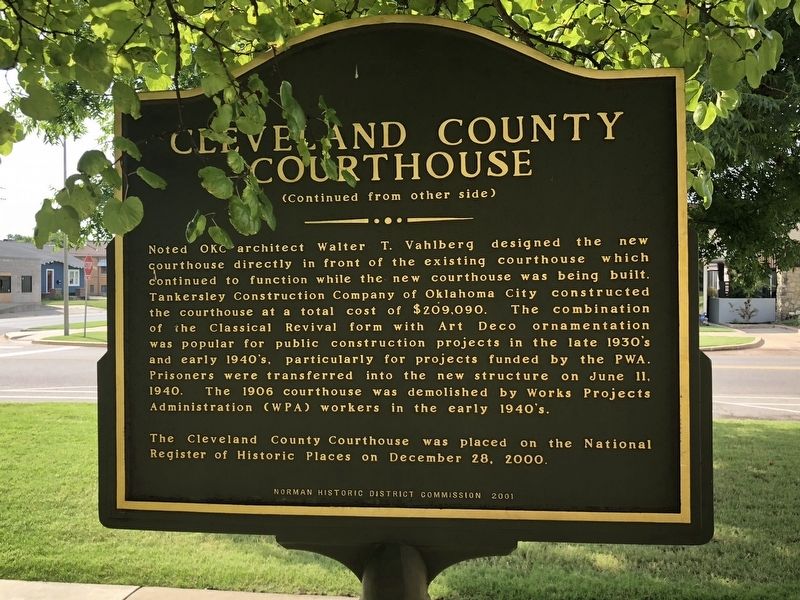
Noted OKC architect Walter T. Vahlberg
this page online
The Cleveland County Courthouse was placed on the National Register of Historic Places on December 28, 2000.
Erected 2001 by Norman Historic District Commission.
Topics and series. This historical marker is listed in these topic lists: Architecture • Government & Politics • Political Subdivisions. In addition, it is included in the Art Deco, and the Works Progress Administration (WPA) projects series lists. A significant historical date for this entry is June 11, 1940.
Location. 35° 13.183′ N, 97° 26.464′ W. Marker is
Photographed by Brian Anderson, August 11, 2018
2. Cleveland County Courthouse Marker reverse

Regionally, this marker is in Central Oklahoma—Frontier Country and in Greater Oklahoma City. It is also in the American South, specifically on the prairies, and on the Southern Plains. Globally, it is in North America, the Western Hemisphere, the Western World, and the Anglosphere. Historically, it finds itself in what was once the territory of the Mississippian Culture and also the Louisiana Purchase.
Other nearby markers. At least 8 other markers are within walking distance of this marker: The Beginning of Cleveland County (within shouting distance of this marker); Norman Public Library (about 400 feet away, measured in a direct line); U.S. Naval Air Station (about 500 feet away); War Years in Norman (about 500 feet away); Santa Fe Depot (about 500 feet away);
Photographed by Brian Anderson, August 11, 2018
3. Cleveland County Courthouse Marker
Photographed by Brian Anderson, August 11, 2018
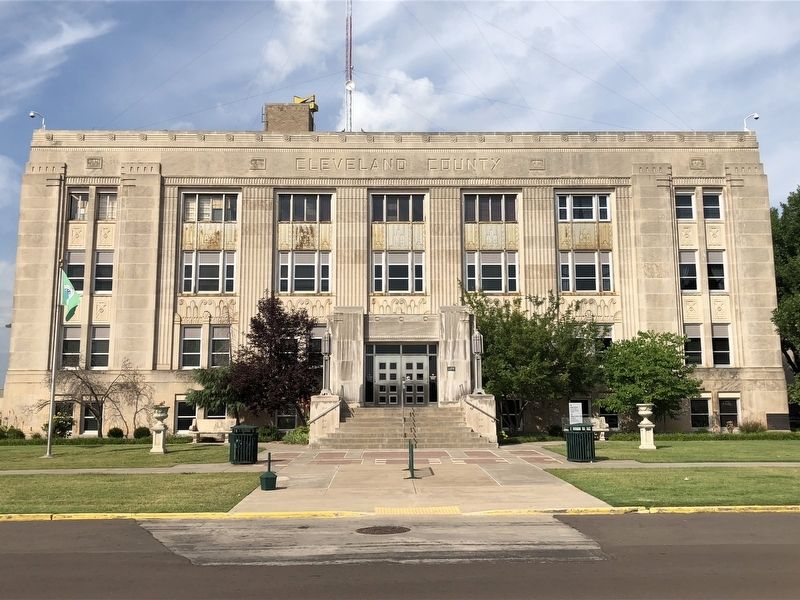
4. Cleveland County Courthouse
Credits. This page was last revised on December 31, 2024. It was originally submitted on August 13, 2018, by Brian Anderson of New Albany, Ohio. This page has been viewed 721 times since then and 107 times this year. Last updated on August 14, 2018, by Brian Anderson of New Albany, Ohio. Photos: 1, 2, 3, 4. submitted on August 13, 2018, by Brian Anderson of New Albany, Ohio. • Andrew Ruppenstein was the editor who published this page.
