Old Town in Alexandria, Virginia — The American South (Mid-Atlantic)
First Presbyterian Church of Alexandria
"Old Presbyterian Meeting House"
| — | American Presbyterian and Reformed Historical Site | — |
Photographed by Richard E. Miller, October 5, 2014
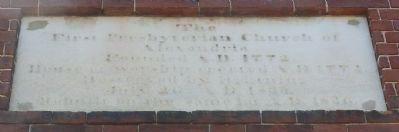
1. "Old Presbyterian Meeting House" - Marker Panel 1
Panel 1 - upper middle of east face:
First Presbyterian Church of
Alexandria
founded A.D. 1772
House of worship erected 1774.
Destroyed by lightning July 20, 1835.
Rebuilt on the same lot A.D. 1836.
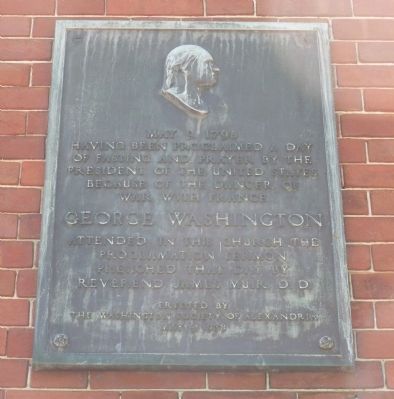
Panel 2 - lower-middle of east face:
Having been proclaimed a day of fasting and prayer
by the President of the United States (JOHN ADAMS)
because of the danger of
war with France
GEORGE WASHINGTON
attended in this church the
proclamation sermon
preached that day by
Reverend James Muir, D.D.
Erected by
The Washington Society of Alexandria
May 9, 1938
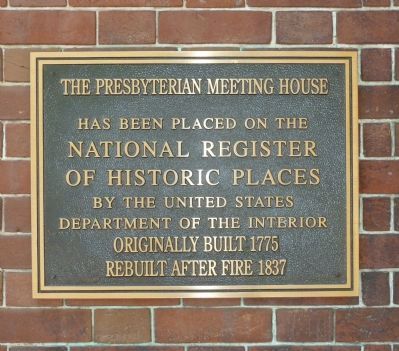
Panel 3 - above the steps, north corner of east face:
has been placed on the
National Register
of Historic Places
by the United States
Department of the Interior
Originally Built 1775
Rebuilt After Fire 1837
Erected 1938 by The Washington Society of Alexandria, U.S. Dept. of the Interior. (Marker Number 22.)
Topics and series. This historical marker is listed in this topic list: Religion & Religious Structures. In addition, it is included in the American Presbyterian and Reformed Historic Sites, and the Former U.S. Presidents: #02 John Adams
this page online
Location. 38° 48.093′ N, 77° 2.597′ W. Marker is in Alexandria, Virginia. It is in Old Town. It is on South Fairfax Street north of Wolfe Street, on the right when traveling south. Touch for map. Marker is at or near this postal address: 323 South Fairfax Street, Alexandria VA 22314, United States of America. Touch for directions.

Regionally, this marker is in the Washington Metropolitan Area and in Northern Virginia. It is also in the American South, specifically in the Upper South, in the Mid-Atlantic, and on the Eastern Seaboard. Globally, it is in the North Atlantic Region, North America, the Western Hemisphere, the Western World, and the Anglosphere. Historically, it finds itself in what was once the territory of the Mississippian Culture, one of the original Thirteen Colonies, one of the Confederate States of America, and the Antebellum South.
Other nearby markers. At least 8 other markers are within walking distance of this marker: Old Presbyterian Meeting House Enslaved Labor Acknowledgement (here, next to this marker); Major John Carlyle (within shouting
Photographed by Richard E. Miller, May 4, 2014
2. "Old Presbyterian Meeting House" Marker Panel 2
Regarding First Presbyterian Church of Alexandria. The Old Presbyterian Meeting House was listed in the National Register of Historic Places in 2001. This church is also one of 445 American Presbyterian and Reformed Historical Sites registered between 1973 and 2003 by the Presbyterian Historical Society (PHS), headquartered in Philadelphia. Approved sites received a metal plaque featuring John Calvin’s seal and the site’s registry number (PHS marker location unknown).
The following text is taken from the Presbyterian Historical
Photographed by Richard E. Miller, May 4, 2014
3. "Old Presbyterian Meeting House" Marker Panel 3
Scottish pioneers built Old Presbyterian Meeting House in 1774, when Virginia's Toleration Act allowed Dissenters to have their own houses of worship. George Washington occasionally worshipped and attended Masonic meetings here. The congregation held the first memorial service, 22 February 1800, commemorating Washington's birthday. Such famous personages as John Marshall, Francis Scott Key and Methodist leader Francis Asbury spoke from the Meeting House pulpit. Closed in 1889, the congregation was reborn in 1949 under Southern Presbyterian auspices. Now a part of the Presbytery of National Capital Union, Old Presbyterian Meeting House is both Presbyterian Church in the US and United Presbyterian Church in the USA.
Also see . . .
1. The Quasi-War with France. (Submitted on October 7, 2014, by Richard E. Miller of Oxon Hill, Maryland.)
2. "Old Presbyterian Meeting House". (Submitted on November 11, 2014, by Richard E. Miller of Oxon Hill, Maryland.)
3. Old Presbyterian Meeting House NRHP Nomination page. (Submitted on August 20, 2018, by Douglass Halvorsen of Klamath Falls, Oregon.)
Additional keywords. President
Photographed by Richard E. Miller, October 9, 2014
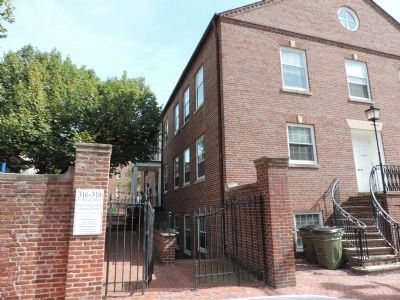
4. Meeting House Cooperative Preschool Building (318 So. Royal Street)
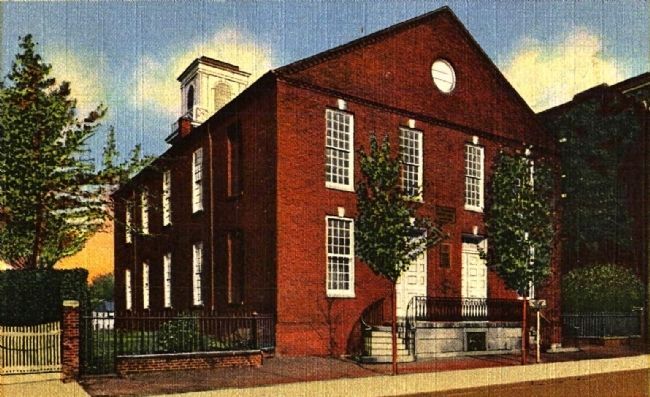
Photographed by B.S. Reynolds Co., circa 1940
5. Old Presybyterian Meeting House Alexandria, Va. Erected 1774
Historical postcard view showing the markers above, between, and below the doors.
![View of the church's bell tower and some of the weathered monuments in its graveyard [lower left] image. Click for full size.](Photos3/306/Photo306932.jpg?54201565700PM "View of the church's bell tower and some of the weathered monuments in its graveyard [lower left]. Click for full size.")
Photographed by Richard E. Miller, November 24, 2014
6. View of the church's bell tower and some of the weathered monuments in its graveyard [lower left]
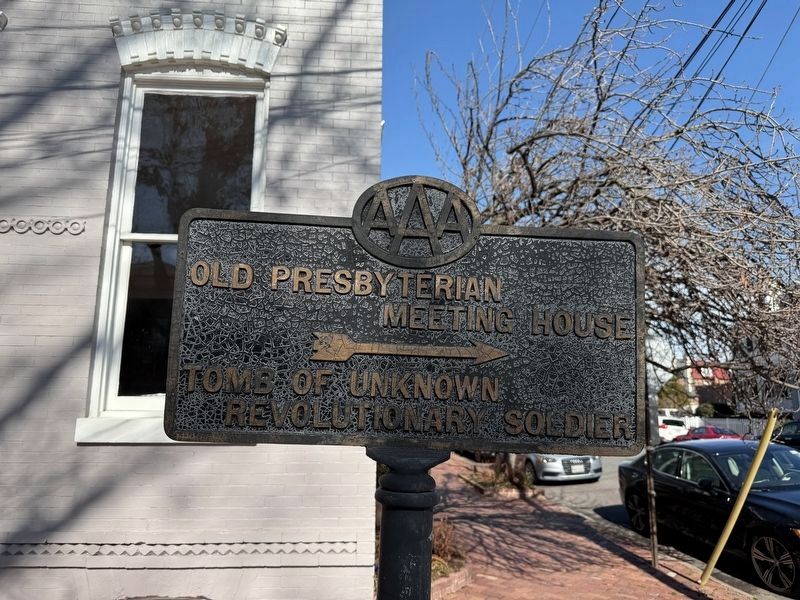
Photographed by Devry Becker Jones (CC0), February 9, 2025
7. AAA Auto Club signage a couple blocks away from the Meeting House
Meeting House
➡
Tomb of Unknown
Revolutionary Soldier
Credits. This page was last revised on February 9, 2025. It was originally submitted on October 6, 2014, by Richard E. Miller of Oxon Hill, Maryland. This page has been viewed 2,139 times since then and 67 times this year. Last updated on August 20, 2018, by Douglass Halvorsen of Klamath Falls, Oregon. Photos: 1, 2, 3. submitted on October 7, 2014, by Richard E. Miller of Oxon Hill, Maryland. 4. submitted on November 13, 2014, by Richard E. Miller of Oxon Hill, Maryland. 5. submitted on November 17, 2014. 6. submitted on May 2, 2015, by Richard E. Miller of Oxon Hill, Maryland. 7. submitted on February 9, 2025, by Devry Becker Jones of Washington, District of Columbia. • Bill Pfingsten was the editor who published this page.
